10 Ways People Make Their Yard Look Smaller With Landscaping
You put time and money into your yard because you want it to feel open, welcoming, and cohesive. A few common design habits can quietly shrink the space, though, making it feel cramped even when you technically have plenty of square footage. By spotting these patterns and swapping them for smarter choices, you can preserve the sense of breathing room that makes an outdoor area a pleasure to use.
Rather than focusing only on what you like in isolation, think about how every plant, path, and feature affects scale and flow. The same hydrangea, fire pit, or border can either stretch your view or chop it into awkward pieces depending on how you place and combine it. Once you understand the specific ways people unintentionally make a yard look smaller with landscaping, you can start editing your own space with a much clearer eye.
1. Crowded beds that ignore mature plant size
One of the fastest ways to visually shrink your yard is to cram too many plants into a bed because they look small and cute in their nursery pots. It is tempting to fill every gap so the border looks lush right away, but those gaps are what allow plants to grow into their natural shapes and still leave you some negative space. Without that breathing room, the bed turns into a solid block of foliage that reads as one heavy mass instead of a series of layered views, which makes the entire garden feel tighter.
plan for the size your plants will reach once they are fully grown, not just the size you see on planting day. That advice shows up again when you read about overcrowding when planting and how it quickly leads to a messy, tired look. If you treat every plant label as a minimum spacing guideline instead of an optional suggestion, you give shrubs and perennials room to frame views instead of smothering them, which instantly makes the yard feel larger.
2. Jumbled, irregular layouts with no clear structure
Even if you have beautiful plants, a jumbled layout can make your yard feel smaller because your eye has nowhere to rest. When you scatter beds, pots, and features at random, you create a visual maze that breaks the space into confusing fragments. In a small garden, that kind of irregular layout is especially punishing, since you already have limited square footage and cannot afford to waste any of it on visual noise.
Design guidance for compact spaces warns that a jumbled, irregular layout is one of the most common mistakes that makes a small garden feel even smaller. You get a much more generous effect when you organize your yard around a few strong lines, such as a straight path, a rectangular lawn panel, or a clearly shaped patio, then repeat those shapes in your beds and borders. With that underlying order in place, you can still add curves or accents, but they will feel intentional instead of random, which lets the space read as one continuous room.
3. Undefined edges and wonky paths
When edges are vague, your yard loses its sense of scale. Beds that bleed into lawn, paths that wander without clear borders, and patios that fade into surrounding gravel all blur together. This lack of definition makes the entire area feel like a single, muddled surface rather than a sequence of distinct zones, which shortens sightlines and makes the space feel smaller than it is.
Advice on common garden mistakes singles out undefined edges and wonky paths as details that quickly make a yard look unkempt or like an afterthought. When you cut a crisp edge between lawn and bed, or line a path with brick, steel, or neatly clipped groundcover, you create clean outlines that your eye can follow. Those outlines exaggerate the length of a walk or the width of a terrace, which tricks the brain into reading the space as longer and broader than the raw measurements suggest.
4. Ignoring scale in small backyards
Scale is not just about how big a plant or feature is, it is about how that size relates to everything around it. In a small backyard, a single oversize element can dominate the view and make the rest of the yard feel like leftover scraps. A collection of tiny, fussy items can have the opposite problem, making the space feel cluttered and toy like, which also shrinks it visually.
Specialists who focus on landscaping small backyards explain that the first trouble spot often appears before you even start planting, when you choose features that are out of proportion to the lot. If you install a massive pergola, an extra wide deck, or a deep raised bed that eats half the yard, you leave yourself no room for circulation. A better approach is to pick a few elements that match the footprint, such as a compact dining terrace or a slim border, and repeat their dimensions in other parts of the yard so everything feels coordinated rather than squeezed in.
5. Flat yards with no height or depth
A completely flat yard with everything at the same level can feel like a blank sheet of paper, which sounds spacious in theory but often reads as shallow in real life. When every plant is roughly the same height and every surface is on one plane, your eye skims across the top and then stops at the fence line. That quick stop shortens the perceived distance from patio to boundary, which makes the space feel smaller.
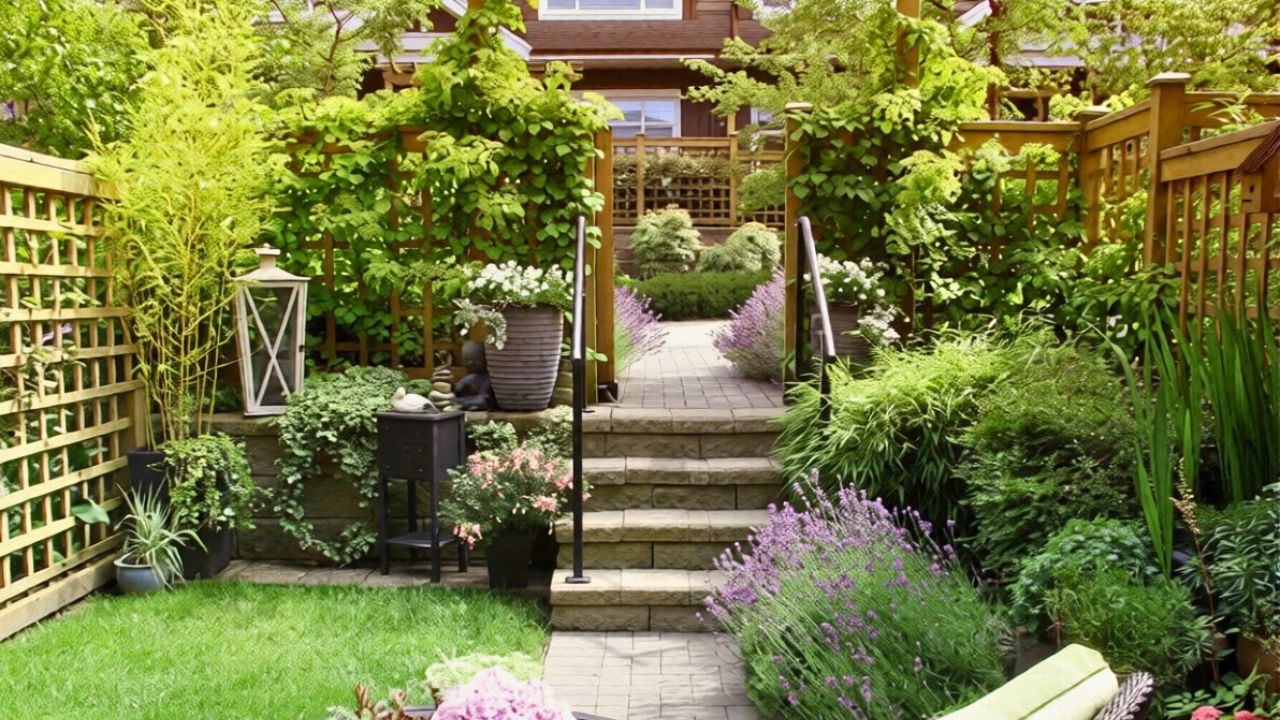
Designers who work with level sites often recommend adding features that create vertical interest and subtle changes in elevation. Ideas such as a sunken patio, stacked planting beds, or low berms introduce depth and height without overwhelming the yard. Using taller shrubs at the back, mid height perennials in the middle, and groundcovers at the front also creates a layered backdrop that draws the eye gradually into the distance instead of letting it slam into a flat wall of green.
6. Cluttered decor and too many containers
It is easy to fall in love with pots, lanterns, and garden art, but when you scatter them across every surface, you chop the yard into tiny visual pieces. A line of mismatched containers along the patio, another cluster at the front door, and a third set by the shed can turn what should be a single outdoor room into a series of cramped corners. That cluttered feeling is especially strong when the containers are small and require constant maintenance, since they draw attention to themselves instead of letting the plants and structure do the work.
Guidance on common gardening mistakes notes that some containers need constant watering and often blow over, which adds to a sense of clutter in the garden overall. If you want your yard to feel larger, you are better off editing your decor down to a few substantial pieces that anchor each zone. A single large planter at the end of a path or one sculptural urn on the patio can mark a destination and stretch the view, while dozens of tiny pots only break up the space and make it feel busier.
7. Choppy flow instead of continuous movement
Even when every individual element looks good, your yard can feel smaller if there is no sense of flow from one area to the next. Abrupt changes in materials, such as jumping from concrete to pea gravel to brick within a few steps, create visual speed bumps. Beds that jut into walkways or furniture that blocks natural routes have a similar effect, forcing you to zigzag and making the space feel cramped and awkward to use.
Designers who focus on small outdoor rooms emphasize creating flow instead as one of the biggest challenges in compact yards. You can improve that flow by repeating materials, such as using the same pavers on the path and patio, and by aligning major features along a few clear axes. When your routes are intuitive and your surfaces relate to each other, you experience the yard as one continuous environment, which automatically makes it feel more generous.
8. Visual dead ends with no intrigue
A yard that reveals everything at once can feel surprisingly small, because your eye reaches the end of the story too quickly. When you see the entire space from one spot, there is no reason to move through it, and the boundaries become very obvious. That effect is even stronger if you position tall fences, sheds, or dense hedges in a way that creates hard visual dead ends without any softening or focal point.
Advice on small gardens points out that the intrigue of what be around a corner can actually make a compact space feel larger. You can use that principle by arranging taller plants or screens to partially hide the far edge of the yard, then placing something attractive just out of sight, such as a bench, a birdbath, or a single standout shrub. That hint of mystery encourages the eye to travel and the body to follow, which stretches the perceived distance and makes the garden feel deeper.
9. Treating the yard as separate from the house
When your yard feels disconnected from your house, it tends to read as an afterthought, which can make it seem smaller both visually and functionally. If the style, colors, and materials outdoors have nothing in common with what you see inside, your brain treats the patio or lawn as a separate zone instead of an extension of your living space. That mental separation limits how large the property feels overall, even if the actual square footage is generous.
You can avoid that trap by borrowing cues from your interior rooms and repeating them outside. If you have clean lined furniture and neutral tones indoors, choose simple patio seating and a restrained palette outside so everything feels related. Inspiration from curated gardening and home resources, such as seasonal design ideas and outdoor mood boards, can help you build that continuity. When the view from your living room flows naturally onto a deck, then into a tidy bed with clear edges and well scaled plants, your whole property feels like one large, cohesive environment instead of a series of small, disconnected pieces.
Like Fix It Homestead’s content? Be sure to follow us.
Here’s more from us:
- I made Joanna Gaines’s Friendsgiving casserole and here is what I would keep
- Pump Shotguns That Jam the Moment You Actually Need Them
- The First 5 Things Guests Notice About Your Living Room at Christmas
- What Caliber Works Best for Groundhogs, Armadillos, and Other Digging Pests?
- Rifles worth keeping by the back door on any rural property
*This article was developed with AI-powered tools and has been carefully reviewed by our editors.