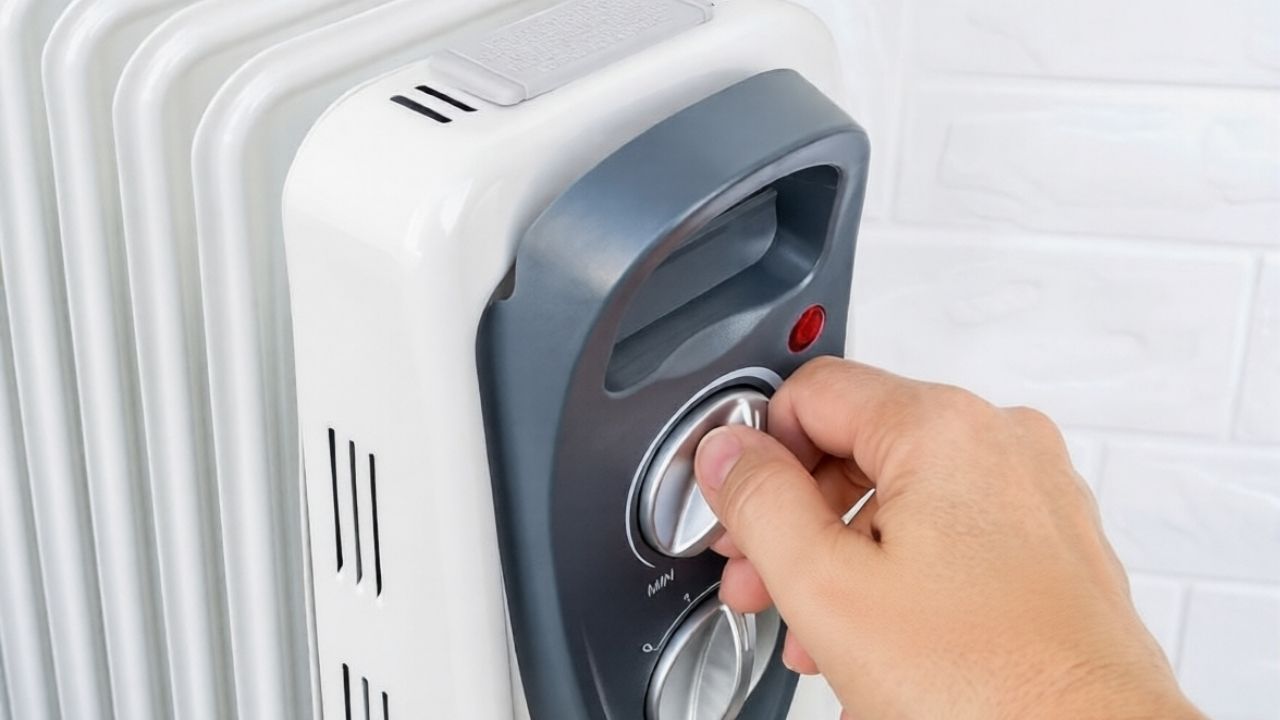
The space heater setting that wastes money and still leaves you cold
Photo credit: Veni vidi.shoot/istock.com
Space heaters promise quick comfort, but one common setting quietly drains your wallet while your toes still feel like ice. If you simply crank the dial to maximum and let it roar, you are paying premium rates for electricity without ever warming the whole room evenly. To actually feel warmer for less money, you need to rethink how you set the temperature, how long you run the unit, and how it works with the rest of your home’s heating.
The worst-performing approach is not about buying the wrong heater, it is about using the right one in the least efficient way. By understanding how wattage, thermostat controls, and room size interact, you can avoid the default “high heat, all the time” habit that wastes energy and still leaves you shivering in the corners.
The high-heat setting that sabotages comfort
The setting that wastes the most money while leaving you cold is the constant high-heat blast, where you turn the knob to maximum and let the heater run flat out. In that mode, the unit pushes out as much heat as it can, but it does not control the room temperature, so you end up with hot air near the heater and chilly air everywhere else. Many portable models are designed around simple high-wattage operation, typically around 1,500 watts, and if you run that continuously you are paying for full power even when the room no longer needs it.
Manufacturers have started to acknowledge that relying on fixed high-wattage operation, typically 1500W, running continuously until the device is manually shut off, is unnecessary and creates wide swings in comfort, which is exactly what happens when you live on the max setting. Newer designs that use an ECO or automatic mode try to avoid that waste by modulating output instead of blasting at full power all the time, as described in the way some heaters are now shaping heat intelligently. If your heater has only a simple high setting, you can mimic that smarter behavior by using the thermostat dial and a timer instead of leaving it pinned to maximum.
Why “set it to max and forget it” costs so much
When you leave a space heater on its highest setting for hours, you are essentially running a small electric furnace at full tilt in a single outlet. The average residential space heater often has two main heat settings, low and high, and the low setting needs 750 watts to run, whereas the high setting typically doubles that draw. If you always default to high, you are paying twice the energy cost of low for the same number of hours, even if the room would feel just as comfortable at a lower output once it is warmed up.
That difference adds up quickly on your bill. Guidance on the average residential space heater shows how a 750 watt low setting can already be significant over time, so doubling that load on high multiplies the cost without guaranteeing better comfort. When you combine that with the fact that electric resistance heat is one of the most expensive ways to produce warmth per unit of energy, the “max and forget” habit becomes one of the priciest ways to chase a cozy room.
Settings that actually keep you warm
To stay warm without overpaying, you need to treat the heater’s controls as tools, not decorations. Instead of leaving the dial at maximum, start by using the thermostat or temperature selector to reach a steady, moderate room temperature, then let the heater cycle on and off. Advice focused on Settings stresses that how you choose to use a space heater can drastically affect energy use and savings, and that includes using built in thermostats instead of treating the unit like a hair dryer.
Many heaters now include ECO or energy saver modes that automatically reduce power once the room reaches a target temperature, which helps avoid the hot and cold swings that come from manual on off cycles. If your model offers that, it is usually more efficient than running on high constantly, because it cuts output when less heat is needed. Even with a basic unit, you can mimic this by turning the knob down once the room feels comfortable and letting the heater maintain that level instead of chasing ever higher temperatures that your small appliance cannot realistically sustain across a large space.
Size, space, and the myth of whole home heating
Another reason the high setting disappoints is that you may be asking a small heater to do a big job. Space heaters are generally very small, although decently powerful, but the size that really matters is the room you are trying to heat. If you place a compact unit in a large open plan living area and expect it to replace your furnace, you will end up with a hot bubble near the device and cold air everywhere else, no matter how high you set the dial.
Guidance that emphasizes Size and Space notes that you need to match the heater’s output to the square footage you actually want to warm, rather than the entire home. There are also hard limits on what these devices can do, since Government regulations limit space heater output to 1,500 watts, which is not nearly enough to heat an entire home. Once you accept that, it becomes clear that the smartest strategy is to use a heater to supplement central heat in a specific room, not to run it on high in a losing battle against the whole house’s heat loss.
Pairing your heater with the right thermostat strategy
The way you set your main thermostat can either amplify or undermine your space heater. If you are using a portable unit to warm the one or two rooms you occupy most, you should turn down your central heating so you do not heat unused areas at full blast. Advice on how to use space heaters efficiently explains that if you are using a space heater to heat the one or two rooms you use most, turning down your central system prevents you from paying twice for the same comfort and encourages you to rely on the portable unit only where it is effective.
At the same time, you should still be strategic with your whole home thermostat. Guidance on Thermostat Settings and Why They’re Important notes that you should Set your thermostat wisely for energy efficiency, with The Department of Energy recommending 78°F in the summer for cooling. In winter, the same principle applies in reverse: aim for a moderate baseline temperature from your central system, then use the space heater to nudge a specific room a few degrees warmer instead of trying to replace the furnace entirely with a single plug in unit.
Use time matters more than you think
Even if you pick the right setting, the number of hours you run the heater can make or break your savings. Leaving a unit on all day because it feels convenient can erase any benefit you gain from turning down the central thermostat. Advice that highlights that Use time matters points out that two heaters running for a short period can use less energy than one heater running for a much longer stretch in the same time period, which means your schedule and habits are as important as the hardware.
To keep control, treat the heater like task lighting instead of a permanent fixture. Turn it on when you sit down to work at a desk or relax on the sofa, and shut it off when you leave the room, rather than letting it hum away in the background. Some energy breakdowns show that the cost to run a space heater depends on the type of heater that you have, including its size and wattage, and that a small unit used for a few targeted hours can be far cheaper than a larger one left on all day, a point underscored when looking at how the cost to run a space heater scales with time.
Placement, outlets, and hidden efficiency traps
Even the best settings cannot fix a poorly placed heater. If you tuck the unit behind furniture or on the far side of a drafty window, the hot air will pool where you cannot feel it, and the thermostat will misread the room. Practical guidance on How To Keep Your Space Heater Operating at Max Efficiency stresses that you should Keep It As Close to Your Wall Socket as Possible, which reduces the need for extension cords that can overheat and also tends to put the heater along a wall where air can circulate more freely.
Safety experts also urge you to place heaters on level, flat surfaces and away from anything that can burn. Official Space Heater Safety Tips emphasize that you should Make sure your space heater has the label showing that it is listed by a recognized testing laboratory and that you keep heaters on level, flat surfaces. Poor placement not only wastes heat, it increases the risk of tipping, overheating, or starting a fire, which is a high price to pay for a little extra warmth.
Safety, wiring, and the real cost of a shortcut
Running a heater on high all the time does not just cost more on your bill, it also pushes your wiring and outlets harder. Guidance on Space Heater Safety and Warming Your Home Safely notes that when you Choose the Right Heater, you also need to think about Location so you do not overload circuits or create an electrical hazard. Plugging a 1,500 watt unit into a power strip or sharing a circuit with other big loads can be a recipe for tripped breakers or worse.
Real world experiences echo that concern. In one frugality discussion, users pointed out that space heaters are a leading cause of house fires, behind cooking, and that Its great until you need to take a shower and discover the limits of your electrical system. Official safety advice also stresses that you should always keep your space heater at least three feet away from anything that can burn and plug it directly into a wall outlet, guidance that appears in resources on Selecting the Right Space Heater for Your York Home and on Power Sources and Electrical Safety. Saving a few dollars on heat is never worth risking overloaded wiring or a fire.
When a space heater actually saves you money
Used thoughtfully, a space heater can still be a smart part of your winter strategy. The key is to limit it to targeted rooms, shorten run times, and avoid competing with your central system. Advice on how to use space heaters efficiently explains that if you are using a space heater to heat the one or two rooms you use most, you should turn down your central heating so you do not heat the rest of the home unnecessarily, and you should also pay attention to the sizing table on the box so the heater matches the room.
It also helps to understand how much electricity these devices draw in context. Guidance that answers How Much Electricity Do Space Heaters Use notes that a typical unit can pull a significant share of a standard 15 amp circuit, which is why you should not run multiple heaters on the same line. Some energy educators have even produced videos like The Secret To Cheaper Electric Bills In Winter! that suggest moving a heater if it sits on the opposite side of a window in the room, so you are not fighting drafts unnecessarily. When you combine smart placement, moderate settings, and a realistic view of what a 1,500 watt cap can do, you can finally stop paying for that wasteful high setting that never quite warms your feet.
Supporting sources: How to use space heaters efficiently – Indiana Connection.
Like Fix It Homestead’s content? Be sure to follow us.
Here’s more from us:
- I made Joanna Gaines’s Friendsgiving casserole and here is what I would keep
- Pump Shotguns That Jam the Moment You Actually Need Them
- The First 5 Things Guests Notice About Your Living Room at Christmas
- What Caliber Works Best for Groundhogs, Armadillos, and Other Digging Pests?
- Rifles worth keeping by the back door on any rural property
*This article was developed with AI-powered tools and has been carefully reviewed by our editors.