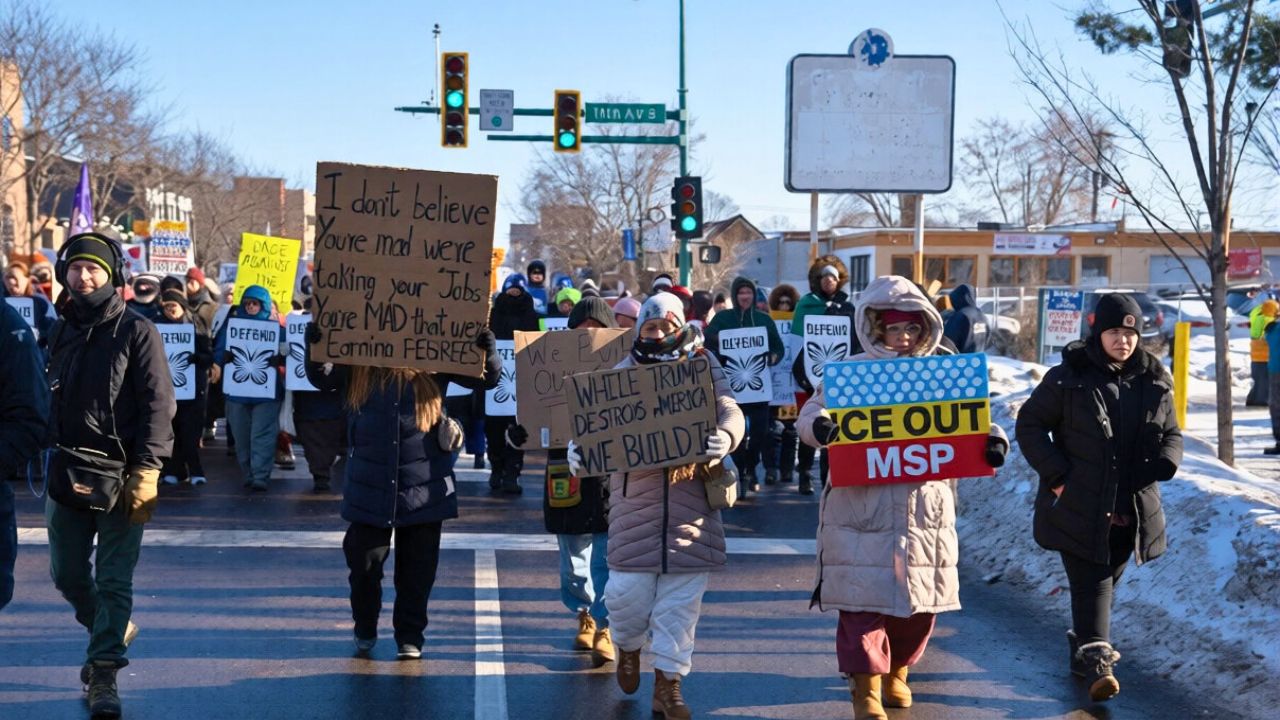
Protesters rally against deportation raids spreading across multiple states
Photo credit: Alejandro Diaz Manrique/Shutterstock.com
Protesters are mobilizing across the United States in response to stepped-up deportation raids, turning city centers into nightly battlegrounds over immigration enforcement and executive power. What began as a local backlash in Southern California has widened into a coordinated challenge to the president’s mass removal agenda, with activists casting the raids as a test of basic democratic norms.
The demonstrations are drawing in long-standing immigrant rights networks, newer anti-authoritarian groups and local officials who say federal tactics are destabilizing their communities. As the protests spread to more states, the confrontation is shifting from a dispute over policy details to a broader fight over who gets to decide who belongs in the country.
From Los Angeles flashpoint to nationwide unrest
The current wave of protests traces back to large crowds that first gathered in and around Los Angeles after federal immigration teams began high-profile raids targeting mixed-status neighborhoods. Demonstrators blocked intersections and surrounded government buildings as word spread that agents were detaining parents outside workplaces and transit hubs.
Police responded with heavy crowd-control tactics, with officers firing tear gas and rubber bullets while the California Highway Patrol used flash-bang grenades to clear downtown streets, according to accounts of the initial clashes that describe a chaotic scene of panicked marchers and armored vehicles pushing into dense crowds. The escalation hardened the sense among protesters that immigration enforcement had become inseparable from militarized policing.
State leaders then called in the California National Guard, sending troops and vehicles into Los Angeles on a Sunday as the unrest continued. For immigrant families already fearful of federal agents, the sight of soldiers patrolling familiar streets reinforced the perception of an occupation rather than a temporary security measure.
Even after a curfew was imposed in downtown Los Angeles, nightly gatherings persisted and hundreds of anti ICE protesters were reported in the city center, according to broadcast coverage that described a tense standoff between marchers and law enforcement. Those scenes circulated widely on social media, helping transform a local protest into a national cause.
Protests spread from coast to coast
Within days, organizers in other cities were staging their own rallies against immigration raids and deportation priorities. In Philadelphia, about 150 protesters gathered outside the federal courthouse, chanting against raids and carrying signs that linked deportations to broader concerns about civil liberties.
Smaller but determined crowds appeared in Seattle and Austin, where marchers moved from downtown plazas to Immigration and Customs Enforcement facilities. Reporting from Washington state described how Spokane Police Chief Kevin Hall said more than 30 protesters were arrested and that officers deployed pepper balls on the crowd, a sign that confrontations were intensifying far from the original Los Angeles flashpoint.
In the Pacific Northwest, officers in Portland, Oregon, fired tear gas and projectiles to disperse a crowd that had gathered outside a U.S. Immigration and Customs Enforcement building and kept pressing against barricades into the evening, according to accounts from the scene. The images echoed earlier footage from California and fed a growing narrative of federal and local forces aligning to protect an aggressive deportation regime.
News segments framed the protests as a response to the president’s deportation efforts that had spread beyond just Los Angeles into dozens of cities, with anchors describing mass marches, blocked highways and tense standoffs outside detention centers. One national broadcast opened by noting that protests sparked by immigration raids had spread across the country in roughly 24 hours, a pace that underscored how deeply the raids resonated with existing networks of activists.
Local flashpoints and federal pressure
The administration’s directive that Immigration and Customs Enforcement prioritize deportations from Democratic run cities added a partisan edge to the unrest. In practice, that strategy concentrated enforcement in urban centers like New York City, Chicago and other hubs that had previously limited cooperation with immigration authorities.
In New York, demonstrators converged on federal buildings and major transit hubs, arguing that the focus on Democratic jurisdictions amounted to political retribution dressed up as law enforcement. Chicago saw similar scenes outside its downtown immigration court, where legal observers documented families waiting anxiously for news from inside while chants from street marches filtered through the glass.
Broadcast interviews featured Los Angeles Mayor Karen Bass and more than a dozen other local leaders who criticized the raids as destabilizing and called for a pause in mass removals. On one public affairs program, Geoff Bennett and Amna Nawaz walked viewers through images of protests in multiple cities while describing the president’s threats of additional deployments if local officials refused to cooperate.
Parallel coverage highlighted how protests were not confined to traditional coastal strongholds. Demonstrations also emerged in Nebraska and other interior states where immigrant labor underpins agriculture and meatpacking, suggesting that opposition to mass deportation had started to cut across some regional and partisan lines.
Linking immigration raids to wider resistance
The current demonstrations are unfolding against a broader backdrop of resistance to the second Trump administration. Since January 2025, protests against mass deportation have broken out in at least 25 states including California, Texas, Minnesota and Washington, according to a chronology that tracks marches, sit ins and courthouse vigils tied to immigration policy.
Activists have also connected the anti raid mobilizations to the October 2025 No Kings protests, a nationwide campaign that explicitly framed itself as opposition to Donald Trump’s second term. Documentation of the October 2025 No lists events in Chico, California, and Chicago under a shared banner that rejected what organizers called monarchical behavior by the executive branch.
That No Kings branding has since surfaced in local mobilization hubs. One event page urges supporters to gather under the slogan No Thrones, No Crowns, No Kings and encourages attendees to bring an item for a food bank, blending street protest with mutual aid. Another description for a gathering in Sonoma County describes a peaceful resistance event where participants will unite in solidarity with Minneapo, a reference to earlier protests in Minneapolis that helped galvanize national attention.
In Petaluma, organizers describe a nonviolent resistance event against tyranny, presented as part of a sustained national movement that began in 2025. A separate listing for a rally in San Jose credits the Indivisible movement as the driving force behind a peaceful demonstration that links local concerns about deportation to a wider campaign against authoritarianism.
In the Bay Area, activists are planning a No Kings themed gathering in San Francisco, promoted by States Win San Francisco, which is described as the successor to the Sister District Project for the No Kings march. The event is pitched as a chance for neighbors to coordinate electoral work with street-level protest, illustrating how immigration raids have become a rallying point for a broader pro democracy coalition.
California’s layered protest map
California remains the geographic center of the current unrest, with events stretching from major metros to smaller cities and wine country towns. In addition to Los Angeles, marches have coursed through California cities that have long histories of immigrant organizing, as well as communities that are newer to mass protest.
In the North Bay, organizers in Santa Rosa and nearby Sonoma have promoted No Kings themed gatherings that explicitly tie local wine country politics to national debates over deportation and executive authority. A separate listing for a march in Petaluma describes the event as part of the same sustained national movement, reinforcing a sense of statewide coordination.
These smaller city events complement larger marches in hubs like Boston and Philadelphia, where immigrant advocacy groups have long pushed for sanctuary policies. Together they map a protest movement that is as much about local identity and community defense as it is about federal immigration code.
What the protesters want
Across cities, demonstrators are demanding an immediate halt to large scale deportation raids, greater transparency about how targets are selected and stronger legal protections for long settled residents. Many also want Congress to rein in executive authority over immigration enforcement, arguing that the current pattern of raids in Democratic run jurisdictions shows how easily that power can be weaponized.
Like Fix It Homestead’s content? Be sure to follow us.
Here’s more from us:
- I made Joanna Gaines’s Friendsgiving casserole and here is what I would keep
- Pump Shotguns That Jam the Moment You Actually Need Them
- The First 5 Things Guests Notice About Your Living Room at Christmas
- What Caliber Works Best for Groundhogs, Armadillos, and Other Digging Pests?
- Rifles worth keeping by the back door on any rural property
*This article was developed with AI-powered tools and has been carefully reviewed by our editors.