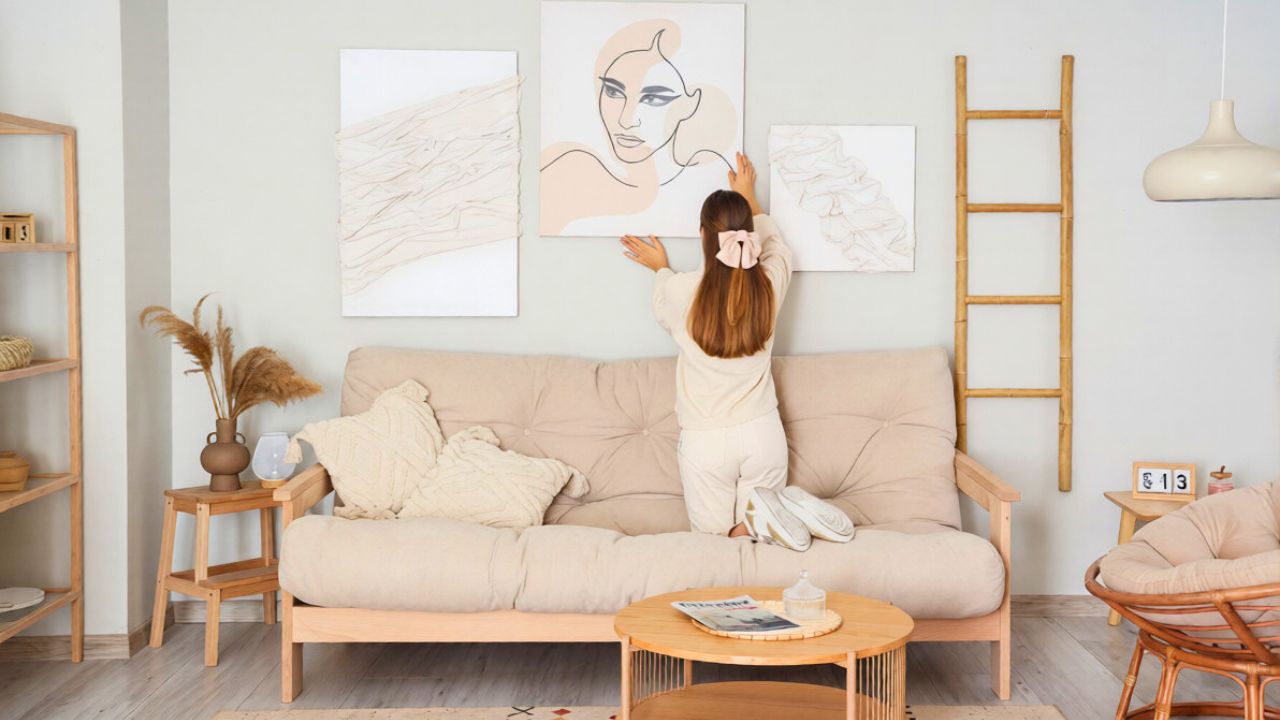
What I changed after the wall decor started making the whole space feel busy
Photo credit: Pixel Shot/Shutterstock.com
When wall decor tips over from layered to loud, the whole room can start to feel smaller, fussier, and oddly restless. Designers and home decorators increasingly say the fix is not another piece of art, but a rethink of scale, spacing, and what gets to stay on the wall at all.
The shift many are making looks subtle on paper yet can transform how a space feels in a single afternoon: fewer pieces, larger focal points, calmer color, and more blank wall that lets the eye rest.
From gallery clutter to one clear focal point
A growing number of homeowners are quietly retiring dense gallery walls in favor of one or two commanding pieces. One analysis of gallery trends notes that Most gallery walls are not curated, They are collected, and that mix of tiny prints and mismatched frames can scatter attention and drain the energy of a room. As a result, large-scale art is increasingly being used to anchor spaces and simplify sightlines, a shift that directly responds to complaints that walls feel visually noisy.
Home decorators who once filled every inch of a living room wall with frames now describe a different approach in community threads. Instead of twelve small photos, they are choosing a single oversized landscape or abstract over the sofa, then letting the remaining wall breathe. The change reduces the number of edges and competing colors at eye level, which immediately makes a room read as calmer and more intentional.
Designers point out that this is not a rejection of personality but a reframe of how it is presented. A single large photograph from a favorite trip or one expressive painting can tell a fuller story than a scattered grid of quotes and novelty prints that the owner no longer even likes.
Letting negative space do more of the work
Professionals often talk about negative space as if it were another piece of furniture. Guidance on busy rooms stresses the need to go light somewhere and treat empty wall as a tool that lets the rest of the decor breathe. In practice, that can mean leaving one wall almost bare so a fireplace or bookshelf can take center stage without competition.
In living rooms that feel overstimulating, stylists recommend stripping back a wall completely, then adding back only what truly earns its place. That might be a single mirror, a simple sconce, or nothing at all. The absence of objects gives the eye a place to pause, which in turn makes the remaining art and furniture feel more deliberate.
Decluttering communities echo this logic. Contributors describe a cycle in which every new print or sign initially feels like a fun addition, then slowly turns into visual noise. The most successful resets start not with buying new decor, but with removing everything and reintroducing a small number of pieces that actually support how the room is used.
Rethinking accent walls and loud finishes
Another shift involves the walls themselves. Designers who once relied on bold accent walls are now more likely to suggest that homeowners Forego the feature wall in favor of consistent finishes. One detailed guide argues that a single high-contrast wall can feel trendy for a season, then quickly date a room and compete with artwork or shelving.
Instead, the recommendation is to use timeless wall treatments such as wainscoting, paneling, or subtle trim, which can frame art without shouting over it. A calm envelope of color and texture lets decor choices stand out, rather than forcing them to fight patterned paint or high saturation behind them.
For those who already have a strong accent wall and feel boxed in by it, repainting in a softer, more unified tone is often the first change that makes the space feel less busy. Once the wall itself steps back, even existing art can look more sophisticated.
Editing what hangs, not just how much
Minimalist voices have long questioned the pressure to hang something on every surface. One widely shared comment jokes about skipping the distressed retro sign that says 5¢ and the faux beach arrow, then gets serious about asking whether each item is something the owner truly wants to live with. The suggestion is to aim for one strong piece per wall and supplement with plants or a functional item like a mirror rather than a barrage of slogans.
On decorating forums, a recurring theme is the power of a single small change. In one thread about small tweaks that made a home feel better, several people mention taking down a cluttered collage or removing one entire row of frames. The physical difference is minor, but the psychological effect is large, because the room suddenly feels less like a bulletin board and more like a place to rest.
Others describe swapping out a patchwork of tiny frames for a cohesive set with consistent mats and finishes. The total number of pieces might not change much, but the visual rhythm does, which can be enough to quiet a previously chaotic wall.
Using proportion and simple rules to calm the view
Beyond editing, proportion is doing more of the heavy lifting. A detailed guide to the 2/3 rule suggests that wall art or a grouping of artworks should be roughly two thirds the width of the furniture below. For a 90 inch sofa, that means about 60 inches of art, which naturally looks balanced and prevents the scattered, postage-stamp effect that often reads as busy.
Similar spacing rules are being used on shelves and mantels. One explanation of the 3 4 5 rule notes that Groups of 3 tend to feel dynamic and natural, Groups of 4 bring structure and balance, and larger Groups of 5 can add fullness without feeling flat. Applying those numbers to vases, frames, or objects keeps styling from drifting into either clutter or sparse awkwardness.
Stylists also lean on furniture guidelines that mirror the wall art advice. A breakdown of the 2/3 rule for sofas explains that the ideal length of a piece relative to surrounding elements uses the same ratio, which helps keep both furniture and art in visual conversation instead of competing for attention.
Borrowing strategies from pros and real homes
Professional projects show how these ideas look at full scale. In one living room, Kelly Finley of Joy Street Design used a favorite abstract painting to dominate the wall and cleverly hide a television behind panels, turning what might have been a cluttered media wall into a single graphic statement.
Broader roundups of wall decor ideas highlight similar moves. Large mirrors, simple picture ledges, and sculptural sconces are used in place of dense grids, with each wall given a clear role instead of acting as general storage for memories and knickknacks.
At the same time, community spaces such as decluttering forums remind readers that there is no single correct level of visual activity. One contributor named Currently describes focusing on keeping a desk area clear while allowing more character elsewhere, a reminder that the goal is alignment with how a room functions, not strict minimalism for its own sake.
Finding a personal balance between character and calm
Interior design discussions frequently circle back to the idea that busy is not automatically bad. One widely shared living room analysis argues that a full space can feel cozy and expressive as long as there is at least one quieter zone and a clear focal point. The key phrase is go light somewhere, which acknowledges that character and emptiness can coexist in the same room.
On decorating subreddits, users wrestling with walls that feel off are often advised to adjust scale and spacing before buying anything new. Suggestions include centering art over furniture, lowering frames that float too high, and expanding into a portrait wall instead of scattering two small pieces on separate surfaces.
What actually changed when the walls calmed down
Like Fix It Homestead’s content? Be sure to follow us.
Here’s more from us:
- I made Joanna Gaines’s Friendsgiving casserole and here is what I would keep
- Pump Shotguns That Jam the Moment You Actually Need Them
- The First 5 Things Guests Notice About Your Living Room at Christmas
- What Caliber Works Best for Groundhogs, Armadillos, and Other Digging Pests?
- Rifles worth keeping by the back door on any rural property
*This article was developed with AI-powered tools and has been carefully reviewed by our editors.