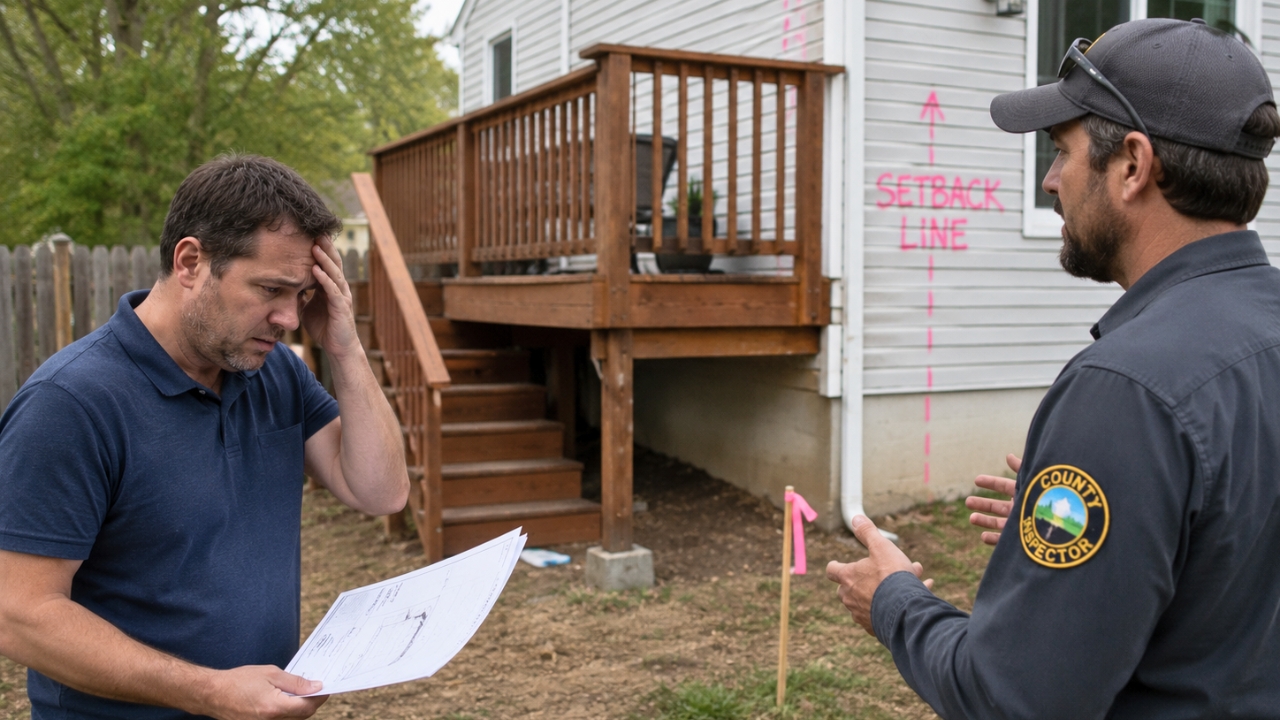
Buyer Finds Out the Seller Built a Deck Over the Setback Line — Then the County Inspection Threatens a Tear-Down
Photo credit: Fix it homestead
A new deck can make a house feel like it has extra living space before a buyer even moves in.
It is the place for a grill, chairs, coffee in the morning, kids running in and out, and family gatherings when the weather is nice. During a showing, a deck can make the whole property feel more finished and useful.
But one buyer found out after closing that the deck came with a problem no one wanted to inherit.
The seller had built it over the setback line.
Then the county inspection raised the possibility that the deck might have to come down.
Suddenly, what looked like an upgrade became one of the most stressful parts of the purchase.
The deck looked like part of the home
Most buyers do not look at a deck and immediately think about zoning setbacks.
They assume a structure attached to the home was permitted, inspected, or at least built where it was allowed to be. If the deck is already there, especially if it looks newer or professionally finished, it feels like part of the property being sold.
That is what made this discovery so frustrating.
The buyer likely believed they were purchasing a home with a usable outdoor space. Instead, they found out the deck might be violating county rules because it was too close to a property line, easement, road, septic area, drainage feature, or another restricted zone.
A deck can be beautiful, sturdy, and functional.
But if it is in the wrong place, the county may still have a problem with it.
The setback issue changed the value of the upgrade
A deck adds value only if the buyer can actually keep it.
Once the county questioned its location, the deck became less of a bonus and more of a liability. The buyer now had to figure out whether it could be approved after the fact, modified, moved, or removed entirely.
That is a brutal discovery after closing.
If the deck had been flagged before the sale, the buyer could have asked the seller to fix it, provide permits, reduce the price, or remove the structure before closing. They might have walked away if the risk was too high.
After closing, the buyer was the one holding the problem.
And if the county ordered a tear-down, the cost and hassle could land on the new owner.
The seller’s decision became the buyer’s problem
The most irritating part was that the seller was the one who built the deck.
If the seller added it without checking setbacks, skipped permits, or ignored zoning limits, the buyer may have inherited a violation they did not create.
That raises the obvious question: did the seller know?
Had the county ever warned them? Was there a denied permit? Did they build it themselves without approval? Did the listing describe the deck as a recent upgrade? Were permits disclosed? Did the home inspector mention anything about setbacks or unpermitted work?
Those details matter because a buyer may feel misled if the deck was marketed as a feature while the seller knew it might not be legal.
But proving what the seller knew can be difficult.
The buyer may need county records, permit files, disclosure forms, listing photos, contractor invoices, and inspection notes to understand what happened.
The county inspection made the problem real
Before the county got involved, the deck issue may have felt like a paperwork question.
Maybe the buyer hoped it was a minor technicality. Maybe they thought the county would approve it retroactively. Maybe they assumed a variance or simple permit would fix everything.
Then the inspection raised the possibility of a tear-down.
That changed the mood quickly.
A tear-down could mean losing the deck completely, paying for demolition, repairing siding or doors, restoring the yard, and possibly rebuilding a smaller deck that meets the rules. If the deck was attached to the house, removal could create additional repairs.
The buyer was not just facing a fine or a form.
They could lose a major feature of the home.
The setback may have protected something important
Setback rules can feel annoying until a buyer realizes why they exist.
They may protect access between homes, keep structures away from property lines, preserve drainage paths, protect septic systems, maintain fire separation, prevent conflicts with roads or utilities, or keep one owner from building too close to another.
If the deck violated that space, the county may not treat it as harmless.
And if a neighbor complains, the issue can become even harder to ignore.
That is why the buyer needed to know exactly which setback was violated and whether there was any path to approval.
Not all violations are equal. Some can be corrected. Some can be approved with a variance. Some are too serious to keep.
Commenters focused on permits and disclosures
When buyers discover unpermitted or noncompliant structures after closing, people usually tell them to gather documents first.
The county permit file matters. The seller disclosure matters. The listing description matters. The inspection report matters. Any contractor paperwork matters. If the deck was advertised as new or recently updated, that may be relevant too.
Commenters also often recommend asking the county what options exist before panicking.
Can the deck be modified? Can the buyer apply for a variance? Does only part of it violate the setback? Is removal mandatory, or does the county want an engineer, permit, or as-built inspection?
The buyer needs clear answers before deciding whether to pursue the seller, negotiate with the county, or start planning for removal.
The real issue was buying an upgrade that might not be allowed to stay
What made the situation so frustrating was the reversal.
The deck probably helped sell the house. It made the property look more usable, more attractive, and more complete. It may have been part of why the buyer liked the home in the first place.
Then the buyer learned that the same deck might violate county rules and could be ordered removed.
That turns an upgrade into a hidden cost.
The buyer did not build over the setback line. They did not choose the location. They did not create the violation. But after closing, they became the person who had to answer for it.
And when a county inspection threatens a tear-down, the question is no longer whether the deck looks nice.
It is whether the buyer was sold a feature they may never have been legally allowed to keep.
Like Fix It Homestead’s content? Be sure to follow us.