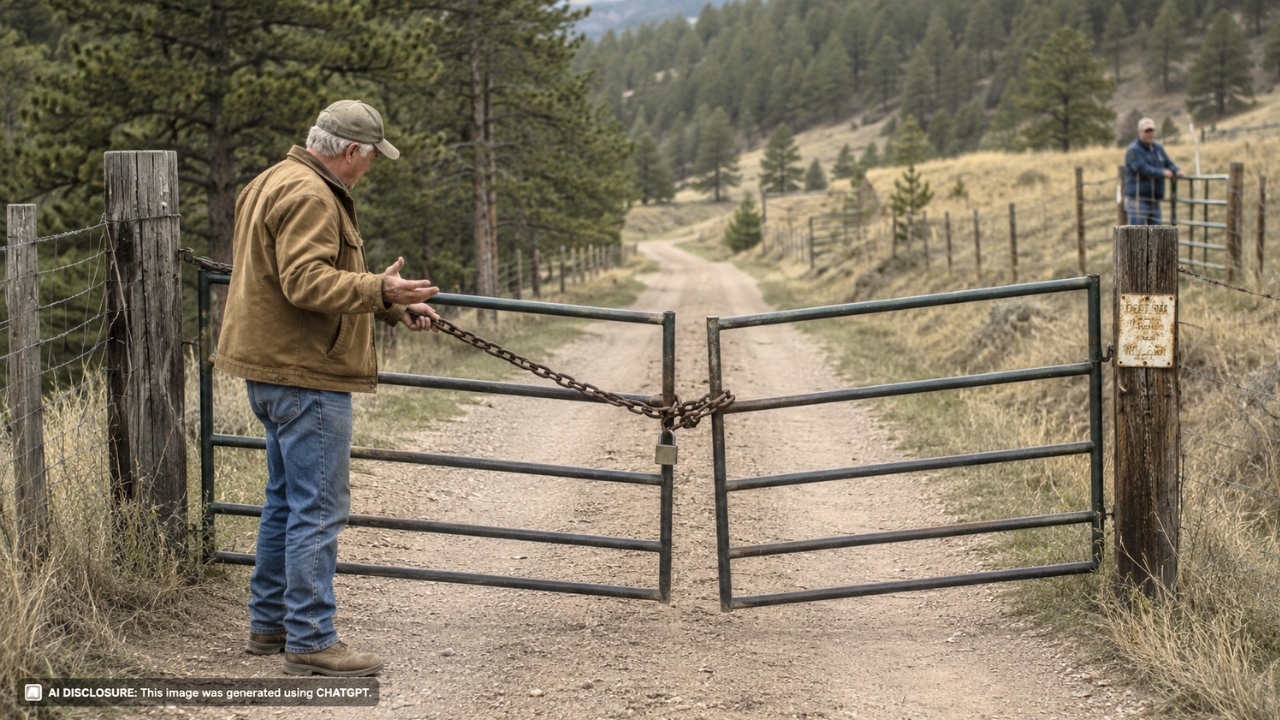
Rural Landowner Finds the Neighbor Has Blocked and Locked the Only Road Crossing the Property — Then the Neighbor Says Anyone Who Wants Access Must Ask Permission First
Photo credit: AI-generated image created using ChatGPT. Illustrative only.
Out in the country, you learn fast that “the road” isn’t always a paved county lane with a sign and a shoulder. Sometimes it’s a skinny dirt track that’s been there longer than anyone can remember, and it’s the only way six families get home every day. That’s why one Oklahoma resident said their stomach dropped when they rounded the bend at night and found the entrance blocked with big chunks of concrete.
In the original post, the resident described a neighbor—someone who can see the road from his house but “doesn’t even use it”—dragging large cement rocks across the dirt road after dark. The reason, they said, was that vehicles were “driv[ing] too fast,” with the poster suspecting it was mostly trash pickup and delivery trucks. The result was immediate: everyone who lives down that road was suddenly being forced to stop, get out, and physically move obstacles just to reach their own homes.
A “private” road that functions like a neighborhood lifeline
This is the kind of rural setup that looks simple until it isn’t. The poster said the road is legally owned by the neighbor who blocked it, but it has also been used publicly as the only route for more than 50 years. Families have been living down it for generations, which makes the blockade feel less like a petty dispute and more like someone grabbing the “off switch” for an entire little pocket of homes.
Even if you’ve never dealt with property easements or deeded access, you can feel the practical problem right away. There isn’t a backup driveway. There’s no alternate lane around the obstruction. If the entrance is blocked, the whole road is effectively shut down.
And the moment it happens at night, it turns into a safety issue, not just an annoyance. A dark dirt road with surprise concrete in it is an accident waiting to happen—especially for anyone unfamiliar with the area, like delivery drivers.
The night it happened, the fix was brute force
The poster said they and their mother discovered the concrete rocks when pulling in after dark. They did what a lot of rural families would do in the moment: they got out and moved the blocks, put them back, and drove through.
But the anger wasn’t just about having to lift something heavy one time. It was about what comes next. The poster expected it could be “even worse come daylight,” meaning bigger barriers, more of them, or something that can’t be shoved aside by two frustrated residents in the dark.
That fear lands differently when you think about who else lives down there. The poster pointed out there are elderly and disabled residents who can’t safely hop out and drag concrete out of the way every time they need groceries or a doctor’s appointment.
When access is threatened, every normal day task gets complicated
Blocking the only route into multiple homes doesn’t just inconvenience commuters. It can mess with trash service, deliveries, school pickups, and anyone trying to get a contractor out to fix a water heater or an ambulance down the lane.
In rural areas, even minor delays can turn serious fast. Response times can already be longer. Addresses can be tricky. Now add a locked-down entrance, and you’ve got first responders potentially stopping short, trying to figure out whether they can move obstacles—or whether they’re supposed to “ask permission first.”
That phrase wasn’t used as a formal rule in the post, but the demand underneath it was clear: one landowner trying to control who uses the road and when, even though entire households depend on it. The poster’s frustration came through in raw, plain language.
They called for help, but tried to keep it from turning into a money pit
In an update, the poster said they contacted both the police department and the fire marshal. They were told someone would come out and take a look, though the poster didn’t know if a visit had happened yet.
That detail will sound familiar to anyone who’s ever tried to get quick action on a rural property dispute. Even when it’s urgent to the people living it, it can get treated like a “civil issue” until the worst-case scenario happens.
Meanwhile, the poster kept doing what they could with what they had: they moved most of the rocks themselves when walking down to check the mail. They also said the families were trying to “do things the easy way first” before dropping money they don’t have on an attorney.
That’s the real trap. When access is on the line, you don’t have the luxury of waiting months to untangle who owns what on paper. But legal help, surveys, and property research cost money—especially when you’re forced to act fast.
Reactions focused on one word: access
While the post itself didn’t include a full comment thread in the shared text, the direction of the conversation was obvious: when a road is the only way in and out, people immediately start thinking about established access rights and what kind of proof matters.
In real life, this usually means digging up old records, taking photos, and documenting exactly what was placed in the road and when. It can also mean contacting local officials who care less about neighbor drama and more about whether emergency vehicles can reach the homes.
It also tends to shift the question from “Who owns the dirt?” to “Who has the right to use the route?” Those are not always the same thing, especially on older properties where a path has been treated like a public or shared road for decades.
And there’s another layer: even if someone believes speeding is a problem, dropping large concrete obstacles onto a travel lane isn’t exactly a controlled traffic-calming plan. It’s unpredictable, and it puts the burden on every driver, every day, to guess what’s changed since last time.
A strange update: the rocks were stacked neatly off the road
In the second update, the poster returned to check and found all the rocks removed from the road and placed off to the side in stacks. The poster said they weren’t the one who stacked them—when they moved rocks earlier, they tossed them into the grass.
So someone came back and cleaned it up. Maybe it was the neighbor backing down. Maybe it was another resident trying to keep the peace. Maybe it was someone responding after the calls were made. The post doesn’t say.
What it does show is how quickly life on a shared rural access route can swing between “normal” and “you can’t get home.” Even with the road open again, the underlying issue isn’t magically solved: one person still believes they can block the only entrance if they feel like it.
For the families living down that dirt road, the biggest question now isn’t whether they can move concrete. It’s whether they can count on getting in and out tomorrow without having to fight their way home first.