New Landowner Gets a Survey Done and Finds the Neighbor’s Paved Driveway Crosses the Property Line by Six Inches — Then the Neighbor Says the Paving Contractor Measured From the Wrong Pin and They Will Not Pay to Fix Someone Else’s Mistake
Photo credit: AI-generated image created using ChatGPT. Illustrative only.
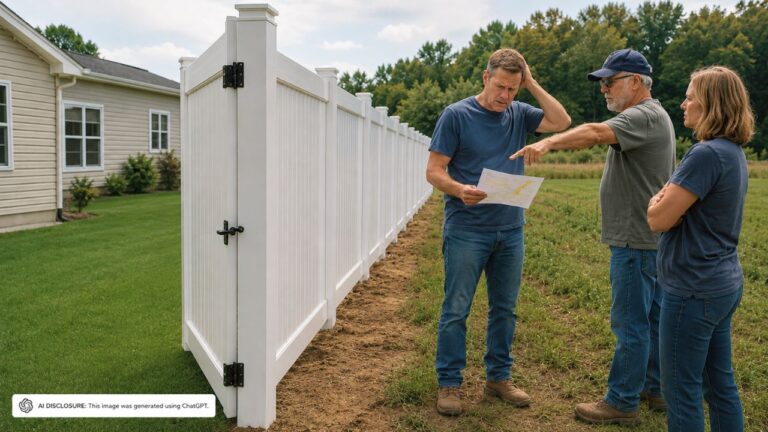
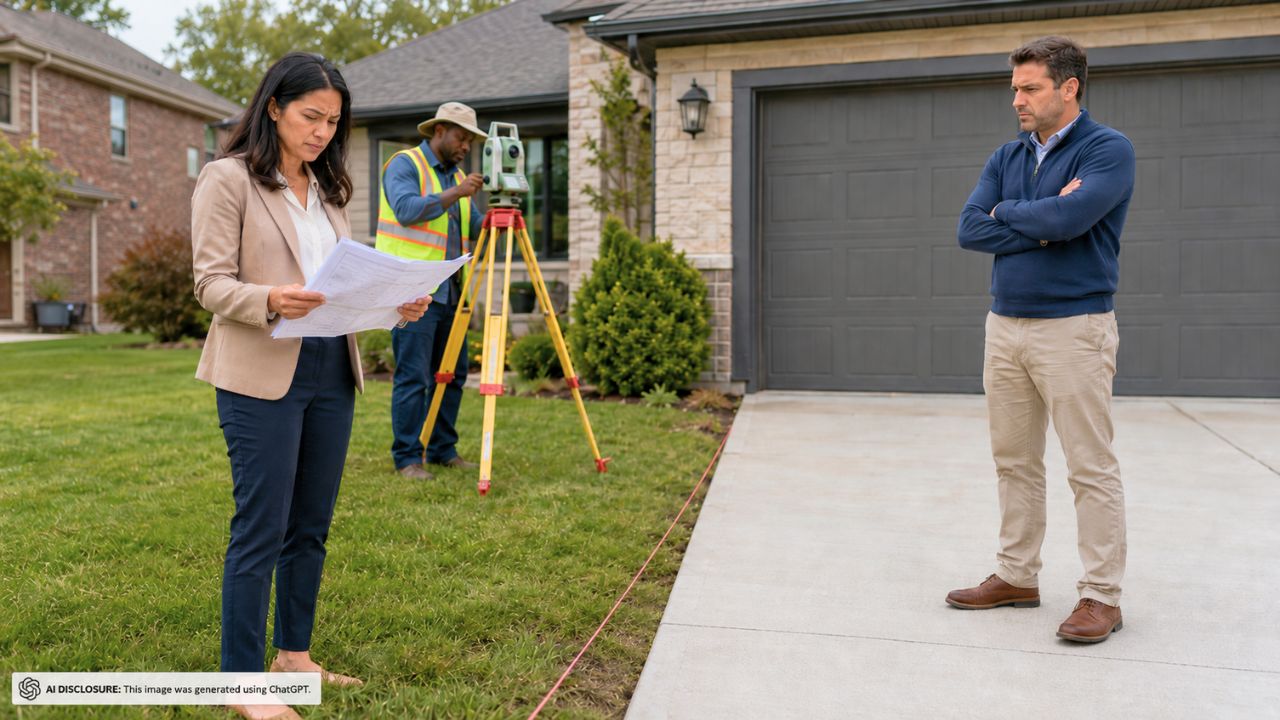
The new landowner did what every cautious buyer says they’ll do “eventually” and finally booked a real survey. Not a quick tape-measure guess, not “the fence looks straight,” but flags, stakes, and a professional looking for the actual corners. And that’s when the line showed up in the worst possible place: right under the neighbor’s paved driveway—by about six inches.
Six inches sounds petty until you picture it in real life. It’s not a tree branch you can trim back. It’s asphalt (or concrete) laid down in a clean, permanent stripe that says, “This is where cars go.” When the new owner brought it up, the neighbor’s response was immediate and blunt: the paving contractor measured from the wrong pin, and they weren’t paying to fix someone else’s mistake. The legal backdrop for this kind of boundary mess is laid out in the source post, and it reads a lot like the start of every neighborhood standoff.
The survey didn’t create the problem, it just exposed it
Most property-line fights don’t start with someone being sneaky. They start with missing or confusing survey monuments, old pins nobody can find, and owners building “close enough” to what they believe is the line. The article notes this is a common occurrence, especially where survey monuments are frequently lacking.
Driveways are especially tricky because they’re functional, expensive, and often poured with the assumption that the edge is the edge. Nobody thinks about how a contractor chose their reference point years ago. Then a new owner shows up with fresh paperwork, and suddenly the ground has a different story than the neighborhood memory.
That’s why the “wrong pin” argument hits such a nerve. It admits there’s an error somewhere, but it tries to push the consequences onto whoever just discovered it.
Six inches of pavement can still turn into a real lever
On paper, six inches looks like a rounding error. In the yard, it can affect how you place a fence, where you run drainage, whether you can widen a gate, or how you plan landscaping along that side. If the driveway is near a side-yard setback, it can also tangle with permits later—especially if either neighbor wants to build or sell.
And there’s the part nobody likes to say out loud: if an encroachment stays long enough without challenge, it can get harder to remove. The source material frames it in a clean dividing line: if an encroachment was constructed less than five years ago, generally it must be removed. Once it’s been there five years or longer, things get more complicated.
That timeline changes the whole tone of the conversation. A new owner hearing “it’s been there forever” may realize they’re not just arguing about concrete—they’re arguing about the clock.
“It’s just a driveway” becomes “who gets to use that strip of land”
The core issue isn’t the material. It’s control. A driveway isn’t decorative; it’s exclusive use in practice. If the neighbor is driving over that sliver daily, parking on it, maintaining it, sealing it, and treating it like theirs, the new owner is effectively shut out from their own land—even if it’s only a narrow ribbon.
The source article digs into how courts look at long-standing boundary encroachments through theories like adverse possession and prescriptive easement. Adverse possession is the big scary phrase people throw around, but it has strict requirements, including paying taxes on the encroached portion. The example case in the source shows how hard that can be: the encroacher lost on adverse possession because they hadn’t paid taxes on the neighbor’s land.
Prescriptive easement is often the more realistic argument because it uses similar elements (open, continuous, hostile, claim of right, five years) without requiring tax payment. But even that has limits when the use is exclusive—when it blocks the true owner from using their own property.
Courts don’t love “exclusive” easements for everyday boundary mistakes
The most useful part of the source material is the real-world example of what counts as too exclusive to be waved off. In the Harrison v. Welch case discussed there, a woodshed and landscaping extended several feet over the line, and the court refused to treat that kind of takeover as an easement. The reasoning is simple: an easement is supposed to be a non-exclusive right to use someone else’s property.
That’s why the court rejected the idea of an “exclusive prescriptive easement” for a “garden-variety residential boundary encroachment,” noting that if the improvement essentially prohibits the true owner from using that portion, it’s closer to ownership than shared use.
Translate that mindset to a paved driveway and you can see why people dig in. To the neighbor, it’s the only way to access their garage or parking pad. To the new owner, it’s a permanent structure occupying their land, limiting what they can do, and potentially setting up an argument later that it should stay.
The advice people give is boring: document first, talk second
When these stories circulate among homeowners, the reactions tend to be practical, not poetic. People don’t want the first move to be an accusation across the fence. They want a paper trail: survey, photos of the flagged line, a copy of the plat, and notes about when the paving was done if anyone can prove it.
Then come the “keep it calm” suggestions—written communication instead of driveway shouting, and asking for a proposal rather than demanding a jackhammer tomorrow. The neighbor’s “wrong pin” defense is exactly the kind of statement people advise getting in writing, because it pins the dispute to a specific claim: the contractor’s reference point.
The other predictable reaction is to focus on timing. If the paving is recent, removal is generally the expectation under the source material’s framework. If it’s old, homeowners start thinking in terms of negotiated solutions: a boundary agreement, a paid easement, or a property-line adjustment—options that cost money but may cost less than ripping out and repouring hardscape.
Sometimes the only “fair” fix is the one nobody wants to pay for
The neighbor’s position—“not paying for someone else’s mistake”—sounds reasonable until you flip it around. The new owner didn’t hire that contractor either. They also didn’t pick the “wrong pin.” Yet they’re the one being asked to donate a slice of land because a third party made an error years ago.
The source material also points out one escape hatch courts sometimes use: a balancing of hardships when the encroachment is a substantial structure like a house. In those cases, a court may weigh the relative hardships and allow the encroachment to remain, with payment for use of the land. A driveway isn’t a house, but it’s still expensive and disruptive to move, and that’s why these disputes often end in negotiation instead of instant demolition.
For the new landowner, the tension is now baked into the daily view out the window. Every time a car rolls over that six-inch strip, it’s a reminder that boundaries aren’t just lines on a map—they’re leverage, money, and the kind of neighbor relationship that can either be fixed quietly or poisoned for years.