Buyer Closes on a Sloped Lot and Finds the Neighbor’s Concrete Retaining Wall Sits Fourteen Inches Over the Property Line — Then the Neighbor Says the Wall Protects Both Properties and Demands It Be Recognized as a Shared Structure
Photo credit: AI-generated image created using ChatGPT. Illustrative only.
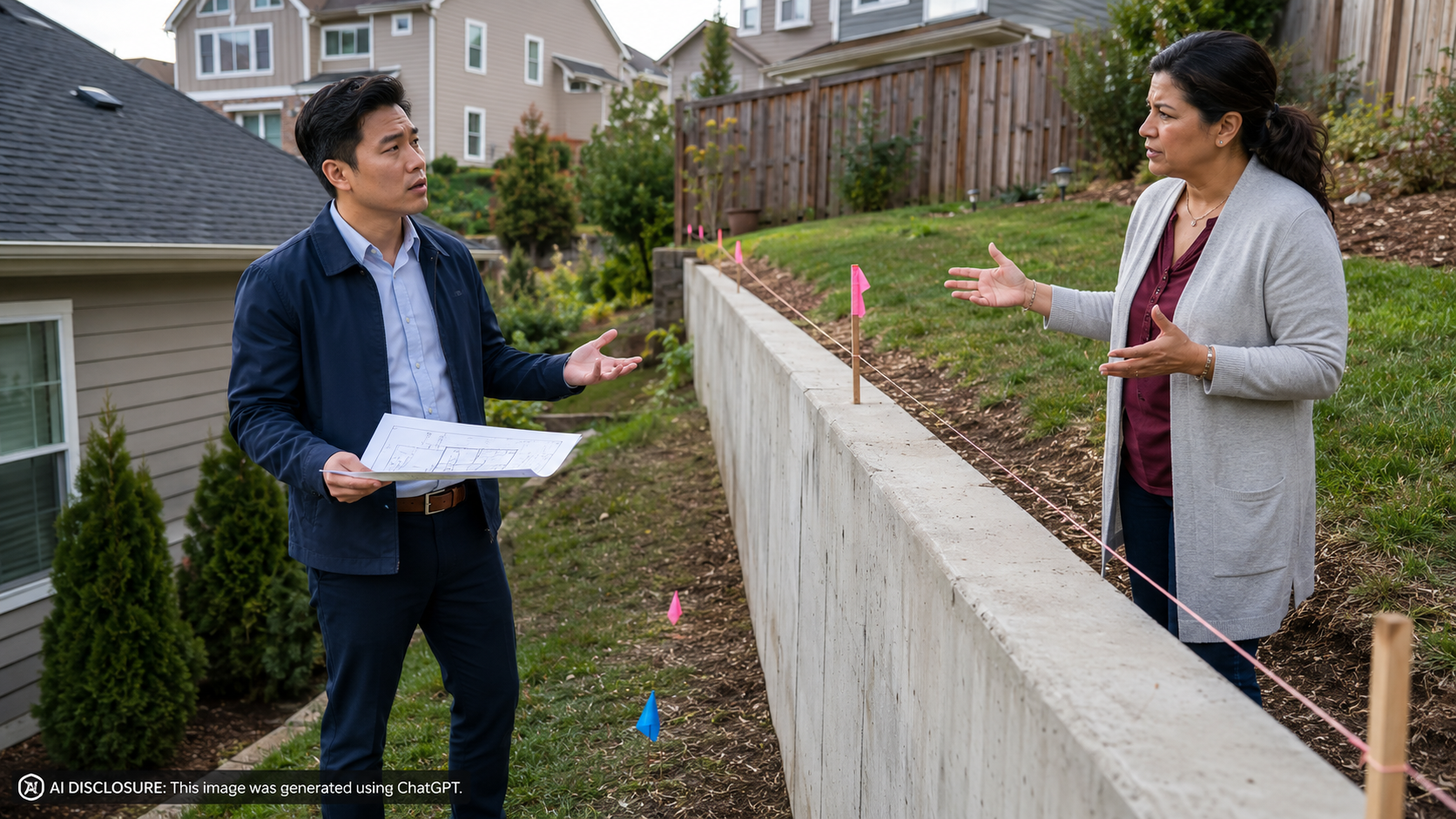
The day you close on a sloped lot, you’re not thinking about concrete geometry. You’re thinking about drainage, mowing, and whether the backyard will ever feel level. But for one homeowner, the post-purchase reality came down to a hard line—literally—when a survey revealed the retaining wall along the boundary wasn’t sitting where everyone assumed it was.
In the discussion, the homeowner explains that a long retaining wall was built by the original builder back in 2006. They bought the home years later, as the second owner, in 2015. After a recent survey, they learned a portion of that wall—about 32 square feet—extends into the neighbor’s yard.
A survey turned a “shared boundary” into a measured problem
Retaining walls on a property line can feel like neutral territory. They’re often treated like fences: there’s the line, and there’s the thing that sits on it, and everyone quietly agrees it’s just “between” the two homes.
That illusion holds until someone pays for a survey. In this case, the survey didn’t just clarify the boundary; it put numbers to the overlap. A measurable section of wall was no longer “between properties.” It was on the wrong side of the line.
And because the lot is sloped, the wall isn’t cosmetic. It’s a structural element that affects soil, runoff, and stability. That’s why the neighbor’s reaction matters: if the wall is framed as protecting both properties, it starts sounding less like “your wall, my wall” and more like “our wall,” whether the paperwork says so or not.
The homeowner’s logic: “I didn’t build it, and I only own what’s inside my line”
The homeowner’s argument is straightforward and, emotionally, it’s hard not to relate to it. They didn’t pour the concrete. They didn’t authorize the work. They didn’t change anything after buying the place. The wall was already there when they purchased the home.
They also point to a basic real estate principle: you can only buy what’s within the legal property line. In their mind, that means they acquired whatever portion of the wall lies within their boundary, and not the part outside it. No improvements were made during their ownership, so they feel the wall’s location isn’t something they “did.”
The big question they’re wrestling with is the kind that can haunt a future sale: if they list the house, do they need to disclose the retaining wall issue? Their instinct is that disclosures are for problems you caused—or at least problems you knew about and failed to address. And they’re trying to draw a bright line between “encroachment I did” and “existing condition that came with the property.”
When the neighbor calls it “shared,” it stops being a simple boundary dispute
The neighbor’s stance adds pressure in a specific way. If the wall protects both properties, the neighbor can argue it functions like a common improvement—even if it wasn’t formally agreed to as one.
That’s where a lot of homeowner-to-homeowner disputes get sticky: one side talks about legal boundaries, and the other talks about practical reality. A retaining wall isn’t like a shed that can be moved in a weekend. If it’s holding back soil, its placement affects who benefits, who bears risk, and who feels exposed if anything shifts or fails.
Even if the homeowner is right that they didn’t “encroach” in the everyday sense, the physical overlap exists. And the overlap can become a bargaining chip. A neighbor can push for written recognition of shared responsibility, shared access, or even future maintenance obligations—especially if the wall ever cracks, leans, or causes drainage trouble.
The sale anxiety: disclosures, financing, and the “surprise survey” problem
The homeowner’s worry isn’t theoretical. It’s the kind of issue that can pop up at the worst possible time: when a buyer’s lender, title company, or home inspector starts asking questions. Surveys have a way of turning neighborly assumptions into closing delays.
From a seller’s perspective, the fear is simple: if you don’t disclose something you know, and it later causes a dispute, you can end up accused of hiding the ball. On the other hand, if you disclose it bluntly without context, you might scare off buyers who hear “encroachment” and imagine a lawsuit waiting to happen.
This is also where the “I only bought what’s inside my line” logic can collide with reality. A future buyer may not care who built the wall; they’ll care whether they’re inheriting a boundary fight, whether they can replace the wall if it fails, and whether the neighbor will demand a legal agreement. Even the phrase “32 square feet” can stick in someone’s head like a warning label.
How homeowners reacted: document first, talk later
When property-line structures come up, the most common practical advice from experienced homeowners is to slow down and get everything in writing. The point isn’t to escalate—it’s to prevent a casual conversation from turning into “but you said…” months later when money is on the line.
People also tend to focus on the paper trail: the survey, purchase records, any plats or boundary descriptions, and anything showing the wall existed long before the current owner. A retaining wall built in 2006 and purchased by a second owner in 2015 is exactly the kind of timeline that makes neighbors argue about “who’s responsible” versus “who’s stuck with it.”
And then there’s the quiet, practical fear behind all of it: if a neighbor can get a wall treated as shared, does that also mean they might ask for shared maintenance, shared repair costs, or a formal agreement recorded against the property? Homeowners who have been through easement and fence battles often urge: don’t sign anything on the spot, and don’t accept a new “shared structure” label without understanding what it obligates you to do later.
A wall can sit still for years—until someone tries to move forward
The hard part about these boundary problems is how long they can stay dormant. The wall was built in 2006. It stood through at least one sale. The homeowner lived with it for years. Nothing changed—until the survey made the overlap undeniable.
Now the homeowner is staring down a future listing with a new piece of knowledge they can’t un-know. They want to be able to say, truthfully, that they didn’t cause the wall’s placement and didn’t alter it during ownership. But they’re also realizing that real estate doesn’t run on fairness alone—it runs on disclosure forms, buyer confidence, and whether a neighbor decides to cooperate or complicate the sale.
On sloped land, concrete isn’t just concrete. It’s leverage. And once a neighbor starts demanding a retaining wall be treated as shared, the next conversation usually isn’t about the past—it’s about who controls the future.
Like Fix It Homestead’s content? Be sure to follow us.