New Landowner Finds the Neighbor’s Leach Field Running Under a Third of the Two-Acre Property — Then the Neighbor Says Relocating It Isn’t Their Responsibility
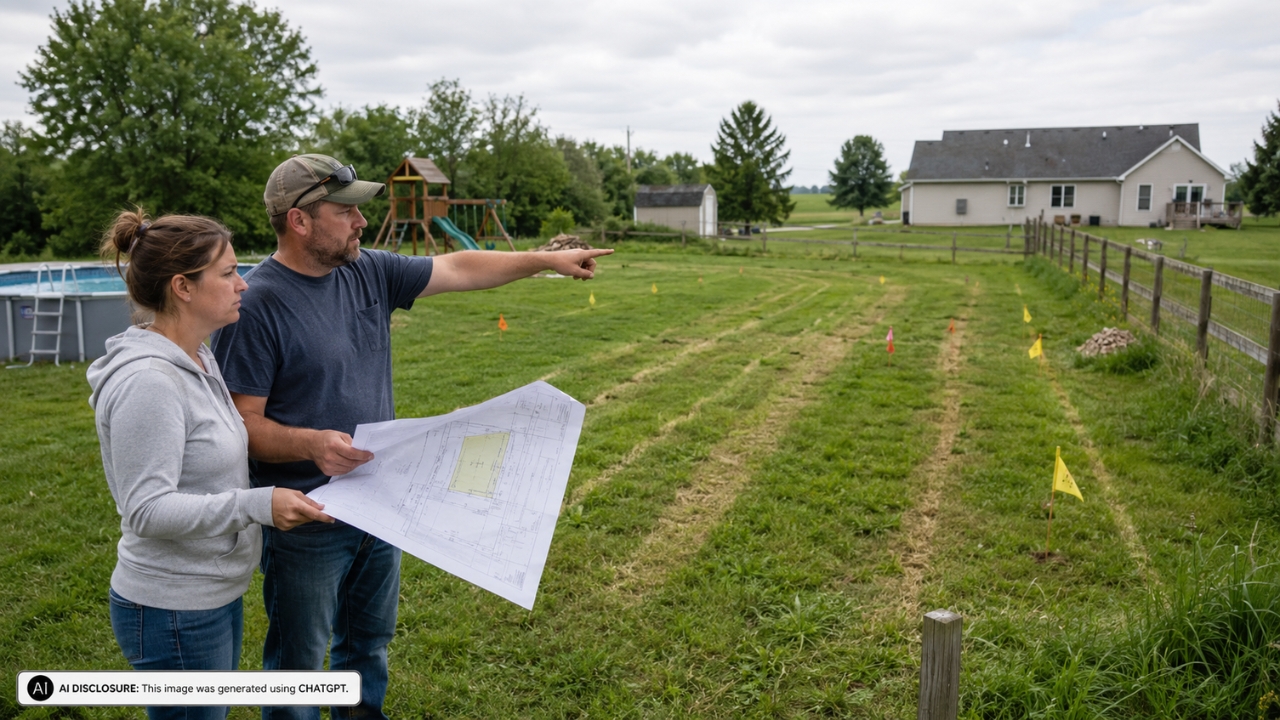
Photo credit: AI-generated image created using ChatGPT. Illustrative only.
It started like a normal “new-to-you property” project: a couple of big backyard upgrades, a few trees, an above-ground pool, and a playground. But when an Idaho homeowner and her husband did the responsible thing—pulling county records to map out their own septic tank and well—they found something that instantly froze the whole plan.
Buried on the public plans was a surprise: the neighbor’s leach field wasn’t just close. It was almost entirely in their backyard. The homeowner laid out the details in the original post, and the numbers are the kind that make your stomach drop if you’ve ever tried to plan around septic setbacks.
They went looking for their own septic lines—and found someone else’s
The couple called the county office to get the plans for their yard, trying to be exact about where their own septic tank and well were located before putting in anything permanent. That’s when the layout stopped being about “where can we place the pool?” and turned into “why is that system on our land?”
According to the records they pulled, all but four feet of the neighbor’s leach field sits on their two-acre property. The leach field spans roughly 84 feet into their backyard, and the end of it is just 10 feet from their house.
The neighbor’s septic tank itself is just on the other side of the fence on the neighbor’s property. In other words: the tank is “theirs,” but the part that spreads wastewater into the ground—the land-hungry part—is basically “yours.”
Backyard dreams meet septic math
If you’ve ever worked around wells and septic systems, you know the land can feel big until it suddenly doesn’t. This homeowner now has three major constraints all competing for the same space: their well, their septic setup, and a neighbor’s leach field running through their yard.
They weren’t trying to squeeze in a whole subdivision of improvements—just the normal stuff families do when they finally have some land. But between required separation distances and the plain reality of not wanting to dig, sink posts, or plant deep-rooted trees over a drain field, their usable backyard started shrinking fast.
And it’s not only about convenience. A leach field ending 10 feet from a house feels uncomfortably close, even if it’s technically functioning. It’s the kind of thing that can change how you think about your own property line, your landscaping choices, and your long-term plans.
The timeline makes it even messier
The history matters here, and the homeowner included key dates. The neighbor’s house was built in 2001. The neighbor originally built it for their son, but later, the son sold it and moved away after the family farm went out of business.
The homeowner’s parcel came later. The neighbor’s property was subdivided, and the homeowner’s place was built in 2009. The couple bought it in 2019—years after everything was already in the ground.
That’s where the tension sharpens. If the leach field has been sitting there since the land was split, was there some agreement nobody mentioned? Was there an easement recorded somewhere? Or was this a quiet “we’ll put it here and deal with it later” decision that never got corrected when the lots changed hands?
The homeowner’s gut feeling is that she didn’t sign an easement—because she didn’t even know the leach field existed on her land. And now that she does know, she’s stuck with the uncomfortable question: who is supposed to fix this?
Neighbor relations: the part no one wants to break
The homeowner didn’t come in looking for a fight. She said she feels bad and hates conflict with neighbors. That’s relatable—especially in rural or semi-rural areas, where you might see the same people for decades and you don’t want the vibe poisoned over a property issue.
But the problem is hard to ignore. The leach field being there isn’t just a line on paper. It’s a system that controls what they can build, where they can dig, and potentially how they manage their own water and septic footprint.
And even if the leach field is working perfectly today, it won’t last forever. If something fails later, the homeowner could be looking at equipment in her yard, disturbed soil, contractors needing access, and a dispute that arrives at the worst possible time—when sewage is involved and everyone is stressed.
What people pushed: proof first, feelings later
Even without a pile of comments included in the source material, the homeowner’s own actions point to the first practical move most experienced homeowners recommend in boundary disputes: document everything before you talk yourself into a corner. She already pulled the county plans for both properties, noting they were public record. That’s a big start.
From there, the predictable next step in these kinds of property-line headaches is getting the “paper” and the “ground” to match. Plans can be wrong, fences can be wrong, and old assumptions can get baked into a neighborhood without anybody realizing it. When an underground system is involved, being certain about what’s where matters more than winning an argument.
There’s also a reason people tend to urge calm, written communication in issues like this. If you go in hot, it turns into a personal war. If you go in organized—with records, dates, and a clear explanation of how it affects your ability to use your land—it stays closer to a fixable property problem.
And the homeowner is already thinking along those lines: should she ask them to move it? That question alone hints at the tug-of-war between what feels fair, what’s legally allowed, and what’s practically possible.
A leach field isn’t a garden hose—you don’t just “shift it over”
Relocating a leach field is a big deal. It’s not moving a shed or adjusting a fence line a foot. It’s permitting, soil considerations, setbacks, and a new design—plus excavation that can chew up a yard. Even when everyone agrees, it’s disruptive.
That’s why the neighbor saying it isn’t their responsibility—if that’s how it plays out—lands like a slap. From a homeowner’s perspective, it feels obvious: it’s your septic system, so why is it on my land? From the neighbor’s perspective, they may be thinking: it’s been there for years, it was approved at the time, and we didn’t create this mess.
Meanwhile, the couple who just wanted to plant trees and put in a pool is staring at the county drawings and realizing a third of a two-acre property can effectively become “off limits” when you factor in wells, septic, and someone else’s drain field.
The hardest part is that this isn’t a cosmetic surprise you can live with. It changes how you use the land every day, and it raises the kind of long-term anxiety that doesn’t go away. When a hidden infrastructure problem finally shows itself, you don’t just unsee it—you either resolve it, or you plan your entire homestead around it.