Rural Landowner Learns the Property Line Actually Sits Forty-Six Feet Past Their Dog Fence — Then Discovers the Neighbor’s New Septic Tank May Be Entirely on Their Land
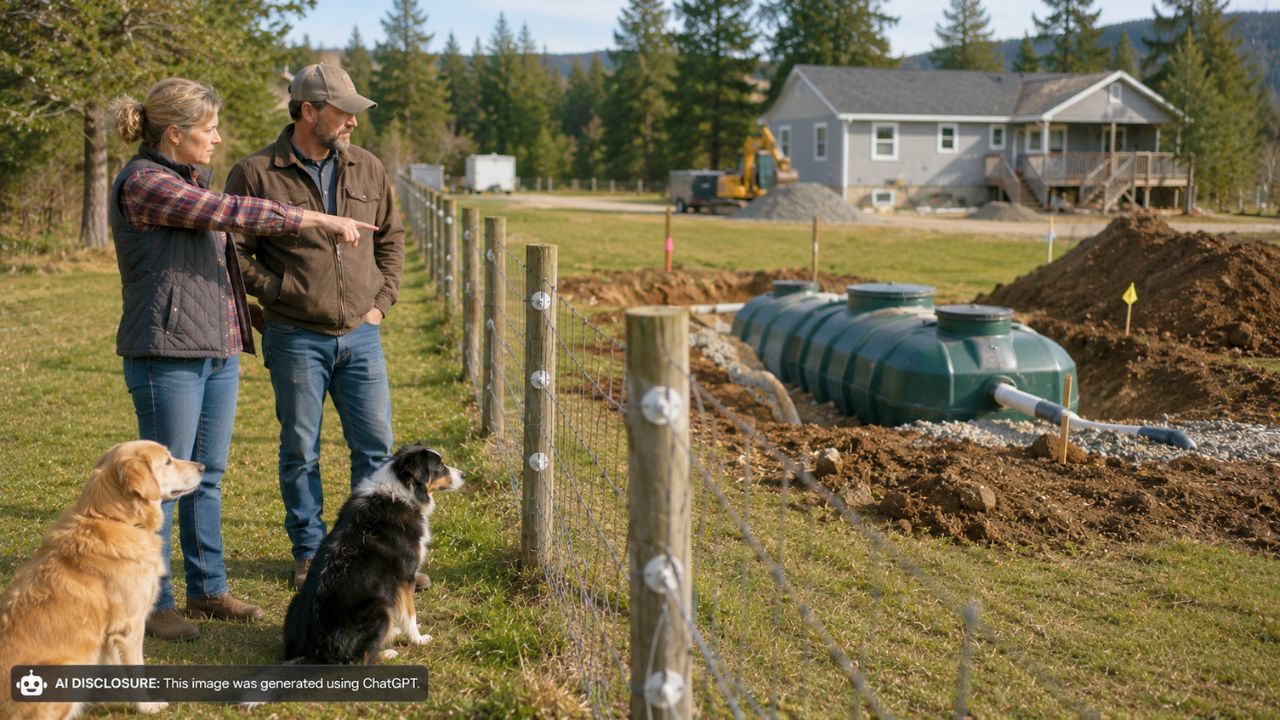
Photo credit: AI-generated image created using ChatGPT. Illustrative only.
Six years ago, a rural Washington homeowner did what a lot of people do when they move onto land with no nearby neighbors: they put up a simple dog fence. It wasn’t meant to mark anything official—just a practical barrier to keep the dogs away from the road when the ground got too rocky to dig any farther out.
Then new neighbors bought the five acres next door, started building, and the “just a dog fence” placement quietly turned into something much bigger. In the source post, the homeowner in Stevens County says they’ve now been told their true property line may sit about 46 feet past that fence—putting the neighbor’s newly installed septic tank potentially halfway, or even entirely, on their land.
A fence built for dogs suddenly looks like a boundary
The homeowner says they built the fence early on, back when they “had no neighbors at the time.” The placement was dictated by the terrain, not the deed: too rocky to work farther out by hand, so the fence went where it could.
Later, when the adjacent parcel sold, the homeowner’s father-in-law (who lives on the property) tried to head off future confusion. He warned the new owners the fence wasn’t the property line—just a barrier for the dogs.
That warning matters, because once a fence sits in place long enough, people start treating it like the edge of the world. Mowing patterns follow it. Animals get penned against it. And, apparently, septic plans can end up drawn as if that fence is a legal border.
The septic went in close—and then the line moved
The homeowner describes watching the neighbor build their septic “really close.” The father-in-law “threw a fit,” then, for the sake of peace, let it go.
It might have stayed an annoying-but-manageable neighbor choice if not for what happened next: a different neighbor—on the other side of the property in question—pointed out that the property line may actually run about 46 feet beyond the fence.
That’s not a couple of feet of wiggle room. On rural lots, 46 feet can swallow a driveway, a shed pad, or a whole section of “their yard.” In this case, it could swallow a septic tank. The homeowner’s gut math was immediate: if the line is really that far past the fence, then the septic tank isn’t just close. It may be on the wrong side entirely.
The stakes aren’t just paperwork—septic is expensive and permanent
A septic system isn’t like a leaning fence panel you can shove back into place. Once it’s installed, it becomes an underground commitment: the tank location, drainfield layout, setbacks, access for pumping, and the permit trail (if there is one) all lock that area into a specific use.
If a tank or drainfield sits on someone else’s property, it can cloud both properties. It can complicate selling. It can complicate financing. It can trigger disputes over access when the system needs maintenance. And if there’s ever a failure or leak, the question of “whose land is it on” gets ugly fast.
The homeowner is trying not to light the fuse before they know what’s real. Their plan is to hire a surveyor first, and then talk to a real estate attorney depending on what the survey shows. The tone is less revenge and more overwhelm: “I’m really in over my head. What happens in these type of situations?”
Then came the pig pen by the creek—and complaints downstream
As if the septic question wasn’t enough, the homeowner says there’s a second problem: the neighbors built a pig pen right next to a creek.
Now, people “down the way” have contaminated water. The homeowner says they do too “technically,” though they draw drinking water from a well, not the creek. Even so, living next to a waterway means you don’t get to ignore what runs past your property line—because it doesn’t stop there.
The homeowner has heard there may be a rule requiring animal pens to be at least 200 feet from the creek. They’re hoping for a civil conversation, but they’re also asking the practical question a lot of rural homeowners eventually have to ask: if the neighbor refuses to fix it, where do you report something like that?
What makes this mess feel especially homestead-real is the order of operations. The homeowner isn’t planning to march over and accuse anyone of building a septic tank on stolen land. They want to do “a little leg work” first: schedule the survey, gather facts, and only then bring up the water contamination and mention the survey appointment. The septic issue, they say, stays unspoken until they know for sure.
People urged proof first, not a showdown
Even without a long thread of comments included in the source material, the homeowner’s instincts line up with the most common, practical advice these disputes tend to draw: get hard evidence before the first confrontation.
A survey is the difference between “I heard the line is over there” and “here is where the corners actually are.” In rural areas—especially with old pins, informal fences, and rolling terrain—property lines can surprise everyone. Having a surveyor mark it turns rumors into a map you can act on.
The homeowner is also smart to separate issues instead of mixing them into one explosive neighbor talk. Septic placement and livestock runoff are each serious on their own. Combined, they can feel like an attack, even if the facts are on your side.
And in the background is a quiet detail that matters: the father-in-law already warned the neighbors the fence wasn’t the property line. That may not solve anything by itself, but it changes the tone. This wasn’t a secret. It wasn’t a trap. The neighbors were told up front that the fence was for dogs, not deeds.
The next steps could decide how livable the neighborhood stays
This is the kind of rural neighbor conflict that can either get handled cleanly—survey, discussion, correction—or harden into years of cold shoulders and “no trespassing” signs.
If the survey confirms the line sits 46 feet past the fence, the homeowner may be forced into decisions they didn’t want: whether to demand the septic be moved, whether to negotiate an easement, and how to protect themselves from future liability tied to a system they don’t own. If the survey shows the septic is fine, at least the anxiety ends and the conversation can shift to the creek-side pig pen and water quality.
Either way, the dog fence is no longer just a dog fence. It’s become the landmark everyone built their assumptions around—and now it’s dragging buried infrastructure and dirty water into the open. In a place where people move for space and quiet, that’s the kind of surprise that can change how “home” feels overnight.
Like Fix It Homestead’s content? Be sure to follow us.