Homeowner Asks the Neighbor to Remove a Repaved Driveway Several Feet Onto Their Land — Then Police Say the Neighbor’s Only Response Was “They Can Take Us to Court”
Photo credit: AI-generated image created using ChatGPT. Illustrative only.
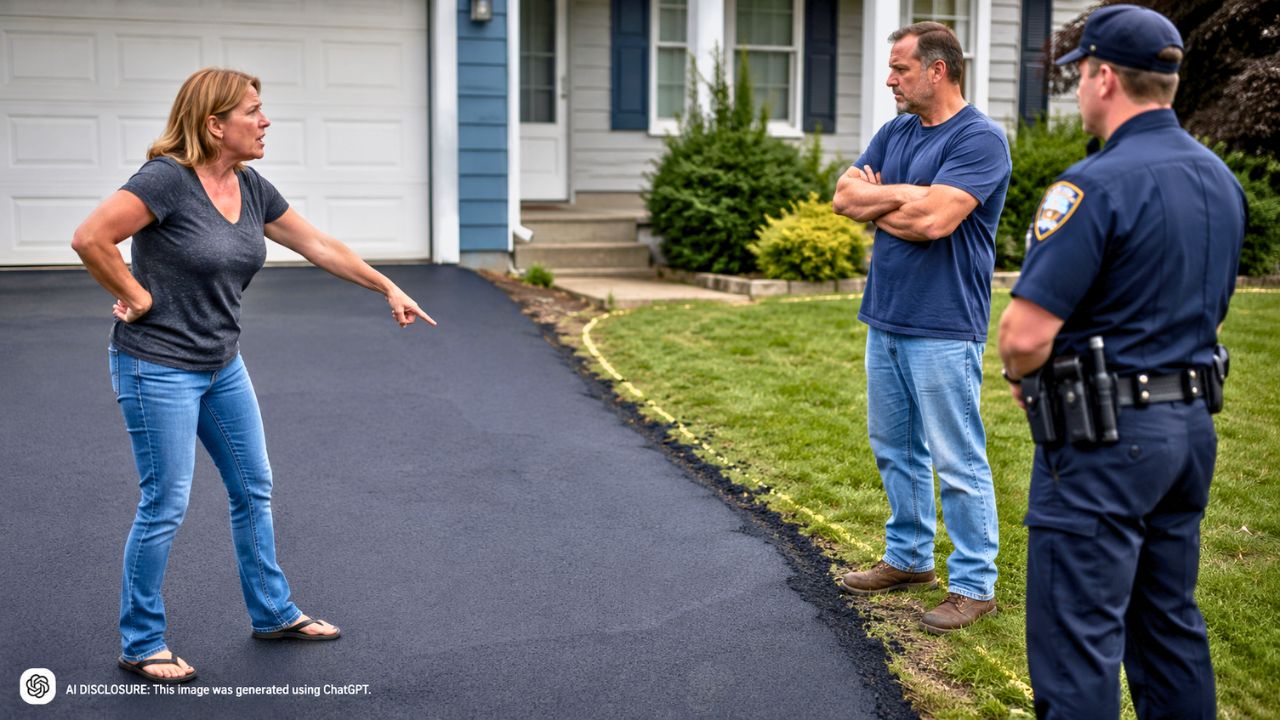
It started the way a lot of boundary problems do: a neighbor upgrades something, and you only notice the “upgrade” came with a little extra land once it’s set in asphalt. In Massachusetts, one homeowner says their neighbors repaved their driveway shortly after moving in, widening the end of it to make the climb to their house less steep and less curved.
The homeowner’s gut told them the new shape didn’t match the property line, so they paid for a survey. The survey confirmed it—the neighbor’s driveway extended onto their land by several feet. The homeowner laid out the details in the original post, and the frustration comes through loud and clear: they asked for the driveway to be removed about a year ago, and nothing happened.
The first repave quietly changed the property line problem
Driveways have a way of becoming “permanent” in everyone’s mind, even when they’re not. A strip of pavement turns into a habit: where cars always pull in, where guests always step, where snow gets pushed, where deliveries roll.
In this case, the homeowner says the neighbors didn’t just resurface what was there—they made the end of it larger. That expansion mattered, because it allegedly pushed the paved area several feet onto someone else’s parcel.
Rather than guess, the homeowner hired a surveyor. That detail is important in any property-line dispute because it turns a suspicion into a document. And the survey, according to the homeowner, backed them up.
A year of asking turned into a year of nothing changing
Once the survey confirmed the encroachment, the homeowner says they asked the neighbors to remove the portion of driveway that sat on their land. They didn’t describe screaming matches or threats—just that the request was made, and the neighbors never followed through.
Meanwhile, other neighbor-to-neighbor problems piled up. The homeowner claims the neighbors drained their pool into the homeowner’s yard, blew snow off their driveway onto the homeowner’s garage roof, and were “overall rude.”
None of those things are as clean-cut as a property line on a survey, but together they create a familiar kind of tension: the feeling that one household keeps treating the other property as a dumping ground—water, snow, and now asphalt.
Then the markers disappeared again under fresh asphalt
The moment that pushed this from simmering to boiling was the second repaving. The homeowner says that after they’d already raised the issue, the neighbors had the driveway repaved again—this time covering up the land marker again.
That’s the kind of thing that feels personal even if it’s not intended that way. To one person it’s “we’re just resurfacing our driveway.” To the other, it’s “you’re paving over the proof.”
At that point, the homeowner called the police. Not because the police can redraw a boundary line, but because from the homeowner’s view, someone had just improved and reinforced a structure that sits on land they don’t own.
The response that made the homeowner feel stuck
When police spoke to the neighbor, the homeowner says the neighbor’s response was blunt: “that’s how the driveway was when we got here, they can take us to court if they want.”
That single line changes the temperature. It’s not an apology. It’s not “let’s look at your survey.” It’s a dare, and it shifts everything into a money-and-time equation—because court is expensive, slow, and draining even when you’re right.
It also left the homeowner with a very practical question that a lot of people quietly wonder about: if the pavement is on my land, can I just remove it? The homeowner asked whether it would be legal to use a backhoe and tear out the portion of driveway that crosses onto their property, or whether they’d need to go to court first.
Why “just ripping it out” can go sideways fast
The homeowner’s backhoe idea is the kind of thing people say when they’ve hit their limit—because it sounds simple. Remove what’s on your land, problem solved.
But driveway encroachments aren’t like moving a trash can back over the line. Pavement removal is loud, destructive, and easy to mis-measure in the moment. If you remove too much, damage something underneath, or cut into what later gets argued as shared access, you can end up trading one dispute for several.
There’s also the real-life angle: if the neighbors are already the type to drain water onto your yard and blow snow onto your roof, they may not respond calmly to heavy equipment tearing into what they consider “their” driveway. Even if the survey is clear, escalation can show up as new drainage problems, blocked access, or retaliatory complaints.
And then there’s the long-term land issue hanging over all of it. A driveway that sits in the wrong place for long enough can become a bigger headache than a one-time trespass, especially if someone later tries to claim rights to keep using that strip. That’s why this kind of encroachment tends to pull homeowners toward paperwork, formal notices, and attorneys instead of improvising with machinery.
What people tend to push in responses: paper trails, not backhoes
The homeowner didn’t paste in comment threads, but the pattern for these disputes is predictable: people urge documentation and formal steps before anyone touches a shovel. A survey is step one, and the homeowner already has that.
From there, the typical advice leans toward keeping everything in writing—requests to remove the encroachment, copies of the survey, dates of repaving, and photos showing the driveway’s footprint and any covered markers. If the problem later becomes a legal boundary fight, the winner is often the person who can show a clear timeline, not the person who can rent the biggest equipment.
People also tend to suggest avoiding self-help demolition because it can create new liabilities. Even when a structure is on your land, tearing it out without a court order can turn into an argument about damages, access, and intent. The neighbor’s “take us to court” line might be bluster, but it’s also a hint they’re prepared to dig in.
The homeowner is left in the spot a lot of property owners dread: they did the responsible thing by paying for a survey and asking politely, and the response they got was essentially, “prove it the hard way.”
For now, the driveway is still there—wider than before, freshly repaved, and, according to the homeowner, still several feet onto land that isn’t the neighbor’s. The real fix may not be concrete work at all. It may be patience, documentation, and the kind of official push that forces a boundary problem back onto the boundary line.
Like Fix It Homestead’s content? Be sure to follow us.