New Homeowner Installs an $11,000 Vinyl Fence — Then a Week Later the Neighbor Ties Their Own Fence Into It Without Asking, Cutting Off Direct Access to Maintain It
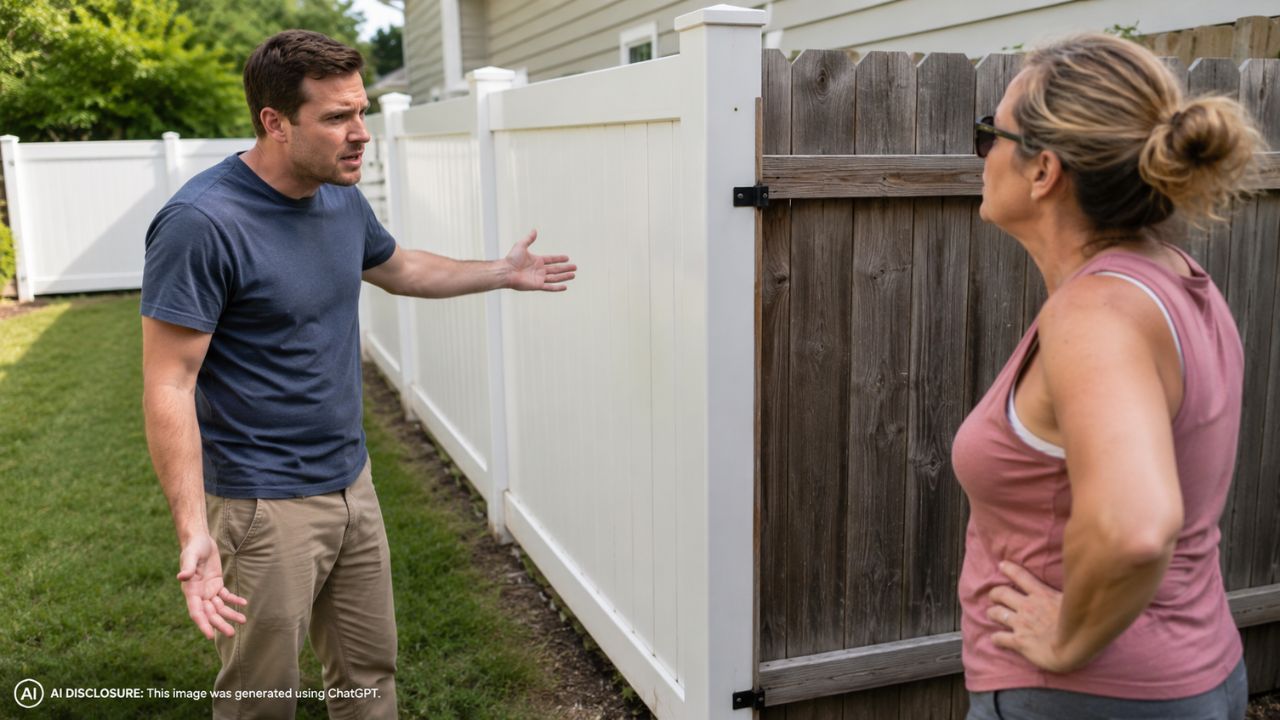
Photo credit: AI-generated image created using ChatGPT. Illustrative only.
You don’t expect your brand-new fence to turn into a shared structure before the vinyl even stops looking “fresh.” But that’s exactly what happened to one new homeowner who spent about $11,000 on a white vinyl fence—only to look out a week later and realize the neighbor had built a wooden fence that tied right into it without asking.
In the original post, the homeowner explained that their fence was installed just inside their property line. Then the neighbor fenced most of their own yard in wood, but used the vinyl fence as one side of their enclosure. Suddenly, something that was supposed to be simple—walking the perimeter to clean, inspect, and repair—turned into a gate problem.
The fence went up… and the “shared” side appeared overnight
The homeowner had just crossed a big project off the new-house list: a full vinyl fence install. It’s the kind of upgrade people plan for privacy, pets, and a clean boundary line—something you shouldn’t have to think about every day once it’s done.
But about a week later, the neighbors started building their own fence. Not entirely—just most of it. The last stretch, the convenient stretch, became the homeowner’s vinyl fence.
No conversation. No “Hey, would you mind if we connect here?” Just a wood fence built up to it and tied in, saving the neighbor money and materials while changing how the homeowner could access their own property feature.
The real problem wasn’t the money—it was access
If the vinyl fence had been on the property line, this might have turned into a classic “shared fence” disagreement. But the homeowner said theirs was inside their property line, which is where things get messy fast.
Now the only way to reach the outside face of the vinyl fence—the side facing the neighbor—was by opening the neighbor’s wooden gate and stepping into the neighbor’s yard. That’s not just awkward. It’s a maintenance trap.
Fences need occasional work: cleaning, checking posts, dealing with algae or staining, fixing loose sections, or replacing damaged panels. Even if vinyl is marketed as low-maintenance, it isn’t no-maintenance. And once a neighbor’s fence effectively blocks your access, you’re no longer in control of when and how you can take care of your own installation.
Then came the questions nobody wants to have with a neighbor
The homeowner wasn’t looking to start a feud. They even said they weren’t trying to be a “dick neighbor.” But they couldn’t ignore the obvious questions once the neighbor made the connection.
Who’s responsible if something happens on that side? If a dog jumps up and dents the vinyl? If a ball slams into it? If someone falls into it? The homeowner spelled out the scenarios because that’s how homeowners think once they’ve paid five figures for something: what can break, who breaks it, and who pays.
And those questions are tougher when you didn’t agree to share the fence in the first place. You don’t just worry about damage—you worry about being forced into an ongoing arrangement where access depends on a neighbor staying reasonable forever.
The homeowner also included a rough visual of the layout, showing how the wood fence met the vinyl. It wasn’t subtle. This wasn’t a case of “my fence happens to be there.” It was a deliberate tie-in that turned the vinyl fence into part of the neighbor’s enclosure.
Where fence tie-ins get risky in real life
This kind of move doesn’t just create social tension. It can create practical and expensive headaches.
If the neighbor relies on your fence as one side of their yard, they may treat it like theirs. That can mean things get leaned against it, climbed on, or used as a backstop. It can mean garden beds pushed up to it, sprinklers constantly wetting it, or decorations screwed into it. Even if none of that happens, you’re still stuck negotiating access to inspect it and keep it clean.
And the worst part is that the cost and hassle often land on the person who tried to do everything “right.” The homeowner paid for a fence placed inside their own line—often done specifically to avoid boundary disputes. Yet the placement didn’t prevent conflict. It just changed the shape of it.
When one side becomes functionally unreachable without permission, it’s easy to imagine how a small issue becomes a slow burn: you notice grime building up, you can’t easily rinse it off, you ask to get through the gate, the neighbor is busy, the season changes, and suddenly your expensive white vinyl looks older than it should.
Commenters pushed the same theme: document, verify, don’t assume
Even without a pile of quoted replies, the general direction from other homeowners in these situations is predictable: get clarity before emotions do. When fences and property lines get involved, people tend to urge steps that create a paper trail and reduce he-said-she-said later.
That usually means confirming where the fence sits relative to the line, keeping records of the installation, and communicating in a way that doesn’t spiral into a shouting match over the backyard. It’s not about being dramatic—it’s about making sure a “small” boundary choice doesn’t turn into a permanent, unspoken agreement.
Homeowners also tend to focus on the long game: even if the neighbor is friendly today, what happens when the house sells? What happens when renters move in? What happens when someone’s dog starts using that fence as a launching pad? Once the fences are physically connected, separating responsibilities can get confusing fast.
The update: the fencing company stepped in and changed the plan
The homeowner didn’t end the story with a standoff at the property line. They made a call.
In an update, they said they spoke with the fencing company and the company was fixing it. The plan was to rebuild it along the neighbor’s allowed fence line, which suggests the original layout and the neighbor’s tie-in created a setup that wasn’t acceptable to leave as-is.
That update is the part that will make most homeowners exhale. It’s one thing to argue with a neighbor. It’s another to have the people who installed the fence confirm there’s a straightforward way to correct it—especially while the project is still fresh and before the connected fences settle into “this is just how it is now.”
But even with the fix underway, the tension doesn’t evaporate. The homeowner still has to live next door. And once you’ve had to intervene to stop someone from treating your $11,000 fence like a free wall, you don’t forget it every time you walk into the backyard.
Like Fix It Homestead’s content? Be sure to follow us.