Utah Landowner’s Recorded Water Easement Runs Along the South Line — Then a Neighbor Drives an Excavator Through the Dead Center of the Property Instead, Leveling Thirty Trees to Fix His Own Broken Line
Photo credit: AI-generated image created using ChatGPT. Illustrative only.
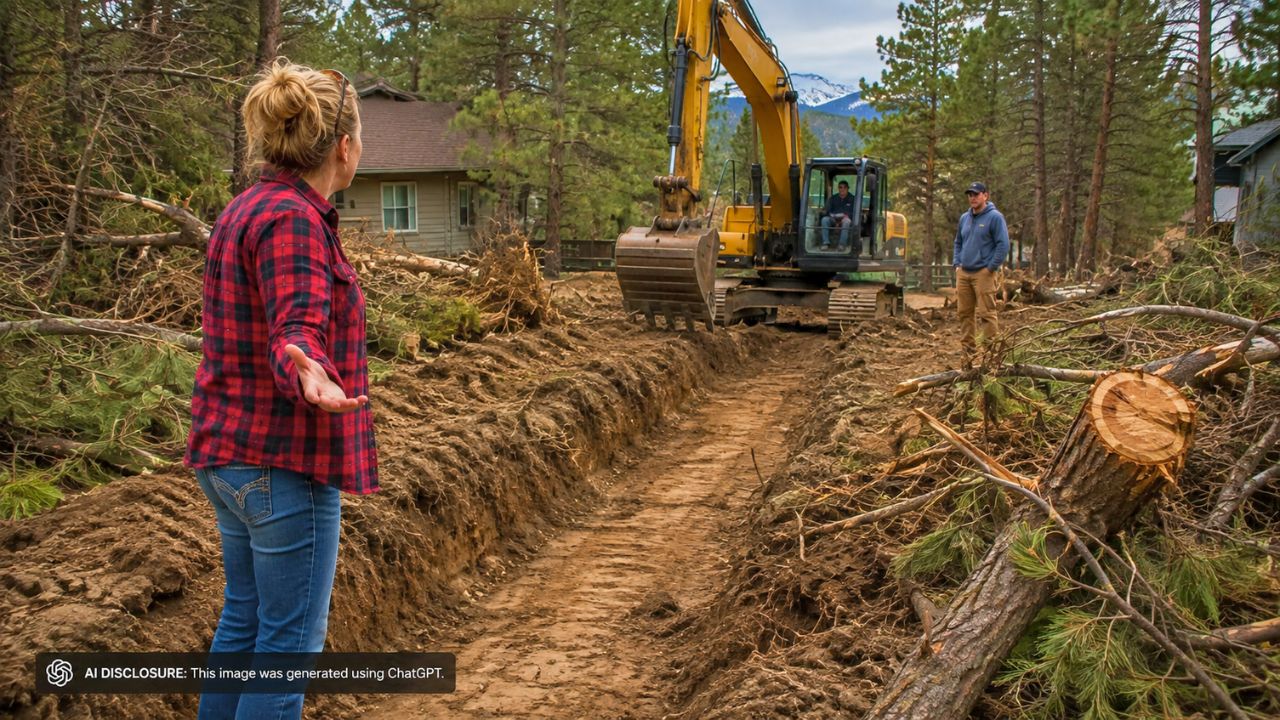
A Utah landowner thought the biggest headache on their wooded lot would be keeping track of utility lines. Instead, they woke up to the kind of “before and after” you can’t unsee: a full-size excavator had cut straight through the middle of their property, turning a dense stand of trees and underbrush into a trench route for a neighbor’s water fix.
In the original post, the owner describes a private lane lot where the water main and four lateral water lines already run on their land. There’s a recorded utility easement, but it sits along the south line of the property, running east to west. The neighbor to the north/east had a broken line—and instead of staying near the recorded easement, the neighbor allegedly drove an excavator “through the dead center” of the lot, clearing everything in its path north to south.
A wooded lot turned into a worksite overnight
This wasn’t a little hand-dug repair with a shovel and a weekend. The owner says the neighbor brought in heavy equipment and created what felt like a new roadway across the property—wide enough that the yard went from “once dense” to “a highway for a trench.”
About 30 trees and thick underbrush were leveled, according to the post. And the gut-punch wasn’t just the loss of privacy and shade. It was the permanence of it: mature trees and established growth aren’t the kind of thing you replace with a quick run to the garden center.
Even worse, the owner says there was no conversation first—no request, no notice, no “hey, my line broke, can we talk about a path.” Not even a handshake agreement over the fence. The equipment arrived, the route got carved, and the damage was already done.
The paperwork said one thing, the excavator did another
The detail that made the story feel especially raw is how clear the owner believed the boundaries were. They say the recorded utility easement is along the south property line. That’s the corridor that’s supposed to handle water infrastructure access.
But the neighbor’s trench wasn’t along the south line. The owner says it cut directly through the center of the property and ran north-south, which reads less like “we had no other choice” and more like “this was the easiest way to get equipment in and a new line out.”
The owner also says the neighbor didn’t even put the new line where the previous line had been when the homes were built in the late 1970s. That matters because it suggests the neighbor wasn’t simply repairing an existing, known pathway. From the landowner’s perspective, it looked like a brand-new route chosen for convenience—on someone else’s land.
The neighbor’s defense: ‘prescriptive’ and ‘necessary’ easements
After the fact, the neighbor claimed they had the right to do it anyway, citing a prescriptive easement and an easement by necessity. Those are legal concepts, but they aren’t magic words that automatically justify driving heavy machinery across someone’s yard.
What’s striking is that the owner says their title report didn’t show documentation supporting the neighbor’s claimed right. The only easement they point to is the recorded utility easement along the south line. So now the homeowner is stuck in that terrible spot: the physical landscape has already been changed, and the argument becomes about what rights existed on paper versus what was done in dirt.
And the emotional part is plain in the wording. The owner says they feel “completely violated” and “devastated.” That’s not just frustration over a broken sprinkler line or some tire ruts. It’s the feeling of coming home to a place you deliberately kept wooded—only to find it stripped because someone else needed a repair.
The damage wasn’t just aesthetic—it changed how the property functions
A trench cut through the middle of a lot isn’t only a visual scar. It can change drainage patterns, invite erosion, and create long-term maintenance issues that don’t show up until the next hard rain or spring thaw.
Tree loss has practical consequences too. Trees block wind, stabilize soil, and provide shade that can keep a property cooler and calmer. Removing “thick underbrush” can also change how water moves across the ground and how visible the home is from the lane and neighboring lots.
Then there’s the awkward reality of a new utility line placed where it’s “most convenient” for the person installing it. If that line ever needs service again, does the neighbor assume they can bring equipment back the same way? Does the trench route become the new normal? That’s the kind of question that keeps people awake, because it’s not just about what happened once—it’s about what happens next time something breaks.
People zeroed in on proof: boundaries, records, and what happened when
Even without a full comment thread included in the source material, you can feel the direction these discussions usually go when property lines and utility access collide: document everything before the story gets rewritten.
When a neighbor claims rights like a prescriptive easement, the details matter—how long something existed, whether it was openly used, whether the owner permitted it, and whether the path was consistent over time. The owner is already thinking in those terms, pointing out that their title report shows no documentation and that the recorded easement is elsewhere.
And because the neighbor’s work allegedly involved heavy equipment and major clearing, the “proof” isn’t subtle. The trench path, the stumps, the disturbed soil—those are physical facts that can be photographed, measured, and compared to the recorded easement description.
This is also where homeowners tend to realize that the best time to clarify easements and access routes is before a problem breaks. But water lines don’t schedule failures. They fail on holidays, weekends, and the exact moment someone gets tired of low pressure and decides the fastest fix is the only fix that matters.
A broken water line turned into a neighbor war nobody asked for
At the core, this wasn’t a dispute about whether the neighbor deserved water service. It was about how far someone can go on another person’s land when they’re in a rush to repair their own problem.
The homeowner says the neighbor isn’t willing to replace any of the destroyed trees and brush “if it could.” That refusal pours salt in the wound, because it signals the neighbor doesn’t see the clearing as a loss they caused—or a loss they need to make right.
Now the owner is left with a wrecked wooded corridor, a newly installed water line that may or may not be where it’s allowed to be, and the lingering fear that the next “emergency repair” will come with the same attitude. The question they ended on—“What do I do?”—captures the feeling of being cornered: the dirt has been moved, the trees are gone, and the property line suddenly doesn’t feel like it protects much unless someone forces it to.
Like Fix It Homestead’s content? Be sure to follow us.