Landowner Finds a Fenced-In Cemetery of Less Than Half an Acre Inside His Fourteen-Acre Plat — Then the Boundary Reaches the Kentucky Court of Appeals
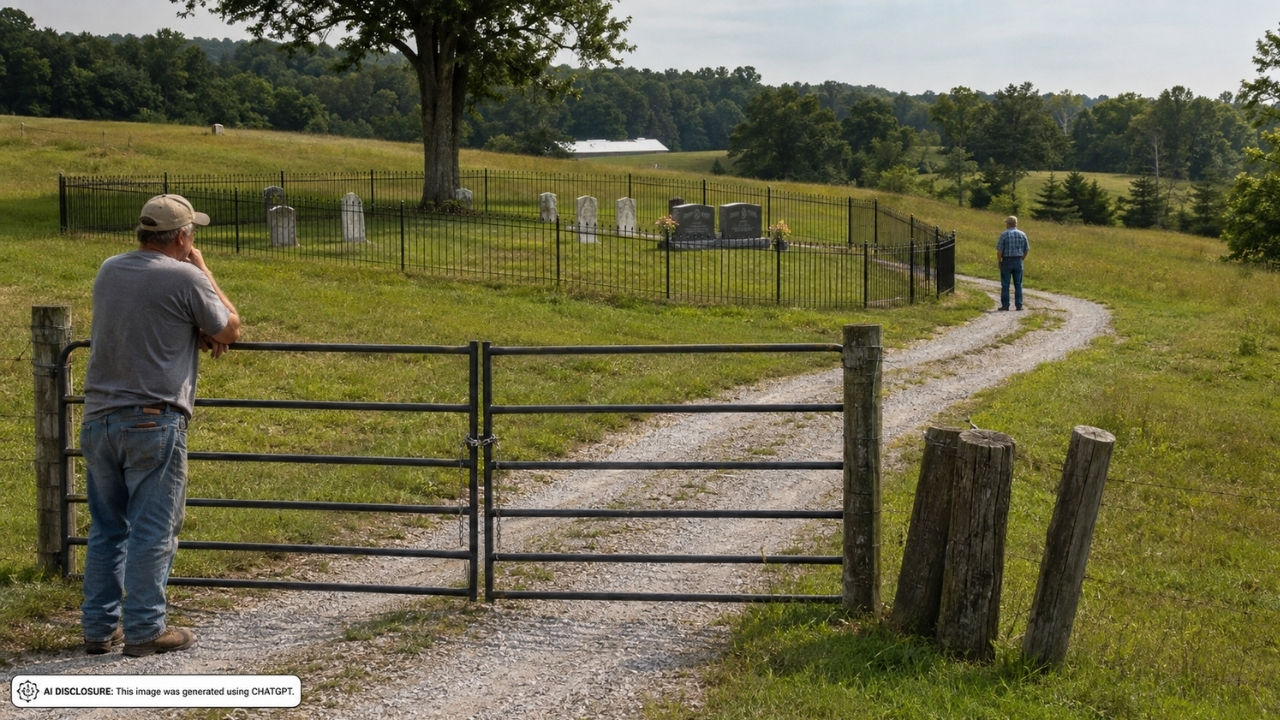
Photo credit: AI-generated image created using ChatGPT. Illustrative only.
Buying rural land can feel like freedom—until you realize part of your “new” property comes with other people’s history, routines, and expectations. In Jackson County, Kentucky, one family bought a 14-acre tract and found an enclosed, fenced-in family cemetery sitting inside it, with a gravel access road leading out to a state road.
What happened next—locked gates, “call ahead” rules, and even obstacles placed near the entrance—ended up in the Kentucky Court of Appeals. The case is laid out in the source post, and it reads like the kind of property-line nightmare people warn you about, except the “line” runs around a burial ground that’s been used for more than a century.
They didn’t just “discover” it—the deed flagged it
Dana, Alyssia, and Kimberly Maddox bought the property in March 2023. On the land sat the Brumagen/Abrams/Hayes Cemetery, with burials going back to at least 1912 and continuing as recently as 2022.
This wasn’t a rumor or a half-forgotten corner of woods. The cemetery was fenced, and the survey attached to the deed showed it as less than half an acre, plus a gravel road connecting the cemetery out to KY-1955.
Even the deed language wasn’t subtle. The conveyance was explicitly “subject to that Cemetery, and the access road thereto,” a phrase that usually reads like a warning label to anyone who’s ever dealt with easements, shared drives, or old rights-of-way.
The gate went up, and the rules got strict fast
Soon after the purchase, the Maddoxes installed a locked gate across the cemetery access road and refused to give Bernie Brumagen a key. They posted a sign requiring 48 hours’ notice to access the cemetery, and it even stated the cemetery would be closed for a period in June 2023.
If you’ve ever lived out in the country, you know the instinct: put up a gate, control traffic, protect what you just paid for. But a cemetery isn’t a deer stand or a private fishing pond. People don’t just “visit” a cemetery—they maintain it, grieve there, and in this case, still bury family members there.
The Brumagen family sued, asking the court to remove the restrictions so they could visit and maintain graves, use the cemetery road, and keep the option open for future burials. That last part is where this stopped being a simple access dispute and turned into something heavier.
Then came the physical barriers—posts, logs, and rebar
The trial court ordered the Maddoxes to give Brumagen a key. But the fight didn’t cool off. The Brumagens later complained the Maddoxes placed wooden posts, logs, and rebar around the cemetery entrance.
That’s the kind of escalation rural property owners recognize instantly: you may technically be “allowed” in, but practically you can’t get equipment through. According to the case summary, the obstacles made it difficult to bring in things like a riding mower, a trailer, larger vehicles, and potentially even a hearse.
The Maddoxes defended themselves by saying they were protecting private property. They also argued that prior owners allowing burials didn’t bind new owners forever, and they took the position that the Brumagens’ ancestors had lost title to the cemetery property years earlier through a tax foreclosure.
In other words: we own it all now, and there’s no deeded burial plot and no recorded easement granting you the right to keep using it.
The court treated the cemetery like its own kind of “right”
The Kentucky Court of Appeals didn’t treat this like an ordinary driveway easement dispute. Kentucky doesn’t have a lot of statutory law controlling burial rights in private family cemeteries, so the court relied on long-standing Kentucky common law.
Under that common law, a buyer who purchases land containing a known family cemetery doesn’t get unrestricted control over that burial ground the same way they control the rest of the tract. The court recognized that a family cemetery can create an easement or burial privilege in favor of descendants—even without a modern written easement.
That doesn’t necessarily mean the descendants “own” the cemetery in fee simple. But it can mean they hold enforceable rights to do the normal cemetery things: visit, maintain, and—when the circumstances support it—continue family burials within the established cemetery boundaries.
The facts here were unusually strong. This was an active, identified family cemetery with many known relatives buried there and burials continuing into modern times. Bernie Brumagen had his own name on one side of a double headstone, with his wife (who died in 2017) on the other side. And there had been a burial as recently as 2022.
The Court of Appeals held that the undisputed evidence established the family’s common-law right to continue future burials within the existing boundaries of the cemetery.
One big detail: the appeals court didn’t settle who “owns” the cemetery
The trial court had interpreted the deed’s “subject to the cemetery and the access road” language as essentially excepting or reserving that cemetery and road from the conveyance to the Maddoxes.
But the Court of Appeals didn’t actually decide who holds fee title to the cemetery itself. It said that ultimate title question wasn’t necessary to resolve the dispute in front of it.
What did matter was practical: the deed language did not transfer to the Maddoxes a right to interfere with the Brumagens’ lawful use of the cemetery and the access road. The injunction stood, and it had teeth.
The Maddoxes were permanently prohibited from interfering with cemetery use. The Brumagens and their heirs and successors were allowed to conduct burials, interments, visitation, services, family gatherings, and maintenance within the cemetery boundary. The Maddoxes also could not erect barriers along the cemetery boundary or the access road.
The real-world pressure didn’t stop while the case crawled through court, either. The record described emergency requests for burial access during the litigation, including one in 2024 involving Tyler Wayne Dunnaway and another after Ricky Brumagen died in April 2025.
How people reacted: “This is why you read every line before closing”
When homeowners hear a story like this, the reactions usually split into two camps. One side sees a locked gate and thinks: I get it—new owners, liability fears, privacy, and the constant worry that “access” slowly turns into “everyone can come whenever they want.”
The other side sees the fence, the headstones, the recent burials, and the deed language and thinks: this was never going to be a normal part of your 14 acres. It came with obligations, whether you liked them or not.
And if you’ve dealt with easements, shared lanes, or inherited “handshake agreements,” you can almost feel where it went sideways. Once access becomes permission-based—48-hour notice, a locked gate, and talk of closing dates—it stops feeling like a right and starts feeling like someone else is managing your family’s graves.
The Court of Appeals decision wasn’t unanimous. Chief Judge Thompson dissented, disagreeing that Kentucky common law creates a perpetual right to future burials based on historical use. But the majority ruled that, on these facts, the descendants’ rights survived the sale.
For the landowners, it means the cemetery inside their fence line isn’t just an odd feature—it’s a living boundary with living consequences. And for the family with relatives buried there, it means the road stays usable, the gate can’t become a choke point, and the small fenced patch on someone else’s 14 acres remains, legally and practically, a place they’re still allowed to return to.
Like Fix It Homestead’s content? Be sure to follow us.