Landowner Wins a Permit for Storage Units and a Vehicle Service Garage on Under an Acre — Then the Zoning Fight Reaches the Appellate Division
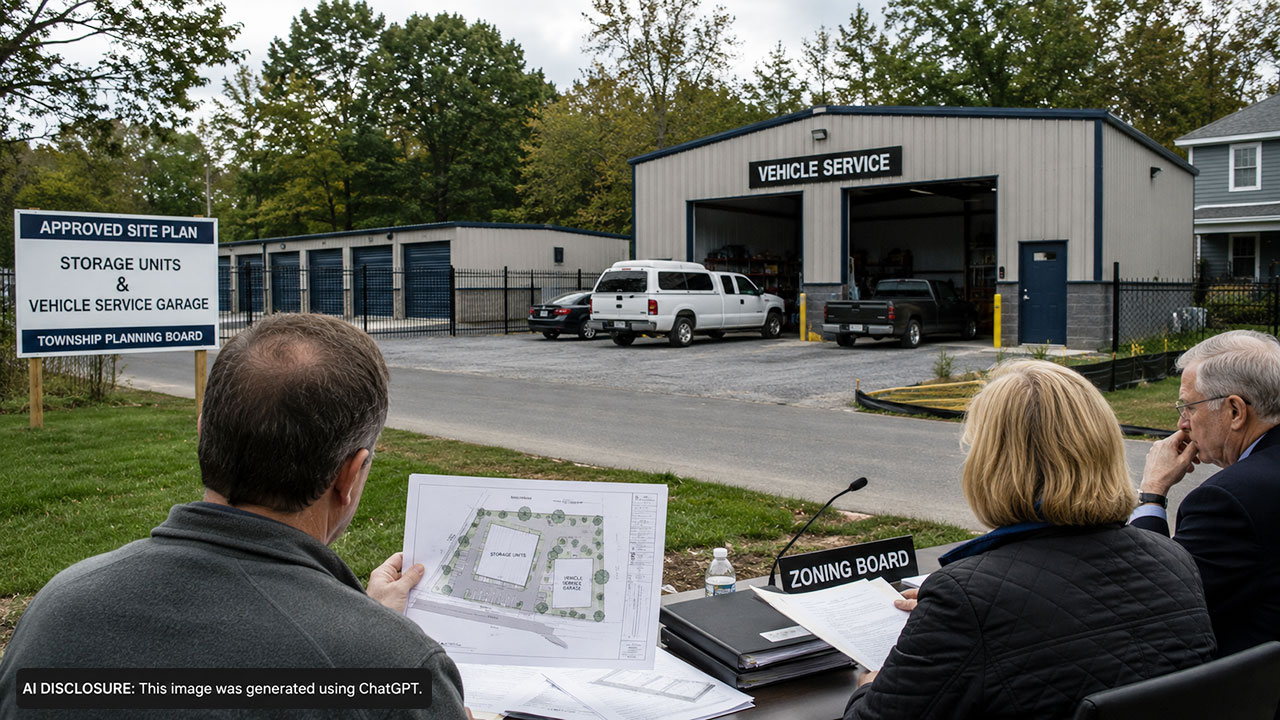
Photo credit: AI-generated image created using ChatGPT. Illustrative only
On paper, it looked like the kind of small-lot hustle you see everywhere: a 0.95-acre parcel, a special-use permit, and a plan to run storage units alongside a vehicle-service garage. Then a second shipping container showed up on the land, and suddenly the “just one more thing” decision turned into a full-blown zoning war that made it all the way to an appellate court.
The details come out in the court’s decision, where judges sided with the Town of Floyd Zoning Board of Appeals after the landowner tried to keep a second container and build a barn that would wrap around both of them.
It started with a permit win on a tiny piece of land
Jeffrey Kotary owned a 0.95-acre parcel in the Town of Floyd, New York. In 2019 he got a special-use permit for what he wanted to do there: storage units plus a vehicle-maintenance/service garage.
That’s already a lot of activity for under an acre, which is exactly why permits, setbacks, and “what counts as a structure” become such a big deal. When everything is tight, every foot matters, and neighbors (and town boards) tend to watch closely.
At first, Kotary also got zoning approval to place one shipping container on the property, used as a storage unit. One container was a known quantity, reviewed and approved under the rules at the time.
Then a second container arrived—without permission
After that initial approval, Kotary bought and installed a second shipping container without seeking or receiving zoning approval. That’s the kind of move that can feel minor to an owner—drop it in, deal with paperwork later—but it’s also the kind of move that flips a project from “permitted use” to “violation” overnight.
Bad timing made it worse. Between approval of the first container and installation of the second, the town enacted a new shipping-container ordinance. The new law generally allowed containers only as accessory structures, limited them to one per acre, and prohibited shipping containers entirely on properties smaller than one acre.
Kotary’s land wasn’t one acre. It was 0.95. In zoning, that missing sliver can be the whole story.
Town officials told him the first container was lawful, but the second was not. Instead of removing it, Kotary tried to engineer his way around the rule.
The “barn fix” didn’t fix it—because work started first
The workaround was to build a wooden storage building or barn that incorporated both shipping containers into the structure. If the containers weren’t “containers” anymore—if they were part of a bigger building—maybe the shipping-container restrictions wouldn’t apply the same way.
But he began constructing the barn before receiving a building permit, and the record showed no indication that a permit was ever issued. That detail mattered, because once framing starts going up, it’s harder for a town to treat the project as a clean application. It starts looking like someone building first and asking later.
When he later sought zoning approval for the barn, the zoning enforcement officer denied the application and told him he’d need variances tied to the second container. He also received a formal notice of violation because the two containers violated the ordinance.
In other words: the town didn’t just dislike the idea. It had a written rule on the books, and it said his lot size made the second container a nonstarter.
Four variances requested, one granted
Kotary went to the zoning board asking for four variances. The requests weren’t small tweaks; they were the kind that reshape how a property functions and how it looks from the road.
He wanted to exceed the maximum allowable height by five feet, reduce the setback from a state highway from 100 feet down to 70 feet, treat the second shipping container as a lawful accessory structure, and allow two containers on a property that was under an acre.
Other local bodies weighed in first. The Oneida County Planning Department reviewed the plan and recommended against it, noting the variances were substantial, appeared to result from “self-created hardships,” and that other options were available. The Town of Floyd Planning Board also recommended denial.
After a public hearing, the zoning board split the difference. It granted the five-foot height variance. It denied the other three—meaning no reduced highway setback, and no blessing for the second container or the “two containers on under an acre” problem.
For Kotary, that’s an awkward partial win. You can build higher, but the core layout still doesn’t work if the setback and container rules block the structure you started.
The appellate court focused on one damaging fact: he created the bind
Kotary took the denials to court, asking a judge to overturn them. But the appellate court emphasized how zoning decisions are reviewed: the question usually isn’t “would we have done it differently?” It’s whether the zoning board had a rational basis and considered the proper factors.
Those factors include the balance between benefit to the owner and potential harm to the neighborhood, whether the variance changes the character of the area, whether there’s another feasible way to accomplish the goal, how substantial the variance is, environmental or physical impacts, and whether the hardship is self-created.
The court concluded the zoning board did consider those factors and acted rationally. The fact that stuck was simple and brutal: Kotary installed the second container after the town had already enacted the ordinance prohibiting it. Then he began barn construction before approvals were in place.
The court said the need for variances tied to the second container was “almost entirely self-created.” And it didn’t help that there was an obvious alternative: build a barn without incorporating the shipping containers into it, which could eliminate at least some of the variance needs.
To the board—and the court—the barn plan looked less like an unavoidable hardship and more like an attempt to sidestep a container ordinance after a violation had already happened. The appellate division unanimously upheld the denial of the three variances and dismissed Kotary’s petition.
The practical homeowner takeaway people zeroed in on
In homeowner circles, this is the kind of story that sparks the same reaction every time: document first, build second. When someone installs a structure without approval and then tries to redesign the entire project around that unapproved piece, it’s easy for a town board to dig in.
People also tend to focus on the “0.95-acre problem.” Zoning doesn’t care that you’re close. If the ordinance says one per acre and none under one acre, being short by 0.05 isn’t a rounding error—it’s a bright line.
And once a notice of violation is in play, every next step gets interpreted through that lens. Even a creative solution can get treated as a workaround rather than a good-faith plan, especially if construction started before permits were issued.
In the end, Kotary kept the one victory—the five-foot height variance—but the town didn’t have to give him the reduced setback or legalize the second container just because it was already sitting there and he tried to build around it. On a small parcel, the margin for “I’ll fix it later” can be thinner than the property line itself.
Like Fix It Homestead’s content? Be sure to follow us.