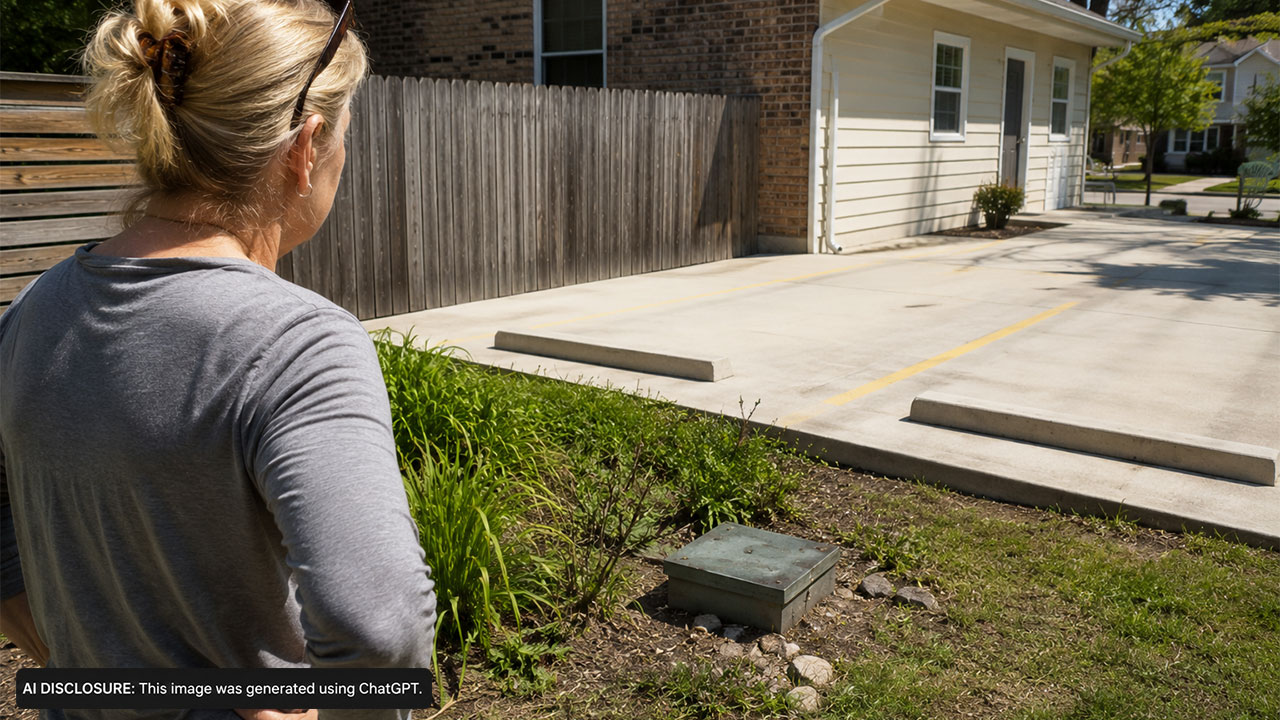
Homeowner Finds the Neighbor’s Concrete Parking Lot Sitting on Her Underground Utility Easement — Then the Court Rules Equity Bars Her From Using the Easement
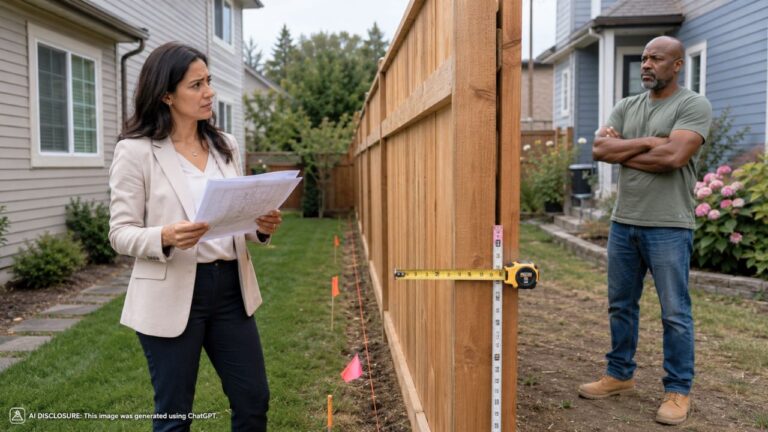
Photo credit: AI-generated image created using ChatGPT. Illustrative only
Owning a place that sits behind someone else’s property is one thing. Trying to bring basic utilities back to life when the only obvious path crosses your neighbor’s freshly poured concrete is another.
That’s the bind Ellen Rubel found herself in after inheriting a home in Lawrence County, Ohio. She believed an old utility easement gave her the right to run gas and water lines straight across the front parcel—right under a new parking lot her neighbors built for an athletic complex. The case ended up in appeals court, and the details are laid out in the discussion.
A landlocked-feeling property and a paper easement that didn’t show its work
Rubel’s parcel sits behind a 1.64-acre tract owned by Scott and Lesley Thomas. In practical terms, the Thomases’ land is between Rubel’s house and the road, which is where water and gas service would typically come from.
Decades earlier, all of it had been one larger tract. When the land was split in 1987, the deed reserved a utility right described as “the right to lay, relay, and maintain all existing utility lines as now located, October 1987” across the front parcel. There was also a separate 12-foot access right-of-way.
Here’s where it gets messy in the way property problems always do: the documents didn’t actually show where the utility lines were. A survey depicted the access route, but not the utility easement. The easement language pointed to where lines were “as now located” in 1987—yet nobody could point to a map, record, or marking that nailed down that location.
Utilities went quiet, and “temporary” turned into years
Rubel didn’t live in Ohio and typically visited only once a year or every other year. Not long after inheriting the house in 2013, she discontinued natural-gas service.
When she tried to restore gas in 2015, the utility company discovered a leak and told her the old service line would need to be replaced. Over time, the gas meter and connection line were removed because the service wasn’t being used.
By December 2015, she’d also lost water service. She learned those lines would need replacement before water could be turned back on.
That’s the kind of homeowner moment people dread: not a flashy renovation, just the basics—water and heat—turning into a big job. And when the lines run through someone else’s land, it’s not just your problem anymore.
The concrete goes in, and the “old route” becomes a fight
While Rubel was dealing with dead utilities, the Thomases started preparing their property for an athletic complex around 2017 or 2018. Before construction, their contractor contacted utility companies to check for active lines crossing the site. He was told there weren’t any.
In 2020, the Thomases poured a concrete parking lot. Three years later, in June 2023, Rubel sued.
Her claim was straightforward from a homeowner’s point of view: the parking lot was built over her utility easement, damaged the old lines, and blocked her from restoring gas and water. She wanted the court to stop the Thomases from obstructing the easement and to award money that would remove the concrete and allow replacement utility lines to be installed.
Rubel’s view was that the historic route ran essentially straight from the road to her house—meaning straight under the parking lot. The Thomases pushed back, arguing there wasn’t reliable evidence showing where those gas and water lines actually were in October 1987, which mattered because the deed tied the easement to that “as now located” language.
In court, the big issue wasn’t just the easement—it was proof
After trial, the magistrate concluded Rubel hadn’t established the exact historical location of the lines. Witnesses who tried to identify the route were leaning on assumptions more than documentation—no utility records, no maps, no clean paper trail that showed, “Here. This is where the lines ran in 1987.”
The trial court agreed. It also concluded Rubel had abandoned the easement through years of nonuse combined with other circumstances, including the gas company removing the meter and connection line and treating it as abandoned, the water meter being reassigned, and the contractor being told there were no active utilities.
But the appeals court didn’t even need to hang the outcome on abandonment. It treated the fight more like this: even if the easement still existed, did Rubel get to force the neighbors to tear up an existing improvement to accommodate the route she preferred?
That’s where equity entered the picture. A mandatory injunction—an order requiring someone to undo what they already built—isn’t automatic. Courts can weigh benefit versus hardship.
The parking lot stayed, because workable alternatives were cheaper
Rubel asked for the kind of remedy that makes neighbors stop speaking for a decade: excavate the lot, put in the lines beneath it, and repair the concrete afterward.
Her estimate for that work came in at $42,500, and roughly $20,000 of that was tied to tearing up and restoring the parking lot. And it’s easy to see why: concrete isn’t just “move it and put it back.” It’s demolition, hauling, base prep, forming, re-pour, cure time—the whole disruption.
But there were alternative routes. Rubel’s own evidence estimated about $10,750 for a gas line routed around one side of the lot and $8,500 for a water line routed around the other. Evidence from the Thomases suggested an even tighter gap—around $3,500 for a direct unobstructed run versus $3,900 to route around the parking lot.
The key point for the court was that Rubel could still obtain water and natural gas service without destroying the lot. Since the end benefit was the same—working utilities to the house—the additional cost and disruption of ripping out concrete looked disproportionate.
The court also noted there was no finding that the Thomases willfully paved over known utility lines. Their contractor had contacted utility companies and was told there were no active utilities crossing the site. That doesn’t make the dispute go away, but it mattered when the court weighed whether to order an extreme fix.
People reading it had the same reaction: “Show me the map”
Home-and-property folks tend to react to cases like this with a familiar mix of sympathy and frustration. Sympathy, because getting utilities restored can already be a nightmare without a neighbor’s construction sitting in the middle of your plan.
Frustration, because the whole thing turns on documentation that’s easy to assume exists—until you need it. The easement referenced utility lines “as now located” in 1987, but the location wasn’t drawn on the survey and couldn’t be proved later with reliable records. That missing detail was like leaving the most important page out of an instruction manual.
And once a big slab of concrete exists, the conversation changes. Even people who instinctively side with the easement holder tend to pause at the idea of forcing a teardown when the utility lines can be routed around. It’s not just principle at that point—it’s who pays, how long the property is torn up, and whether you get the same result either way.
In the end, the appeals court affirmed the judgment. Rubel still has a path to run new gas and water lines across the Thomas property as reasonably necessary—but she can’t require that the route go beneath the parking lot, and the neighbors don’t have to excavate their concrete to satisfy her preferred line.
For anyone who owns a tucked-back property, it’s a hard lesson in how quickly “we’ve always had an easement” can turn into “we can’t prove where it is,” especially when years pass, utilities get disconnected, and the land in between gets developed.
Like Fix It Homestead’s content? Be sure to follow us.