Homeowner Finds E. Coli-Contaminated Wastewater From a Dismantled Septic System on His Land — Then the Court Rules the Neighbor Holds an Easement for It
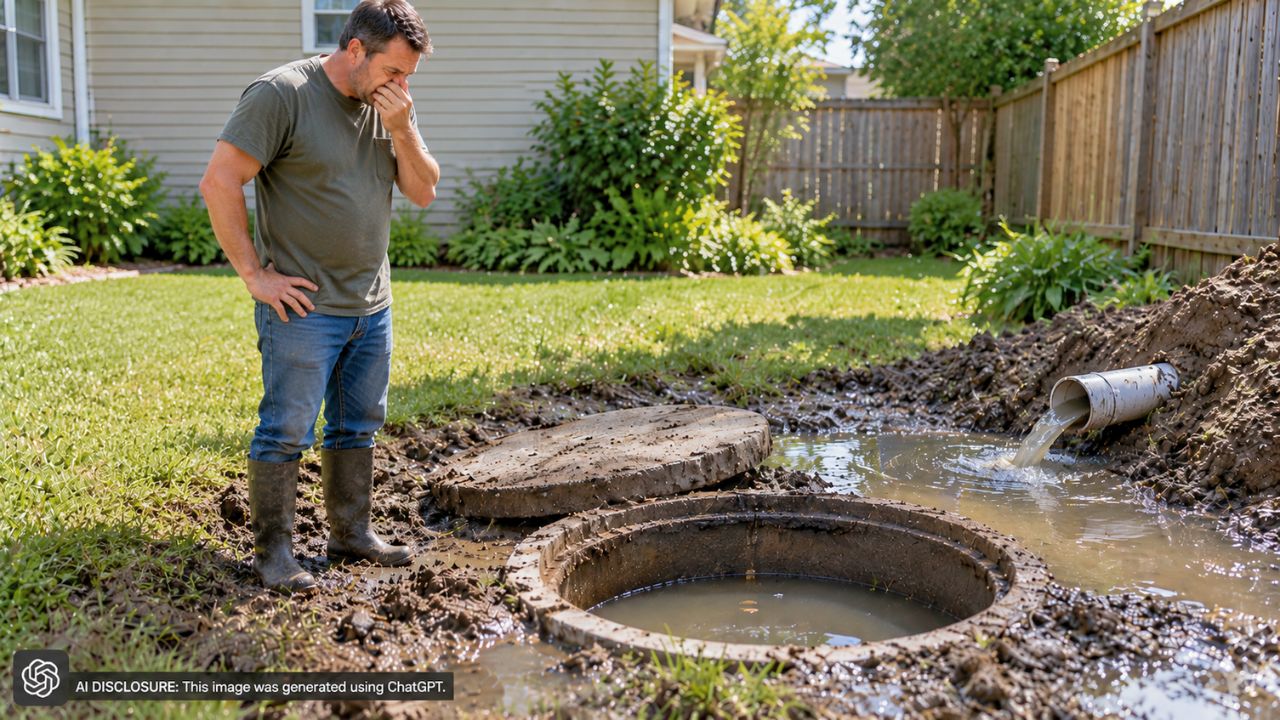
Photo credit: AI-generated image created using ChatGPT. Illustrative only
It starts the way these rural property fights often do: a homeowner digs around his own land and finds something that shouldn’t be there. In this Tennessee case, Jeffrey Heatley said he uncovered a clay pipe on his property that ran back toward his neighbor’s house—and what came next turned into years of litigation over sewage, contamination claims, and a long-forgotten septic setup that crossed a property line.
The May 29, 2025 opinion from the Tennessee Court of Appeals lays out how the dispute unfolded and why the homeowner ultimately lost the nuisance claim on summary judgment, even after alleging dangerously high E. coli readings. The decision is in the court’s published opinion, and the details read like every homesteader’s nightmare: buried infrastructure you didn’t install, a neighbor’s use you didn’t consent to, and the feeling that your soil and animals are paying the price.
The pipe that led to a problem nobody wanted to “own”
Heatley and his wife owned land next to property owned by David and Patricia Gaither. Decades earlier, both properties were part of one parcel owned by Melvin and Anna Malone. Back in the late 1960s, the Malones installed an underground sewage disposal system with two septic tanks.
When the Malones later subdivided the land, the old house ended up on what became the Gaither property—but part of the septic system ended up underneath what became the Heatley property. That’s the kind of thing nobody notices until they’re trenching, planting, grading, or chasing a drainage issue and hit a pipe.
In October 2013, the Heatleys told David Gaither they’d uncovered a clay pipe on their side. The parties discovered it connected the Gaither property to a septic tank located on the Heatley property—meaning wastewater from the neighbor’s structure had been routing through the Heatleys’ land.
Skylar House, permits, and the scramble to disconnect
After buying their property, the Gaithers renovated the old Malone house for use as a mental health adult supportive residential facility. The opinion notes that Skylar House opened in fall 2011 with approval from the Tennessee Department of Mental Health.
Once the septic connection was discovered, David Gaither had the newly found tank emptied on November 4, 2013, and applied for a permit to disconnect it. Under the supervision of the Tennessee Department of Environment and Conservation (TDEC), the septic line was permanently severed and sealed on or about February 21, 2014.
That February 2014 disconnection date becomes a key pivot point in the court record. It’s the “before and after” line for what could still be flowing, what could still be blamed on the neighbor, and what kind of proof Heatley would need to keep the case alive.
Three lawsuits later, it turned into an easement fight and a proof fight
This wasn’t a single clean lawsuit where everyone showed up with a survey and a contractor bid and hashed it out. The appeals court describes it as three related lawsuits. In the first action filed in January 2014, the Heatleys alleged sewage or wastewater was continuously leaking from the septic tank onto their property, asserting claims including negligence and trespass.
In an earlier appeal (described in this 2025 decision), the Court of Appeals held that an easement to use the septic system arose by implication from the previous common ownership. The Gaither property benefitted (dominant tenement) from using the septic system located on the Heatley property (servient tenement). The court treated it as an easement appurtenant that ran with the land—even binding the Heatleys, despite them buying without knowledge of it.
That’s the gut-punch part for homeowners reading this: you can buy a place, never be told about an underground system crossing your boundary, and still be bound by an easement the court says exists because of how the land used to be configured decades ago.
But the 2025 appeal wasn’t about trespass anymore. Heatley appealed only the dismissal of his nuisance claim against Patricia Gaither. And nuisance isn’t just “this is gross” or “this shouldn’t be here.” The court framed it around whether there was proof of a continuing wrongful condition causing substantial harm or interference with the use of property—and whether Gaither did something to cause or maintain it.
The E. coli lab results were alarming—then the court asked for the link
Heatley’s complaint described conditions no landowner wants near a barn, garden, or backyard: “sewage surfaces, pools, and flows” onto the property; “swamp like” conditions; and claims that the waste “sickened” animals and polluted soil.
The complaint also described sampling handled through Tennessee Tech’s Water Resource Center Lab. According to the allegations summarized in the opinion, the Heatleys collected water and soil samples in sanitized bottles following protocol, sealed them, iced them, and returned them the same day.
The reported result: “exceedingly high E. Coli and total Coliform colonies,” including readings listed as greater than 2,400 CFU—“off the chart,” according to the complaint’s description. Heatley even compared it to Tennessee water quality rules that quarantine recreational waters when E. coli exceeds 126 CFU.
But at summary judgment, the question wasn’t whether E. coli is dangerous (it is) or whether those numbers sound scary (they do). The question was whether Heatley produced admissible proof showing contaminated wastewater was actually leaching onto his property in a way that could be pinned on Gaither as an ongoing nuisance—especially after the line was capped and permanently closed in 2014.
The trial court found there was no admissible proof that a nuisance existed, and if it did, what was causing it and that Gaither caused it. The record included affidavits supporting that the line had been capped and permanently closed, and evidence that the Heatleys were present when it was done and said the property improved afterward. The court also noted interrogatory responses that did not identify facts or conduct by Gaither establishing unreasonable or unlawful causation of a nuisance.
The appeals court agreed: at the summary judgment stage, Heatley didn’t meet the burden to show leaching of contaminated wastewater onto his property. Without that, the nuisance claim couldn’t survive.
The part homeowners can’t unsee: an easement for something you never wanted
Even though this appeal focused on nuisance, the backstory matters because it explains why “get it off my land” wasn’t as simple as it sounds. The earlier ruling recognized an implied easement appurtenant for the septic system arising from prior common ownership. That’s a concept that shows up with old driveways, shared wells, spring houses, drainage swales—and yes, septic components.
For homestead-minded buyers, it’s a reminder that what’s underground can be legally “alive” even when it’s physically old, half-forgotten, or poorly documented. And when a property is subdivided, the paperwork doesn’t always catch up with the reality of where lines and tanks were placed decades earlier.
This case also shows how quickly “I found a pipe” turns into an argument about who has a duty to maintain, who has the right to use, and what happens after a system is supposedly disconnected. The courts treated the 2014 severing and sealing—done under TDEC supervision—as a major fact cutting against a claim of ongoing contamination from the neighbor’s use.
The reactions you hear in real life: document first, then talk
When homeowners swap stories about boundary-line utilities, the practical advice tends to sound the same: prove what exists before you accuse anyone of causing it. People talk about photos with dates, video of surfacing effluent, written lab chain-of-custody, and independent inspections that clearly identify the source and pathway of any discharge.
This opinion shows why that mindset matters. The courts weren’t deciding whether sewage is bad; they were deciding whether the plaintiffs could produce specific facts, in the summary judgment record, showing an actual ongoing leaching of contaminated wastewater onto their property and tying it to the neighbor in a way that fits nuisance law.
In other words: if the connection was capped in 2014, you may need stronger, clearer proof of what’s happening now—where it’s coming from, and why it’s still attributable to the other property—before a nuisance claim can go forward.
The ending is a kind of unresolved quiet. The homeowner alleged contamination and interference with use of his land, but the nuisance claim against Patricia Gaither didn’t survive summary judgment. For anyone living on acreage with old improvements, it’s a hard lesson: the most expensive part is often not the repair—it’s the years spent trying to prove what’s underground, who’s responsible for it, and whether the law says your neighbor still has a right to be there.
Like Fix It Homestead’s content? Be sure to follow us.
- Man Says He Found Out the Fence He Paid For Wasn’t Actually on His Property
- Woman Says Her Neighbor Started Taking Mulch From Her Delivery Pile Before She Could Even Spread It
- I made Joanna Gaines’s Friendsgiving casserole and here is what I would keep
- What Caliber Works Best for Groundhogs, Armadillos, and Other Digging Pests?