Homeowners Get a City Key to the Gate That Has Locked the Historic Monument Road for Forty Years — Then They Say It Keeps Failing
Photo credit: AI-generated image created using ChatGPT. Illustrative only
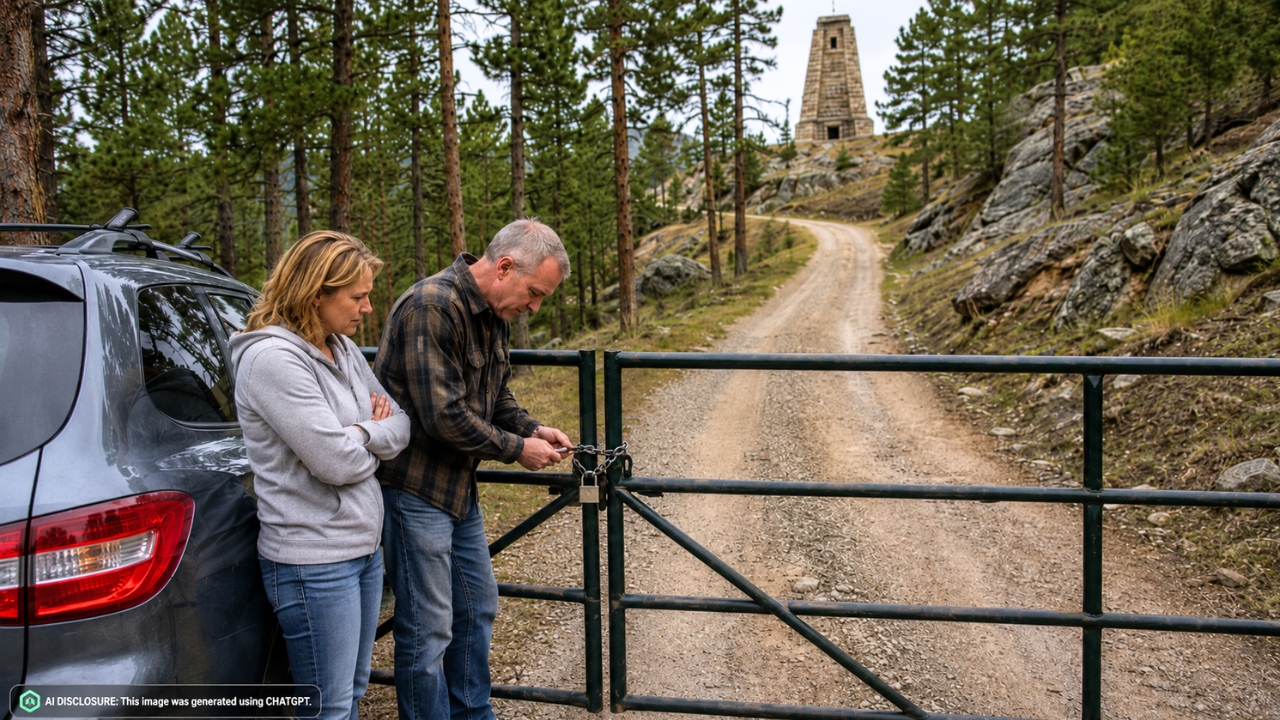
If you’ve ever lived behind a gate, you know the quiet fear: what happens when the lock decides you’re not coming home tonight? For Leslie and Karen Turgeon in Spearfish, South Dakota, that worry wasn’t hypothetical. The only way to reach their property is a narrow route tied to a historic site—and a locked gate at the north entrance that’s been there for decades.
They did have a key from the City of Spearfish. The problem, they alleged, is that the key “occasionally malfunctions,” leaving them stuck on the wrong side of their own access road. Their dispute ended up in the South Dakota Supreme Court in the source post, and it reads like a very specific kind of homeowner nightmare: a road that looks public on paper, a gate that says otherwise, and legal documents that don’t line up neatly across 70 years.
A road that exists because of a monument
The Thoen Stone Road leads to the Thoen Stone Monument, a replica marker memorializing an early 1834 gold discovery story tied to the Black Hills. The City owns the monument and the land around it, operating it as a city park. The road itself didn’t start as a normal subdivision street—it started as access.
According to the court opinion, the access was created through a 1953 easement from Frank Thomson. That easement granted the City and other parties rights to establish the historic marker and museum “for public display,” along with a “gravelled road right-of-way (25 feet wide)” and rights of ingress and egress.
That history matters because when a road begins as “a way to get to a specific place,” it can stay trapped in that identity. People treat it like a driveway, not like a public street, even if later paperwork uses words like “public right-of-way.”
The gate that turned access into permission
The gate is the practical, everyday trigger here. The northern entrance of the road is “secured by a locked gate,” and the opinion notes it has been there for at least forty years. That’s long enough that many residents would grow up assuming it’s normal—just part of how you visit the monument or drive up the hill.
The City issued keys to certain individuals, including the Turgeons, so they could access adjacent properties. But the Turgeons claimed their key did not always work properly, preventing them from unlocking the gate on occasion.
That’s the kind of problem that sounds small until you live it. Being locked out isn’t just an inconvenience; it’s deliveries that can’t reach you, emergency access anxiety, and the constant feeling that your home is downstream from someone else’s hardware choices.
Old documents, new plats, and a promise that the road “shall not be fenced”
Part of what makes this messy is that the road’s legal story is layered. In 1971, Thomson subdivided the property by plat into three lots (37A, 37B, and 37C), and he and the City signed an agreement where Thomson transferred Lot 37A to the City. Lot 37A was to be used “exclusively” as a city park tied to the Thoen Stone’s historical interest.
Here’s the line homeowners latch onto: the 1971 agreement described access by granting a “right-of-way for ingress and egress” over the existing roadway and stated it “shall be maintained by the City of Spearfish and shall not be fenced.” That phrase—“shall not be fenced”—sounds like a plain-language promise that you shouldn’t be dealing with barriers across the road.
A year later, in a 1972 warranty deed, Thomson conveyed a portion of Lot 37C (Lot 37C-2) to the City for “the use and purpose of maintaining a road” to provide access to the monument road, again with reversionary language if it stopped being used for that purpose.
Then, in 2012, things got even more pointed: property owners (including the City) filed a revised plat that dedicated Thoen Stone Road as a 70-foot “PUBLIC RIGHT-OF-WAY.” The City approved that plat, and in its certification it said the plat “was done at the City’s request for the purposes indicated hereon.”
The homeowners asked the court for one simple thing: treat it like a real public road
In 2023, the Turgeons filed a declaratory action asking the court to declare the road a public right-of-way and to order the City to remove obstructions. They also wanted an injunction prohibiting the City from placing or maintaining a gate across the road that obstructs access for them and the general public.
The City pushed back hard on the “public highway” idea. Their position, as summarized by the opinion, was that even if the 2012 plat expressly dedicated the road for public use, the dedication was never accepted by the City—neither expressly nor by implication. And without acceptance, dedication alone doesn’t finish the job under South Dakota law.
The circuit court took a split view: it found no intent to dedicate the road for public use in the older documents, but it did find the 2012 plat showed “an unequivocal dedication” as a public highway. Still, the circuit court concluded the City did not accept that dedication. Why? Because the City provided limited maintenance consistent with pedestrian access to a park, posted park hours, and “prevented unrestricted vehicular travel by means of a locked gate for over forty years.” It called the gate the “antithesis of public use.”
On appeal, the South Dakota Supreme Court said the case shouldn’t have been ended on summary judgment in the City’s favor, affirming in part and reversing in part, and sending it back for trial. Translation for normal people: the record wasn’t clean enough to declare “no acceptance” as a matter of law and walk away.
How people react when “the key fails” becomes a legal issue
Even without a comment thread attached, the reaction pattern is familiar to anyone who’s watched property-access fights play out. Once a gate and a key are involved, people stop treating access as a right and start treating it as a favor—something that can be granted, revoked, or “accidentally” broken.
Homeowners in that position typically zero in on proof: what documents say, what the plat shows, what maintenance the city has done, and whether the road has been treated like a public way in practice. In this case, the gate’s existence for forty years cuts two ways. It supports the City’s argument that access has never functioned as public vehicular travel, but it also highlights how long the barrier has shaped everyone’s expectations—especially if later paperwork says “PUBLIC RIGHT-OF-WAY.”
And then there’s the human piece: a malfunctioning key. If you’re the person stuck at the gate, that detail isn’t minor. It’s the moment the abstract debate becomes a real-world failure point—like a shared well that suddenly stops, or a private bridge that a neighbor decides to block “just for a weekend.”
The road up to a historic monument sounds quaint until you’re living at the far end of it. Then it’s not quaint at all. It’s your commute, your access for repairs and deliveries, and the one route that has to work every time—whether the lock feels like cooperating or not.
Like Fix It Homestead’s content? Be sure to follow us.