Landowner Finds Trees and Shrubs Cleared 150 Feet Past His Line — Then the Neighbor Who Hired the Crew Says There Was No Evidence Against Him
Photo credit: AI-generated image created using ChatGPT. Illustrative only
You know that sick feeling when you walk your land and something looks “too open,” like the woods got a haircut while you weren’t looking? That’s the kind of discovery that kicked off a years-long neighbor fight in Oregon—one that ended with a jury deciding the clearing wasn’t a mistake and a court letting a huge damage award stand.
In the source post, the Oregon Court of Appeals reviewed a timber-trespass case between adjoining landowners after one side said trees, shrubs, and other plants were removed roughly 150 feet past the property line during construction work next door.
The clearing didn’t stop at the “obvious” boundary
The plaintiff, Tom Butori, owned one parcel (government Lot 6). Next door was government Lot 7, owned by Bosma Enterprises, Inc., a company tied to Henry “Hank” Bosma.
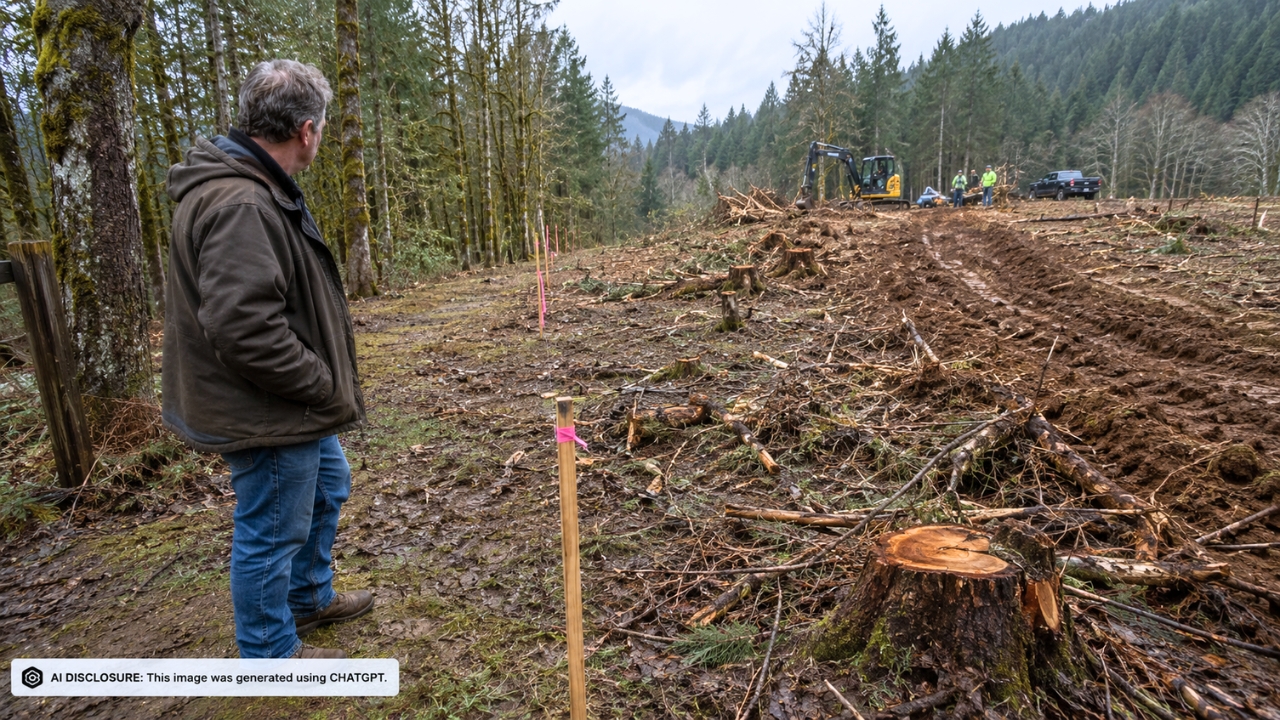
According to the court record, Butori alleged that back in 2018 Bosma hired a construction company (VB Construction, Inc.) to do work on Lot 7, and that during that work the crew crossed onto Butori’s property and cleared vegetation well beyond the line Butori believed was correct. The number that sticks out is the distance: about 150 feet past the boundary.
That’s not a couple branches leaning over a fence. That’s “we brought equipment in here” territory—exactly the kind of damage that changes drainage, privacy, wind exposure, and how a rural place feels day to day.
“No proof it was me” doesn’t land well when the work was directed
The defense approach centered on the property line itself. If the disputed area wasn’t actually Butori’s, then the clearing wasn’t trespass. That’s common in land fights: people don’t argue about what got cut until they’ve argued about whose dirt it was on.
But the jury ultimately sided with Butori on the boundary and also found the timber trespass was “willful or intentional.” Under Oregon law (ORS 105.810(1)), that finding matters because it opens the door to treble damages—triple the amount of damages assessed.
The final judgment the appeal discusses: $810,000 in treble damages. Bosma and Bosma Enterprises appealed, arguing the trial court made key errors and that there wasn’t enough evidence to pin personal liability on Bosma as an individual.
The property-line “belief” fight and the hearsay argument
A surprisingly big flashpoint on appeal was what Butori was allowed to say about how he came to believe the line was where he said it was. At trial, he started to mention what the county surveyor told him, and the defense objected on hearsay grounds.
The judge initially sustained that objection—meaning Butori couldn’t repeat the surveyor’s statements unless the surveyor testified. But then Butori’s attorney reframed the question, asking whether Butori developed his own understanding of the property line after observing markers and meeting the county surveyor, without repeating what the surveyor said.
The appeals court agreed that this reframed testimony wasn’t hearsay. The key detail: Butori testified to his own belief about where the line was, not an out-of-court statement offered for its truth. The defense argued it still “impliedly” injected hearsay. The court wasn’t persuaded.
To homeowners, this part reads like a familiar courtroom tug-of-war: one side trying to keep “and then the expert told me…” out of the jury’s ears, the other side trying to explain why they acted the way they did without crossing the evidentiary line.
The earlier settlement came back—just not for the reason you’d think
Another detail that made this mess feel personal: there had been a prior timber trespass dispute between the same parties in the same general area near the line. That earlier conflict ended in a settlement agreement.
The defense fought hard to keep that settlement out of the new trial. Their point was straightforward: if a jury hears “they paid to settle last time,” it’s natural to assume they were guilty then and probably guilty now—even if the settlement document disclaimed liability.
The trial court let the settlement agreement in for a limited purpose: not to prove liability, but to show notice and knowledge—specifically, that Bosma was on notice there was a dispute about where the boundary was. That goes directly to whether a new encroachment was careless versus willful.
The judge also required the settlement to be redacted to remove the amount paid, recognizing that the dollar figure would strengthen the unfair “they must have known they were wrong” inference. The jury got a limiting instruction: consider it only for whether defendants acted willfully or intentionally (or whether their actions were casual or involuntary), and for no other purpose. The Court of Appeals said that handling was within the trial court’s discretion.
Personal liability: the “company did it” shield only goes so far
The final argument on appeal is the one that hits closest to real life for property owners who operate through entities: Bosma argued there wasn’t enough evidence to hold him personally liable, separate from the company.
Oregon law generally protects LLC members/managers from being personally on the hook for company liabilities solely because of their role. But the court emphasized the exception regular people understand intuitively: you can still be liable for your own actions. If you personally direct or participate in the wrongful act, the business structure isn’t a magic cloak.
The appeals court pointed to trial testimony that Bosma personally made decisions about the property, hired people to perform work, and directed work. A surveyor named Wickman testified that Bosma hired him years earlier (2011) to survey Lot 7 for a topographical map related to a road near the line, and that they met onsite to discuss the boundary. Wickman said he cautioned Bosma to stay within the right-of-way, and described Bosma as “dismissive” of Wickman’s understanding of where the property line was.
That kind of testimony is exactly what juries latch onto: not just that damage happened, but that there was a warning, and the warning didn’t change the plan.
The reactions you’d expect: “survey first, clear later”
If you’ve spent any time around rural property owners, the practical reactions almost write themselves. People hear “150 feet past the line” and immediately jump to documentation—because once mature trees and shrubs are gone, you can’t un-cut them. You’re left proving what existed, where it stood, and who ordered the work.
This case also shows why neighbors push for surveys and clearly marked boundaries before heavy equipment shows up. The court record reads like a lesson in how fast “I thought it was mine” turns into “prove it,” and how prior disputes (even settled ones) can come back to establish knowledge when the same strip of land gets touched again.
In the end, the Oregon Court of Appeals affirmed the trial court across the board: no hearsay error, no improper admission of the prior settlement (given redactions and instructions), and enough evidence for a jury to consider Bosma personally responsible.
For anyone living on acreage, it’s a stark reminder: property lines don’t just live on paper. Once crews start clearing, the damage is immediate—and the argument over intent, notice, and who gave the directions can get very expensive, very fast.
Like Fix It Homestead’s content? Be sure to follow us.