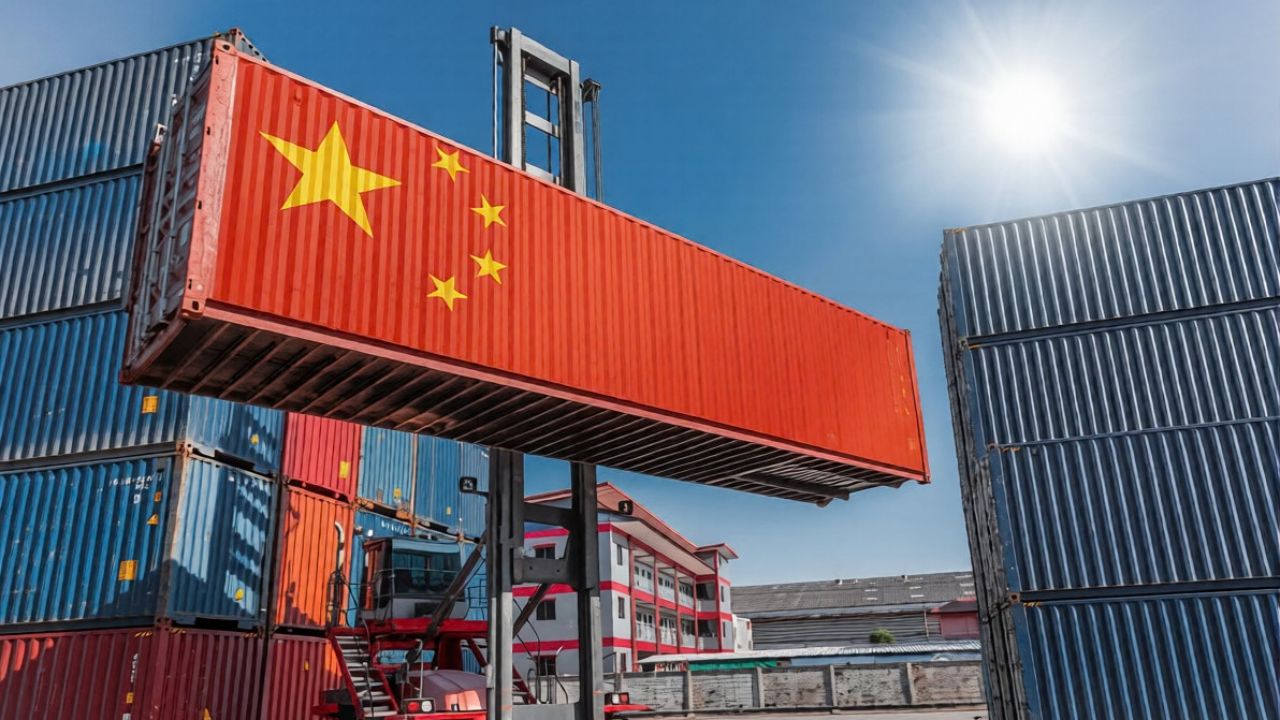
China exports surge nearly 22% despite weakening trade with the United States
China has opened 2026 with an export boom that few forecasters saw coming, lifting global trade even as its commerce with the United States weakens. Shipments abroad jumped nearly 22 percent in the first two months of the year compared with a year earlier, marking the strongest start in four years and sharpening debates over tariffs, industrial overcapacity, and the next phase of globalization.
The surge underscores how China is reorienting its trade machine away from the United States and deeper into Asia, Europe, and the Global South, even as its domestic economy shows signs of strain and global scrutiny of its manufacturing model intensifies.
Exports race ahead while overall trade swells
According to customs data, China’s exports in January and February climbed by about 21.8 percent year on year, a performance that one major outlet described as the biggest gain in four years and that another summarized as “nearly 22 per cent” growth. The combined figure reflects the way China’s General Administration of Customs typically merges data for the first two months to smooth out distortions around the Lunar New Year.
The export surge helped push overall foreign trade in goods up by 18.3 per cent in the period, with the total reaching 7.73 trillion yuan, roughly $1.12 trillion, underscoring the scale of China’s role in global commerce. That momentum left the country with a trade surplus of $213.62 billion in Jan and Feb, far above many expectations and a reminder of how much the world still buys from Chinese factories.
Behind the headline number sits a familiar mix of sectors. Electronics remain a key engine, with demand for everything from smartphones and laptops to electric vehicle components feeding order books across coastal manufacturing hubs. China’s exports of semiconductors by value soared nearly 73% in the first two months of the year, helped by higher prices and a global scramble for chips that can support artificial intelligence, cloud computing, and advanced automotive systems.
Textiles, machinery, and a wide range of manufactured goods also contributed to the upswing, reinforcing China’s status as a diversified export powerhouse rather than a single-industry story. Even with rising labor costs and supply chain diversification, the country’s dense industrial clusters and infrastructure keep production costs competitive for many global buyers.
Waning U.S. trade, rising Global South demand
The most striking feature of the latest data is not just how fast exports are growing, but where they are going. Several reports highlight that shipments to the United States have fallen sharply, with one describing “plummeting” trade with the U.S. and another noting that China Starts Year With Booming Trade, Despite U.S. Exports Drop. Tariffs linked to policies associated with Donald Trump, along with ongoing technology controls and political tensions, have clearly left a mark.
By contrast, exports to Asean, Europe and South Korea have picked up the slack. One analysis notes that exports to Asean jumped an annual 29.4 per cent in the January to February window, while shipments to Europe and South Korea also rose, highlighting how regional and transcontinental demand is cushioning the loss of some U.S. orders. Trade with ASEAN has become one of the most important stabilizers for China, tying its factories more tightly to Southeast Asian supply chains.
China’s outreach to the Global South is also visible in the numbers. A detailed review of China Starts Year With Booming Trade, Despite U.S. Exports Drop points to a surge of roughly a fifth in total trade in the first two months, driven in part by deeper engagement in emerging markets. Energy, infrastructure, and consumer goods flows between China and partners in Africa, Latin America, and the Middle East are increasingly central to its external strategy.
Within this rebalancing, semiconductors stand out as both a commercial and geopolitical flashpoint. With China’s exports of semiconductors by value up 73%, buyers in Asia and Europe are racing to secure supply, even as Washington pushes for tighter controls on cutting-edge chip technology. The boom in chip shipments reflects not just cyclical demand, but also a structural shift toward more electronics content in cars, appliances, and industrial equipment.
Trade structure and the scale of the surplus
Behind the headline growth, Trade Data show that General Trade Remains Dominant in China’s external accounts. General trade, which covers the bulk of ordinary imports and exports rather than special processing arrangements, still accounts for the largest share of flows, suggesting that the surge is not just a statistical quirk tied to re-exports or bonded zones.
China’s foreign trade in goods up 18.3 per cent YoY in Jan-Feb 2026 to 7.73 trillion yuan also reflects a mix of rising export volumes and firm prices for some commodities. While global energy and raw material prices have moderated from earlier peaks, demand for processed goods, machinery, and consumer electronics remains strong enough to keep China’s factories busy.
The trade balance grew to a surplus of $213.62 billion in the January-February period, well above some forecasts that had centered around $177.40 billion. Analysts link the strong surplus to the combination of surging exports and relatively subdued import growth, with domestic demand still lagging behind the external sector. For policymakers in Beijing, the surplus offers a cushion for growth and employment, but it also risks inflaming trade tensions with partners that see persistent imbalances as politically sensitive.
Some economists argue that the current pace of export gains is unlikely to be sustained, pointing to softer global growth and the risk that more countries will adopt U.S.-style tariffs in response to concerns about Chinese overcapacity. One detailed review of China’s export performance notes that China’s export push may face hurdles in 2026 if more nations adopt U.S.-style tariffs, driven by worries about sectors such as electric vehicles, batteries, and solar panels flooding foreign markets.
Tariffs, overcapacity, and policy uncertainty
That warning has already started to shape the debate in Washington and Brussels. Policymakers in the United States have maintained and in some areas expanded tariffs on Chinese goods, while Europe has launched investigations into subsidies and potential dumping in green technologies. The concern is that China’s industrial policy, combined with weaker domestic demand, could push a wave of underpriced exports into global markets.
Economists quoted in one assessment of the outlook say they were surprised by the scale of the January and February surge, particularly given a Reuters poll of 7.1% growth that had suggested a far more moderate start to the year. Some now expect exports to remain relatively strong through the first half of 2026, even if the growth rate cools from the initial 21.8% pace.
Others are more cautious. One analysis highlights that while the recent pace of gains is unlikely to be sustained, exports are likely to remain solid given the recent decline in U.S. trade to its lowest share of China’s total exports since 1991. In other words, the diversification away from a single dominant market could make China’s external sector more resilient, even if individual bilateral relationships become more fraught.
Inside China, the export boom also masks a more complicated domestic picture. Commentators at the Economist Intelligence Unit, cited in a detailed review of the trade data, have pointed out that headline trade strength can coexist with a slowing economy, especially when household consumption and private investment lag behind state-led infrastructure spending and property remains under pressure.
What the surge means for global supply chains
For multinational companies, the latest figures reinforce a reality that has been clear for years. Despite efforts to diversify production to countries such as Vietnam, India, and Mexico, China remains a central node in global supply chains, with deep ecosystems in electronics, machinery, textiles, and increasingly green technologies. A quick search for China’s basic economic profile underlines how large its manufacturing base is relative to most peers and why a 21.8% export jump can ripple across continents.
The concentration of trade through major ports such as Qingdao Port, which handles vast volumes of foreign trade containers, also highlights the physical infrastructure that supports China’s external reach. Even as companies shift some assembly to other countries, many still rely on Chinese components, tooling, and intermediate goods.
Like Fix It Homestead’s content? Be sure to follow us.
Here’s more from us:
- I made Joanna Gaines’s Friendsgiving casserole and here is what I would keep
- Pump Shotguns That Jam the Moment You Actually Need Them
- The First 5 Things Guests Notice About Your Living Room at Christmas
- What Caliber Works Best for Groundhogs, Armadillos, and Other Digging Pests?
- Rifles worth keeping by the back door on any rural property
*This article was developed with AI-powered tools and has been carefully reviewed by our editors.