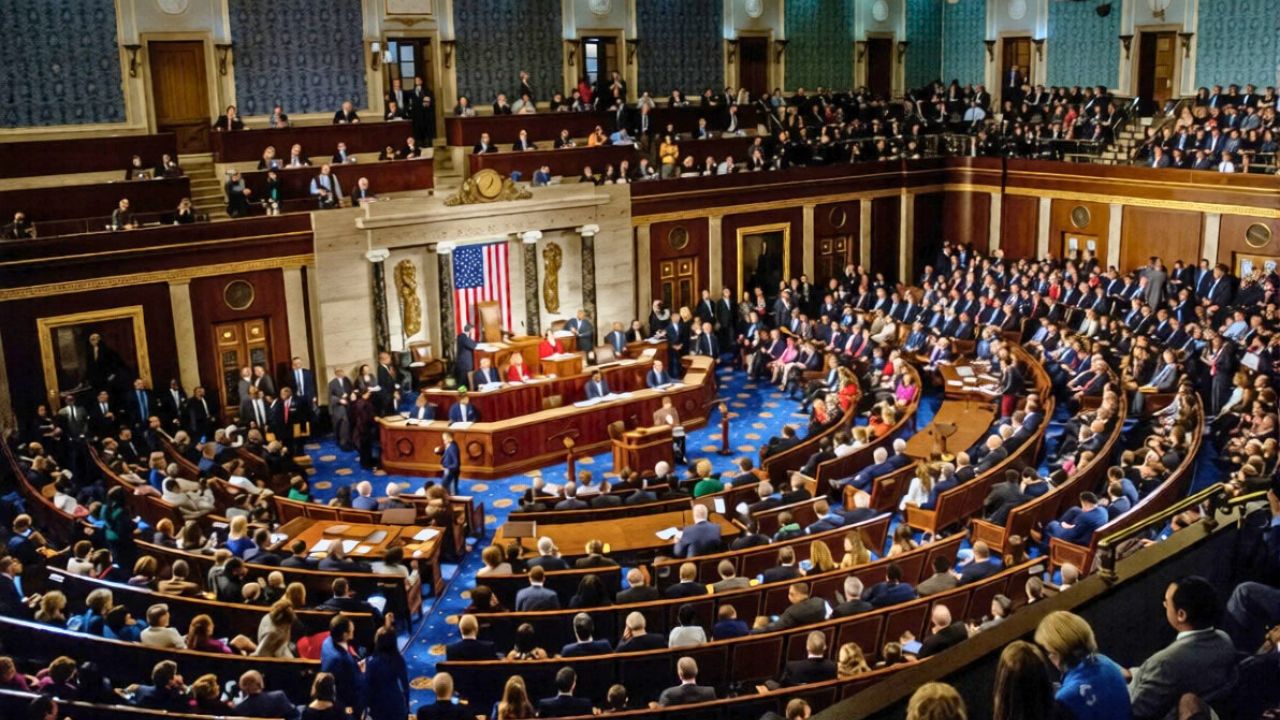
Congress debates war powers as lawmakers question U.S. strikes on Iran
Congress is once again locked in a fight over who controls the decision to go to war, this time in response to a new U.S. bombing campaign in Iran ordered by President Trump without prior authorization from lawmakers. The strikes have set off a fast-moving clash over the War Powers Resolution and the basic question of whether the White House can launch an open-ended conflict without a clear mandate from Capitol Hill.
As the operation in Iran expands, lawmakers in both parties are demanding answers about the administration’s goals, the legal basis for the attacks, and the exit strategy, while leadership scrambles to manage a series of symbolic but politically charged votes.
Strikes first, permission later
The current clash began when President Trump announced that the United States had started what he described as an “epic fury” campaign against Iranian targets, telling the Iranian people that the United States would keep bombing until their government changed course.
Video of President Trump’s address played in the White House as missiles hit Iran, even though the operation had not been approved by Congress and came without any new authorization to use military force.
Lawmakers quickly learned that the strikes were not a limited one-off action but the start of a broader effort against Iran and its military infrastructure.
Members of both parties said they saw no detailed plan for what would follow, with some warning that the United States could be pulled into a widening Middle East conflict without clear congressional backing.
War powers votes expose deep split
In response, Democrats and a small group of Republicans on Capitol Hill escalated their push to reassert Congress’s authority under the War Powers Resolution and Article I of the Constitution, which gives Congress the power to declare war.
Senator Tim Kaine, who has long argued that presidents rely too heavily on old authorizations, pressed colleagues to force a debate over whether the new Iran campaign was legal, while Senator Rand Paul joined the criticism from the Republican side, warning against another open-ended war in the region.
That pressure produced the first Iran-related war powers votes in both chambers, a test of whether Congress was willing to confront the commander in chief in the middle of an unfolding conflict.
In the Senate, Republicans blocked legislation that would have required the president to halt offensive operations, with opponents arguing that such a measure would send the wrong signal to Tehran and undermine U.S. leverage.
The vote was framed as a choice between backing the troops and restraining presidential power, and Senate Republicans ultimately voted down the effort to Halt Iran War in what became Congress’s first vote on the conflict.
On the other side of the Capitol, the House of Representatives took up its own war powers resolution aimed at reining in Trump on Iran, only to reject it in a narrow vote after hours of tense floor debate.
The House vote mirrored the Senate outcome and left the administration’s legal position intact, even as it exposed deep unease in the chamber about Trump’s strategy and the risk of a larger war.
Supporters of the measure said the House had missed a chance to put clear limits on the president, while opponents insisted that tying Trump’s hands in the middle of a fight with Iran would embolden adversaries.
Legal arguments and constitutional stakes
Behind the floor drama lies a fundamental argument about how the War Powers Resolution applies to modern conflicts and whether Trump’s Iran campaign fits within existing authorizations.
Some legal experts argue that the strikes in Iran are illegal and unconstitutional because they go far beyond the self-defense rationale presidents often cite and involve sustained offensive operations without a specific congressional mandate.
Advocates of a stricter reading of war powers point to Article I, Section 8, Clause 11 of the U.S. Constitution, which states that Congress holds the exclusive power to declare war, and say that the current operation violates that standard.
Democratic members have introduced a new War Powers Resolution that would direct the president to remove U.S. forces from hostilities in Iran, unless Congress issues explicit authorization for the campaign that began on February 28, 2026.
Supporters describe the measure as a necessary check on unilateral military action and a way to force a public debate over the costs and goals of the conflict.
Republican leaders counter that the president already has sufficient authority under his role as commander in chief and under prior authorizations to respond to Iranian threats, and they accuse Democrats of trying to micromanage the battlefield.
The dispute has revived long-running questions about whether the War Powers Resolution itself is enforceable and whether Congress is willing to use stronger tools, such as cutting off funding, if the president ignores its directives.
Inside the Senate clash
Within the Senate, the Iran fight has scrambled some usual alliances and highlighted the influence of hawkish and libertarian factions.
Senator Tim Kaine has worked with Republicans in the past to update war authorizations and is again pushing colleagues to revisit the aging authorizations that presidents have used for operations far from their original scope, including in Tim Kaine’s own repeated calls for a new Iran-specific framework.
At the same time, libertarian-leaning Republicans such as Rand Paul argue that the party has drifted too far toward permanent war and that the Iran strikes represent exactly the kind of unchecked executive power the War Powers Resolution was meant to prevent.
Leadership figures like John Thune and national security voices such as Mark Warner and Marco Rubio have taken more traditional positions that emphasize deterrence and support for the commander in chief, even as they seek more clarity on the administration’s endgame.
Secretary of State Marco Rubio has briefed lawmakers on the Iran campaign and faced pointed questions about the risk of a widening Middle East conflict and the absence of a clear exit plan.
Behind closed doors, senators have argued over whether a vote to limit Trump would undermine negotiations with Iran or instead force the White House to define realistic objectives and timelines.
The internal Republican debate has been sharpened by outside analysis warning that airstrikes alone are unlikely to change Iranian behavior and that the United States could find itself drawn into a longer confrontation than the public expects.
House tensions and leadership pressure
In the House, the war powers fight has collided with partisan battles over Trump’s broader foreign policy and with leadership’s efforts to keep the conference unified.
Speaker Mike Johnson has faced pressure from conservatives who strongly back the president’s hard line against Tehran and from moderates who worry that their constituents are wary of another major war in the Middle East.
Democrats, for their part, have used the floor debate to accuse Trump of bypassing Congress and to argue that the Iran strikes fit a pattern of unilateral action that ignores legislative input.
Some members have cited intelligence briefings suggesting that Iran was on track to expand its nuclear capabilities, while others question whether the preemptive strike was necessary or proportionate.
Progressives have pressed leadership to go beyond symbolic resolutions and consider concrete steps such as restricting funding for offensive operations in Iran, although those efforts face steep odds in a closely divided chamber.
Republican allies of Trump have warned that any move to cut off resources would be seen as abandoning U.S. forces in the field and could fracture the conference at a moment when party unity is already under strain.
Uncertain path ahead
For now, the early war powers votes have left the basic structure of Trump’s Iran campaign intact, even as they send a clear signal of unease from large blocs of lawmakers in both parties.
Members who opposed the resolutions insist that Congress will still have opportunities to shape policy through defense spending bills and future authorizations, while supporters argue that delay only entrenches a conflict that began without proper debate.
As the operation in Iran continues, lawmakers say they remain uncertain about the immediate future and about how long the United States will stay engaged at the current tempo.
Like Fix It Homestead’s content? Be sure to follow us.
Here’s more from us:
- I made Joanna Gaines’s Friendsgiving casserole and here is what I would keep
- Pump Shotguns That Jam the Moment You Actually Need Them
- The First 5 Things Guests Notice About Your Living Room at Christmas
- What Caliber Works Best for Groundhogs, Armadillos, and Other Digging Pests?
- Rifles worth keeping by the back door on any rural property
*This article was developed with AI-powered tools and has been carefully reviewed by our editors.