HGTV’s favorite “open concept” move is the reason so many living rooms feel awkward
Television makeovers have spent years teaching you that knocking down walls is the fastest route to a stylish, modern home. Yet once the dust settles, that same “open concept” move often leaves you with a living room that feels exposed, echoey, and weirdly hard to furnish. The problem is not your sofa or your styling instincts; it is the way a single, uninterrupted box of space quietly erases the structure your furniture needs to make sense.
Remove walls between living, dining, and kitchen zones and you also remove the built‑in cues that tell you where conversation should happen and where circulation should flow. HGTV favorites might glide from demo to reveal in under an hour, but you are the one left wrestling with a sectional that floats in the middle of nowhere and a TV that has no logical home. With a few targeted fixes, you can keep the airy feeling you wanted and finally make your living room feel intentional instead of improvised.
How HGTV sold you on “Open Concept Home Right for You”
For years, you have been told that an “Open Concept Home Right for You” is the hallmark of an updated house, especially if you live in a smaller footprint or an older layout. On camera, crews swing sledgehammers, reveal a huge combined space, and talk about how you will finally be able to see the kids while you cook or host friends without feeling cut off. That promise of togetherness and light is real, and open layouts can make compact homes feel larger by letting natural light travel further and reducing redundant hallways, which is why so many shows frame the choice as almost automatic.
What you rarely see in those glossy reveals is the quiet tradeoff that comes with that drama. When you remove interior walls between living and dining zones, you also remove the natural breaks that keep clutter, noise, and visual chaos in check, something even pro‑open floor plan guides acknowledge when they weigh whether an Open Concept Home really fits your daily life. The camera pans across a pristine, styled room for a few seconds, then cuts to credits, while you are left trying to figure out where a real‑world mail pile, dog bed, or homework station should actually live.
The hidden downside: “Con, Large Space May Feel Too Big”
Once you live in that big new room, you often discover the fine print captured in the phrase “Con, Large Space May Feel Too Big.” Without walls to stop your sightlines, your eye keeps traveling, and your furniture can start to look like a handful of islands floating in a sea of flooring. That scale shift is especially jarring if you moved from a smaller, compartmentalized home into a larger open plan, because pieces that once felt substantial suddenly seem undersized and adrift.
Designers warn that even when you have generous square footage, a wide, unbroken rectangle can feel cavernous instead of luxurious if you do not break it into human‑scaled pockets. Guides that celebrate open layouts also caution that a Large Space May if you ignore proportion, which is exactly what happens when you follow the typical TV playbook of shoving a sofa against the far wall and calling it a day. The result is an awkward living room that feels more like a lobby or a corridor than a place where you want to curl up and stay.
Why combining zones makes your living room feel like a hallway
On screen, combining living, dining, and kitchen zones looks effortless, but you feel the strain the minute you try to live in that triple‑duty room. Treat the whole floor as one undifferentiated space and your living area becomes a pass‑through for every other activity: people cut between the sofa and the TV to grab snacks, kids race behind seating on their way outside, and guests have to weave around furniture just to reach the table. The space stops functioning like a room and starts behaving like a thoroughfare.
Designers who specialize in open layouts describe this as one of the classic dilemmas of combining living, dining zones, and they consistently recommend creating clear divisions so each function has a defined footprint. When you skip that step, your living room loses its boundaries and your furniture ends up hugging the perimeter to keep walkways open, which only intensifies that hallway feeling. The fix starts with acknowledging that even in an open plan, you still need to think in terms of rooms, not just one giant box.
The “push everything to the walls” trap
One of the most common moves you see in quick TV staging is the instinct to push every major piece of furniture to the perimeter. It looks tidy on camera, and it seems logical if you are trying to keep the center of the room open, but it almost guarantees that your seating will feel disconnected and your conversations will stretch across an uncomfortable distance. You end up with a ring of furniture framing a big empty void, which is exactly the opposite of the cozy, social atmosphere you probably wanted.
Designers who have experimented with multiple open layouts admit that this strategy leaves walls crowded and the center of the room unused, which is why they caution that, might seem intuitive to the edges, it rarely serves the way you live. Instead, you are better off pulling seating into the room and letting your sofa or a pair of chairs act as a low, flexible divider between zones. That shift instantly shrinks the perceived scale of the space and turns dead air into a defined living area that invites people to sit and talk.
Why your “Long and Narrow Rooms” feel like a bowling alley
If your open concept living room falls into the “Long and Narrow Rooms” category, the awkwardness can feel even more stubborn. The proportions encourage you to line everything up along the length of the room, which exaggerates the corridor effect and makes it hard to create a natural focal point. You might find that no matter where you put the sofa, you are either blocking a walkway or staring straight into the kitchen clutter, which is not exactly relaxing.
Layout guides point out that Long and Narrow can feel more like corridors than cushy hangouts unless you break the length into smaller zones and use furniture to redirect traffic. That might mean rotating your main seating area ninety degrees so the sofa faces across the width of the room, then adding a console or low cabinet behind it to visually cap the space. By treating one end as the living zone and the other as a dining or workspace, you stop the eye from racing straight through and give your living room a defined footprint within the larger rectangle.
How to “Make Open Floor Plans Feel Cozy and Defined”
Once you accept that your living room needs its own boundaries inside the open shell, you can start to “Make Open Floor Plans Feel Cozy and Defined” with a few simple tools. The goal is not to rebuild walls; it is to give your furniture clear edges so the room feels intentional. You do that by layering visual cues that tell your brain, without words, where the living area starts and stops.
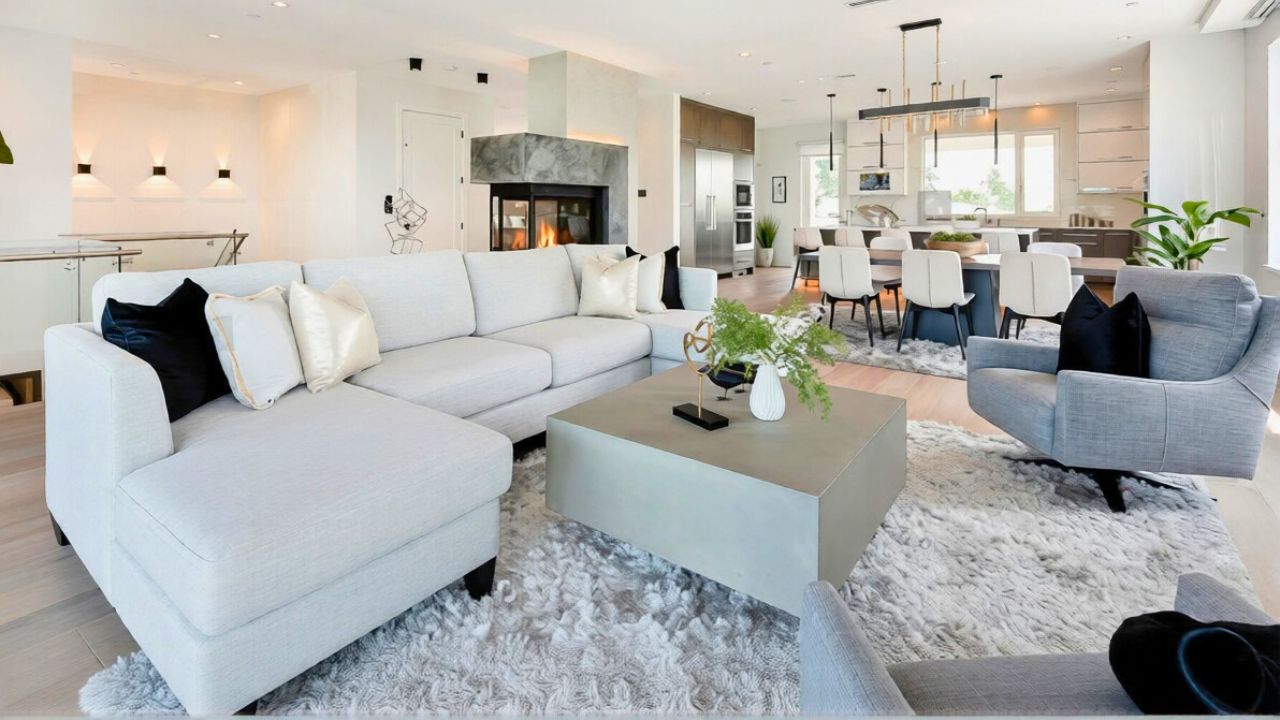
One of the most effective strategies is to use area rugs and visually separate living, dining, and kitchen zones. When your sofa, chairs, and coffee table all sit on a single rug, that rectangle becomes the “room” your eye reads, even if there are no walls around it. Designers who work on open layouts also lean on coordinated but distinct lighting, paint colors, and ceiling treatments to reinforce those boundaries, so your living area feels like a destination rather than a leftover patch of floor between the island and the back door.
Ajai’s hack for awkward open living rooms
If you are staring at a big, blank living room and feeling stuck, it helps to remember Ajai’s practical hack for awkward open spaces. Instead of treating the lack of walls as a design dead end, you treat it as an invitation to build your own “walls” out of furniture and accessories. You start by deciding exactly where you want conversation to happen, then you arrange seating to support that, even if it means floating pieces away from the perimeter.
As one stylist put it, here’s the thing: you have to define the space using other items like area rugs, colors, floor lamps, or even a bookcase that subtly divides the room. Ajai’s approach often involves pulling the sofa into the room, backing it with a narrow console for storage, and flanking it with lamps to create a clear bubble of light and function. When you copy that logic in your own home, you stop fighting the openness and start using it, because your living room finally has a strong, legible shape inside the larger volume.
Noise, privacy, and why “open” can feel exposed
Even if you solve the furniture puzzle, you might still feel oddly on display in your living room, especially when other people are home. Open layouts connect every zone acoustically as well as visually, so a conversation on the sofa competes with clattering dishes and TV noise from the next area. Guides that highlight noise and privacy in open concept homes point out that sound travels easily in one large space, which can make it hard to relax or focus.
That constant exposure can make your living room feel less like a retreat and more like a public square, particularly if your main seating faces the kitchen or entry. Some homeowners now talk openly about “Lack of Privacy” in open plans and how difficult it is to enjoy a quiet moment when every activity shares the same air. You can soften this by adding fabric, rugs, and curtains to absorb sound, and by arranging seating so it tucks into a corner or faces away from the busiest zones, but the underlying issue remains: without walls, your living room has to work harder to feel sheltered.
Using rugs, zoning, and “Open” structure to fix the awkwardness
The good news is that you can use the very qualities that made you crave an “Open” layout in the first place to fix the awkwardness. A big, continuous floor and long sightlines give you flexibility to experiment, as long as you stop thinking of the space as one monolithic room. Instead, you carve it into clear zones, each with its own focal point, furniture grouping, and lighting, then you let circulation snake around those islands instead of cutting straight through them.
Designers who work in open homes often remind you that open concept living precisely because it offers flow, airiness, and shared space, but they also stress that you still need structure. That is where area rugs, low bookcases, and even changes in ceiling height or beam placement come in, giving your living room a sense of enclosure without undoing the renovation. When you combine those physical cues with a thoughtful layout that prioritizes how you actually sit, talk, and watch TV, your once‑awkward open concept living room starts to feel less like a TV set and more like a home built for you.
Like Fix It Homestead’s content? Be sure to follow us.
Here’s more from us:
- I made Joanna Gaines’s Friendsgiving casserole and here is what I would keep
- Pump Shotguns That Jam the Moment You Actually Need Them
- The First 5 Things Guests Notice About Your Living Room at Christmas
- What Caliber Works Best for Groundhogs, Armadillos, and Other Digging Pests?
- Rifles worth keeping by the back door on any rural property
*This article was developed with AI-powered tools and has been carefully reviewed by our editors.