HGTV’s typical laundry room setup ignores how families actually use the space
You keep being told that a “dream” laundry room looks like a boutique hotel closet, yet your own laundry zone has to corral muddy cleats, pet towels, and a week’s worth of school uniforms. The glossy setups you see on HGTV lean on symmetry, cabinetry, and styling tricks that photograph beautifully but rarely match how you actually move through the space. If you want a laundry room that works for your family instead of for the camera, you have to question that script and rebuild the room around your real habits.
That starts with acknowledging what the TV version leaves out: the piles, the bottlenecks, and the constant shuffling between washing, drying, folding, and storing. When you look at how designers, stagers, and even HGTV’s own viewers talk about laundry spaces, a pattern emerges. The most photogenic layouts often sideline basics like a proper folding surface, logical appliance placement, or a place to stash bulk detergent, which means you end up working harder in a room that was supposed to make life easier.
How HGTV frames the “perfect” laundry room
On HGTV, laundry rooms are usually treated as a style showcase first and a workroom second. You see wall-to-wall cabinetry, a front-loading washer and dryer tucked under a continuous countertop, and decorative touches like framed art or a runner that softens the utilitarian vibe. In one HGTV segment featuring Mina and Karen’s “Little Laundry Room Revamp,” you are invited to see a compact space as a mini destination, with Mina joking that it is “room adjacent” but still worthy of a full design treatment for Rebecca and Ryan, even though it started as “just a closet” that you could barely spin around in. That framing suggests that any laundry nook, no matter how small, should aspire to look like a fully finished room, complete with styled shelves and coordinated finishes.
Social posts reinforce that message by insisting that laundry can be a kind of personal sanctuary if you simply layer on more finishes and fixtures. HGTV’s own feeds highlight spaces where design and style are celebrated as equal to function, and promotional captions stress that “just because your laundry room is a practical space” does not mean it cannot be pretty, with images that spotlight patterned tile, statement lighting, and curated accessories. As you scroll through those photos, you are encouraged to prioritize visual cohesion and high-end materials, often before you even consider where hampers, drying racks, or family-specific storage might go.
Why the staged version falls apart in daily use
Once you step away from the camera, that design-forward formula runs into trouble. Families use laundry rooms as drop zones for sports gear, pet supplies, cleaning tools, and bulk household products, and those items rarely fit inside a row of identical upper cabinets. Professional stagers acknowledge that when they coach you to “start with a clean slate” and “maximize storage and organization” so buyers can imagine their own systems in place, which is very different from living with a space styled purely for a listing photo. When you follow advice that focuses on how to stage a laundry, you are optimizing for a short-term impression, not the grind of weekly chores.
Designers who see laundry rooms after the cameras leave point to recurring flaws that make everyday use frustrating. One breakdown of “design flaws hiding in almost every laundry room” calls out missing folding surfaces, poor appliance positioning, and a lack of zones for sorting and air-drying as issues that show up again and again, even in brand-new builds. You are often left carrying damp clothes across the room because the washer and dryer doors open into each other, or you are forced to fold on the floor because the only flat surface is the machine tops. Those problems are not accidents; they are a direct result of treating the room as a backdrop instead of as a small-scale workshop that needs to handle repetitive, physical tasks.
The problem with endless cabinetry and closed doors
One of the most common HGTV moves is to line every available wall with cabinets so the room looks seamless and clutter free. That approach can be seductive, especially when you see it paired with matching hardware and a glossy countertop that runs from wall to wall. A popular tip that encourages you to add more cabinets in “this room, not the kitchen” leans into the idea that you can never have too much closed storage, and that any blank wall should be filled with boxes that hide your products. When you follow that script, you risk creating a tunnel of doors that looks impressive but forces you to open and close multiple cabinets for simple tasks like grabbing detergent or a stain stick.
Real users often have mixed feelings about that kind of storage, just as they do with open shelving in kitchens. In one discussion about “tacky” interior choices, a commenter pushes back by saying their experience with open shelving is “totally different” and “extremely practical” in some layouts, especially when you keep everyday items within arm’s reach instead of behind doors. The same logic applies in your laundry room. If you rely solely on closed cabinets because they photograph cleanly, you may end up stacking products on top of the machines or on any spare surface, which defeats the purpose of all that built-in storage and makes the room harder to clean.
How appliance placement and layout slow you down
On screen, appliances are usually treated as interchangeable boxes that slide neatly under a counter, as long as the finishes match and the sightlines stay clean. In practice, the way you position your washer and dryer can either streamline your workflow or add extra steps to every load. Detailed guidance on laundry design flaws emphasizes that you should “position side-by-side units with doors opening in the same direction for direct transfer,” so you are not twisting or reaching awkwardly with a heavy armful of wet clothes. When you ignore that advice in favor of a perfectly centered pair under a window, you may end up leaning over door swings or bumping into cabinetry every time you switch cycles, which is exactly the kind of daily friction that never shows up in a reveal shot.
HGTV’s own renovation shows sometimes highlight how cramped layouts can sabotage a space, even when the finishes look new. In a full episode recap of a laundry remodel in the Memorial area, you see the host arrive to meet Anmarie and talk through a room that started as a functional afterthought. The original layout forced awkward circulation and left little room to maneuver around the machines, which meant Anmarie had to shuffle baskets and cleaning tools just to reach basic controls. When the remodel shifts walls and repositions appliances, the change is not just cosmetic; it allows you to stand in front of the machines, open doors fully, and access storage without a choreography of sidesteps.
The missing folding, sorting, and hanging zones
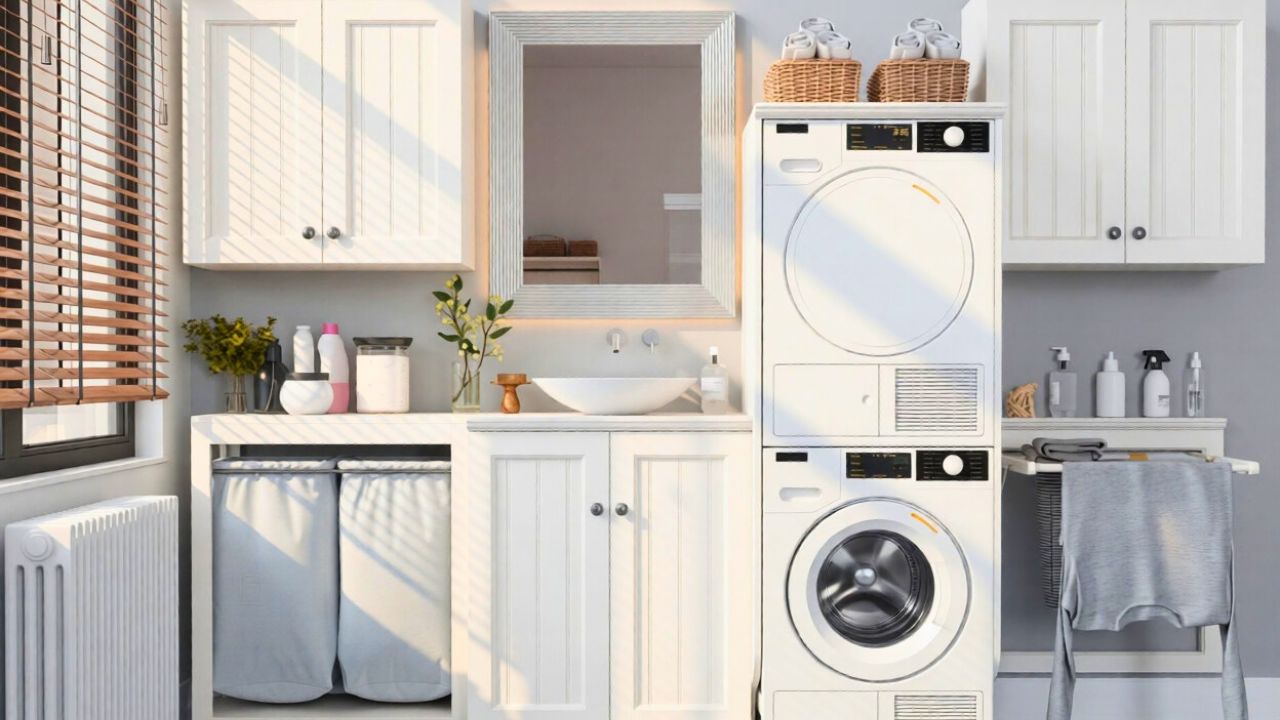
In many HGTV-ready laundry rooms, the countertop above the machines is treated as a styling surface for plants and baskets, not as a serious workstation. Designers who study how you actually use the room point out that “no designated folding surface” is one of the most common flaws, along with the absence of a clear place to sort clothes for different people in your household. When you skip those zones, you end up folding on the bed or dining table and hauling stacks back and forth, which increases the chance that clean clothes will sit in limbo or get wrinkled before they ever reach a drawer. A more functional approach gives you a generous folding counter, built-in sorting hampers, and even tall cabinets for brooms and bulk supplies so you are not constantly leaving the room mid-task.
Some of the most admired show homes hint at how powerful those details can be when they are actually built in. One breakdown of a recent HGTV house calls the laundry room’s “contractable clothing racks” ingenious and singles out that space as a favorite specifically because the racks tuck away when not in use. When you add retractable hanging bars, wall-mounted drying rails, or ceiling-mounted racks to your own room, you give yourself a place to air-dry delicate items and hang shirts straight out of the dryer, which cuts down on ironing and clutter. Without those elements, you are left improvising with doorframes and shower rods, even if the room around you looks like a design catalog.
Lighting, dust, and the reality of cleaning the room
Television-ready laundry rooms often glow with soft, even light that makes every surface look flawless. In real life, many utility spaces are buried in basements or interior hallways with little natural light, which makes tasks like checking stains or reading care labels harder. Lighting specialists warn that “skimping on lighting” is one of the biggest mistakes you can make, since laundry rooms are “inherently” prone to feeling drab if you rely on a single overhead fixture. When you invest in layered lighting, such as bright ceiling fixtures plus under-cabinet strips or a focused sconce over the sink, you make it easier to spot discoloration, sort colors accurately, and keep the room feeling safe and inviting for every member of your household.
Dust and lint are another area where the HGTV fantasy diverges sharply from reality. On one HGTV Facebook post that showcases a highly styled laundry space, a viewer bluntly comments that “laundry rooms get so dusty” and that the beautiful design is “just another room to clean,” especially when you add chandeliers or intricate moldings that trap lint. That criticism reflects a basic truth about the work you do in this room. Every cycle throws microscopic fibers into the air, which settle on open shelves, decorative objects, and light fixtures. If you load the room with fussy details that require special cleaning, you are signing yourself up for more maintenance in a space that already demands constant attention.
Smart tech, storage, and what actually helps you
When you look past the styling, the most helpful upgrades tend to be the ones that reduce friction in your routine rather than simply dressing up the room. Smart front loaders that connect to apps, like the ones in the AEG 9000 AbsoluteCare range, can fine-tune cycles for delicate fabrics and adjust energy use, which helps you stretch both your wardrobe and your utility budget. Guides on how to refresh a laundry room with technology stress that you should “upgrade the everyday” and lean on “custom storage solutions” that limit how much time you spend sorting and hunting for supplies, instead of pouring money into purely decorative finishes. That might mean pull-out hampers for each family member, a dedicated spot for lost socks, or a shallow drawer for stain-removal tools near the sink.
Even HGTV-adjacent influencers who share laundry makeovers on Instagram are starting to emphasize function as much as finishes. One detailed caption about a reworked laundry space points you toward “built-in sorting hampers that keep colours and linens separate,” “tall cabinets for brooms and bulk supplies,” and “a generous folding counter” as the features that truly change how you move through the room. Another designer post about a premium laundry highlights how “the selection of premium materials and refined finishes” can elevate the space, but only when those choices are paired with practical performance so the room feels like “a private sanctuary” where “performance meets sophistication.” When you combine durable surfaces with well-planned storage and tech, you get a room that feels calm without sacrificing utility.
What HGTV gets right, and how you can adapt it
Designing a laundry room that matches your real life
How to edit the HGTV script in your own home
Like Fix It Homestead’s content? Be sure to follow us.
Here’s more from us:
- I made Joanna Gaines’s Friendsgiving casserole and here is what I would keep
- Pump Shotguns That Jam the Moment You Actually Need Them
- The First 5 Things Guests Notice About Your Living Room at Christmas
- What Caliber Works Best for Groundhogs, Armadillos, and Other Digging Pests?
- Rifles worth keeping by the back door on any rural property
*This article was developed with AI-powered tools and has been carefully reviewed by our editors.