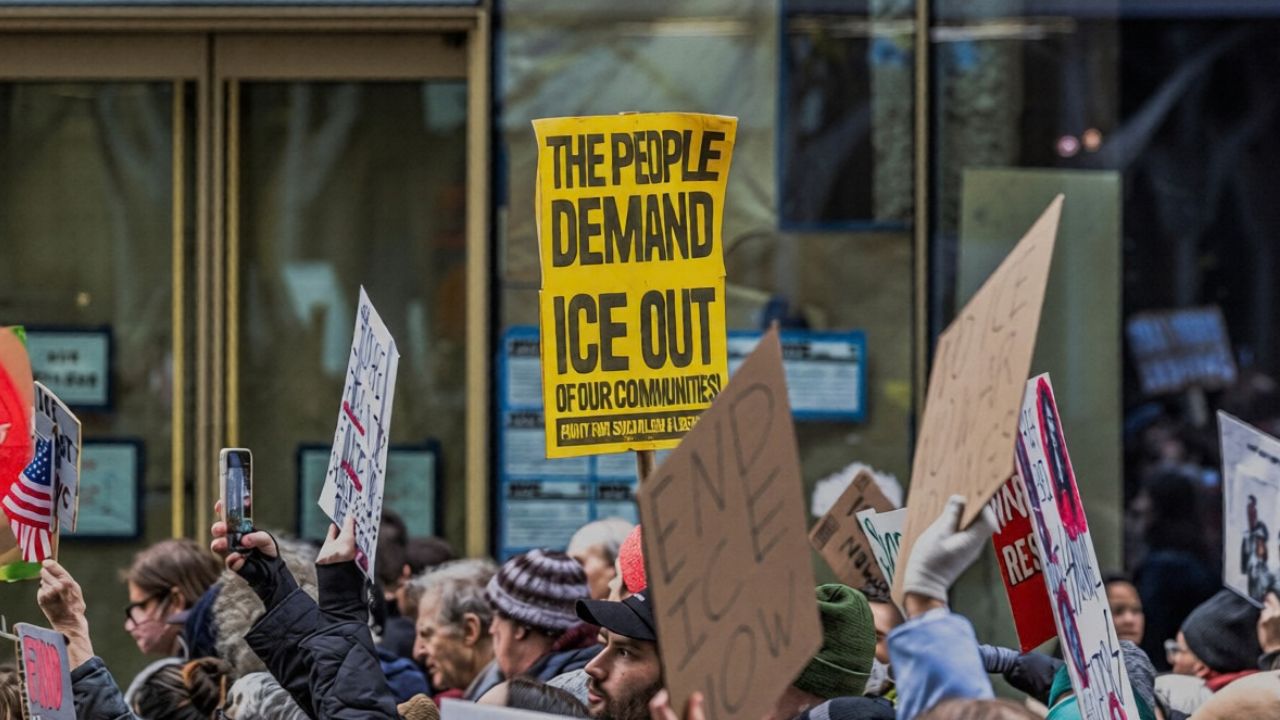
Nationwide protests intensify as activists demand “ICE Out” policies
From Minneapolis to New York City, a swelling protest wave is demanding that local governments cut ties with federal immigration enforcement and adopt sweeping “ICE Out” policies. What began as outrage over deadly raids and shootings has evolved into coordinated strikes, economic boycotts, and walkouts that organizers say will continue until Immigration and Customs Enforcement is pushed out of workplaces, schools, and city contracts.
Activists describe a national showdown over who controls public safety: federal agents with broad arrest powers, or communities insisting that basic services not be used as immigration dragnet infrastructure. Their message is blunt, summed up in chants and banners: “ICE Out of Everywhere.”
From Minnesota flashpoint to national call
The current escalation traces back to intensified operations in Minnesota, where immigration raids labeled Operation Metro Surge triggered a statewide backlash. Minnesotans braved -10°F in a midwinter strike and street protests, signaling that resistance would not be confined to immigrant neighborhoods or warmer states.
Those early marches quickly fed into a broader “ICE Out” push that linked local anger over raids to national concerns about the Trump administration’s immigration crackdowns. Organizers framed the Minnesota actions as proof that coordinated disruption could rattle both federal agencies and corporate partners that facilitate arrests.
High-profile deaths added urgency. Earlier this year, federal agents shot and killed Renee Good in a case that activists say epitomizes excessive force during immigration enforcement. In a separate incident, DHS said a shooting occurred during a targeted vehicle stop and identified the driver as Luis David Nino, events that fueled calls for independent investigations and public release of body camera footage.
The fatal shooting of Alex Pretti in Minneapolis became another rallying point. The Justice Department responded by opening a federal civil rights probe into the killing, a step that protesters cite as evidence that sustained public pressure can force scrutiny of ICE tactics.
As outrage spread, a statewide economic blackout in Minnesota protesting intensified ICE actions expanded into a nationwide movement. Activist networks used that momentum to knit together local grievances into a single demand: get ICE out of daily civic life.
Strikes, shutdowns and “ICE Out” targets
Organizers have not limited themselves to marches. A national shutdown campaign urged “no work, no school, no shopping” on a single weekday, turning ordinary routines into leverage for immigration justice. According to its own description, the National Shutdown drive was designed as a catalyst for wider action, not a one-off protest.
Parallel efforts have targeted corporate partners. The “ICE Out of Target” campaign, prominently led by ICE Out of Minnesota and allied groups, urges Target Corp to stop sharing data or cooperating with immigration enforcement and to guarantee that employees and customers are protected. Activists see these consumer-facing brands as pressure points in what they describe as the infrastructure behind deportations.
Other anti-ICE actions go further. One network called 50501 is rolling out pressure campaigns against landlords, data brokers, and local agencies that activists see as the scaffolding that allows ICE to track and detain people. These efforts reflect a strategic shift from confronting only federal agents in the street to challenging the web of institutions that make large-scale enforcement possible.
Street energy has matched these behind-the-scenes campaigns. Tens of thousands of people have turned out for “ICE Out of Everywhere” demonstrations that include vigils, marches, and sit-ins. In downtown Minneapolis, tens of Minnesotans chanted “No hate, no fear, immigrants are welcome here” as clergy, students, and families filled major intersections.
Similar scenes played out at the Foley Square “ICE OUT” protest in NYC, where Gen Z students walked out of public schools to denounce what they described as brutal immigration crackdowns. Young organizers there linked their action to a long line of student walkouts over civil rights and war policy.
Escalating confrontations and official responses
Federal tactics have hardened alongside the protests. Raids in Southern California were carried out in a military-style operation, which intensified concerns about the level of force used by federal immigration teams. Activists on the ground described armored vehicles, long guns, and early morning door knocks that left entire apartment complexes in fear.
In Minnesota, federal agents shot and killed a man during a raid that officials said involved a suspect who weaponized a vehicle. That incident, along with the deaths of Renee Good and Alex Pretti, reinforced protesters’ claims that immigration enforcement has blurred into domestic militarization.
National political tensions form the backdrop. The unrest is unfolding amid a standoff in Washington, where congressional Democrats have blocked DHS funding bills in an effort to push ICE reforms. Activists see that gridlock as both a risk and an opening, arguing that sustained street pressure can shape any eventual compromise.
State and local officials are under growing pressure to choose sides. In Minnesota, Attorney General Keith Ellison has been pressed by advocates to investigate shootings and to clarify how far state law enforcement can go in cooperating with ICE. Local prosecutors in Minneapolis face similar demands as residents question whether city resources should support federal raids.
Nationally, the Justice Department’s civil rights probe into the Alex Pretti shooting in Minneapolis, announced by Deputy Attor Todd Blanche, signals that federal oversight of ICE conduct is now part of the political battle. Protesters argue that any investigation must be transparent and must include community voices, not just internal reviews.
“ICE Out” as policy agenda, not just slogan
Behind the chants, “ICE Out” has a concrete policy list. Organizers want local governments to end contracts that allow ICE to rent bed space in county jails, to stop sharing license plate and utility data, and to prohibit school districts and hospitals from cooperating with immigration arrests on their grounds.
Reporting on the protests notes that activists are pushing cities to cut ties with what they call the infrastructure supporting immigration enforcement. That includes pressure on landlords who share tenant information, tech firms that sell surveillance tools, and transit systems that let ICE use fare data to track riders.
Other organizers are calling for civilian oversight boards with subpoena power to review any local support for immigration operations. They want public logs of every time ICE requests help from a city agency, along with clear policies for when officials can refuse.
Labor and faith communities have become key players. On one Minnesota strike day, roughly 100 clergy, according to a news release from the ICE Out of MN coalition, were arrested for their part in the stand against deportations. Their participation signaled that resistance to ICE is not limited to directly affected families but has spread into broader civic life.
Across the country, tens of thousands of people have joined more than 300 anti-ICE protests that continue to challenge Trump immigration policies. Activists frame these events as both moral witness and practical leverage, arguing that sustained disruption can force policy change even without new federal legislation.
Organizers also emphasize training and discipline. Protest leaders have prepared thousands of participants to observe, document, and de-escalate during raids, part of a strategy to protect communities while gathering evidence for future legal challenges. They warn that “they are coming for you” is not rhetoric but a description of how deeply ICE operations now reach into ordinary neighborhoods.
For now, the “ICE Out” push shows no sign of fading. Nationwide protests have already swept cities such as Washington DC, Los Angeles, Portland, and Austin, and activists are planning additional walkouts and boycotts throughout the year. Whether local officials adopt the full menu of “ICE Out” policies or opt for narrower reforms, the movement has already shifted the debate over who gets to decide how immigration enforcement touches everyday life.
Like Fix It Homestead’s content? Be sure to follow us.
Here’s more from us:
- I made Joanna Gaines’s Friendsgiving casserole and here is what I would keep
- Pump Shotguns That Jam the Moment You Actually Need Them
- The First 5 Things Guests Notice About Your Living Room at Christmas
- What Caliber Works Best for Groundhogs, Armadillos, and Other Digging Pests?
- Rifles worth keeping by the back door on any rural property
*This article was developed with AI-powered tools and has been carefully reviewed by our editors.