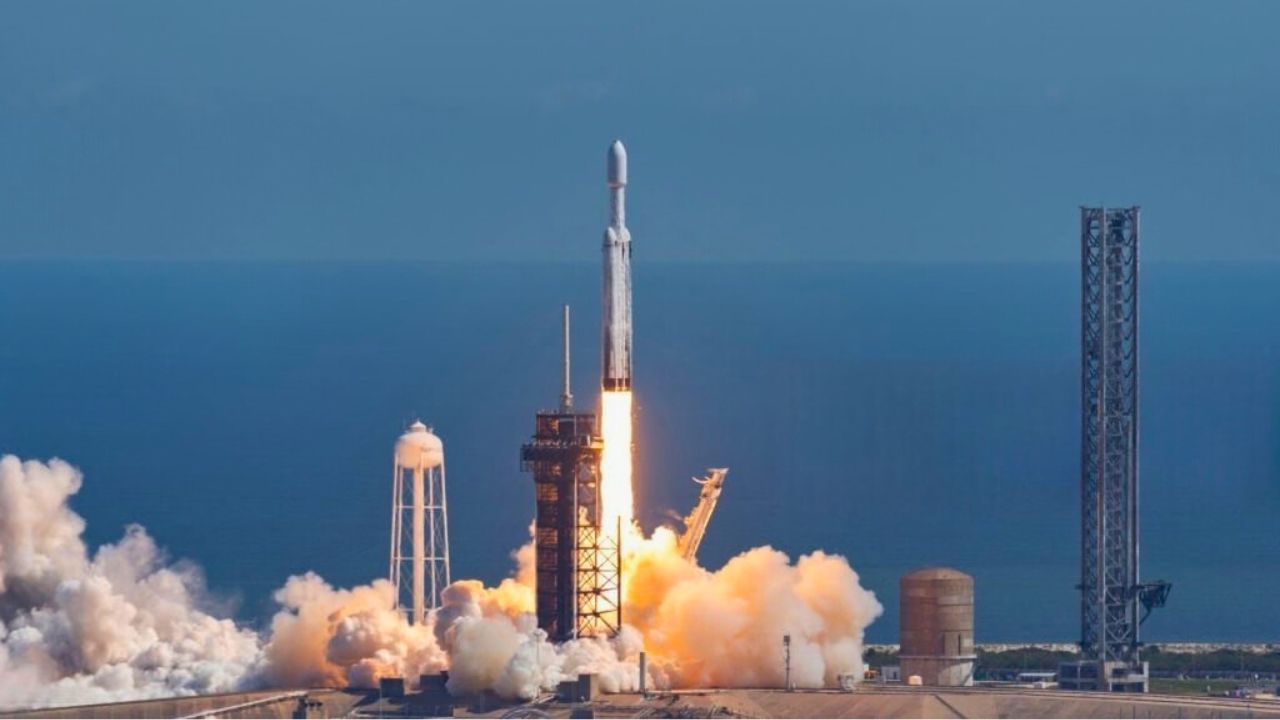
SpaceX launches Crew-12 to the ISS for an eight-month mission — with U.S., Russian and French astronauts aboard
CAPE CANAVERAL, Fla. — SpaceX launched its 12th long-duration crewed mission to the International Space Station early Friday, sending four astronauts — two Americans, a French astronaut and a Russian cosmonaut — into orbit for an eight-month science mission that underscores the continued day-to-day cooperation aboard the station even amid strained geopolitics on Earth. The mission lifted off from Cape Canaveral at about 5:15 a.m. Eastern, riding a Falcon 9 rocket topped with a Crew Dragon capsule named “Freedom.”
The Crew Dragon is scheduled to arrive at the station on Saturday afternoon after a roughly 34-hour flight, docking with the orbiting laboratory about 250 miles above Earth. The crew is led by NASA astronaut Jessica Meir, joined by NASA’s Jack Hathaway, European Space Agency astronaut Sophie Adenot of France, and Russian cosmonaut Andrey Fedyaev. After reaching orbit, Meir radioed SpaceX flight control: “That was quite a ride,” and thanked the teams supporting the launch.
The mission is more than a routine rotation. Reuters reported that the station had been operating with a reduced crew after an unprecedented medical evacuation in mid-January prompted an earlier-than-planned departure of a four-person team that had been expected to remain until the arrival of Crew-12. NASA has said it remains committed to operating the ISS through the end of 2030, and crew rotations are the backbone of maintaining steady research and maintenance work in orbit.
Once aboard, Crew-12 will take on a slate of scientific, medical and technical experiments in microgravity. Reuters reported that the work includes studies involving pneumonia-causing bacteria to improve treatments on Earth and experiments examining plant and nitrogen-fixing microbe interactions aimed at improving food production in space — research that feeds into NASA’s long-term goals for human exploration beyond low-Earth orbit. Much of the station’s science agenda is increasingly framed as a pipeline for future missions, including NASA’s Artemis program, which is designed to return astronauts to the moon and eventually support deeper-space travel.
The launch also highlights how the ISS remains, in practice, one of the last major U.S.-Russian cooperative projects operating continuously. Reuters noted the station is run by a consortium led by the United States and Russia that includes Canada, Japan and multiple European countries, and has been continuously staffed for more than two decades. The collaboration was originally conceived to improve ties after the Cold War and has outlasted repeated political crises.
For SpaceX, the flight extends a partnership that began carrying U.S. astronauts to orbit in 2020, when NASA restored domestic crew-launch capability after relying on Russian Soyuz rides for years. The company’s routine cadence of crew missions has become central to NASA’s staffing model, while also demonstrating the broader shift toward private-sector launch providers handling missions that were once run solely by governments.
Crew-12’s arrival will restore staffing and momentum aboard the station at a time when long-duration health, materials and life-support research remains central to how NASA plans future human spaceflight. For the next eight months, the team’s work will be both practical — keeping the station running — and experimental, testing how the human body and biological systems behave in microgravity in ways that are difficult to replicate on Earth.