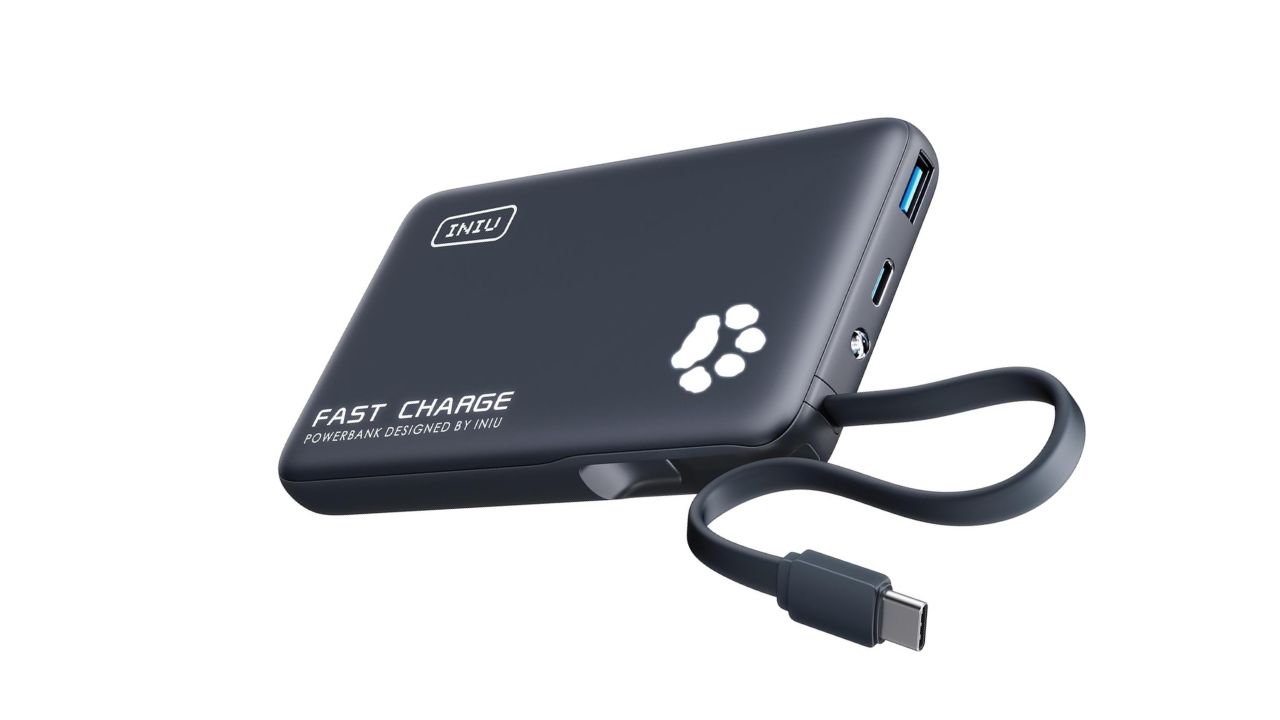
The paw-print LED detail that helps identify the recalled INIU power banks fast
The recall of INIU’s compact power banks is not an abstract safety notice, it is about a specific pocket-size gadget that may be sitting in your bag, desk drawer, or car console. One small design flourish, the brand’s paw-print LED indicator, has become the quickest way for you to spot whether your charger is part of a nationwide safety campaign to get risky batteries out of circulation.
If you use a portable charger that looks slim, candy-bar sized, and lights up with a paw-shaped pattern when you press the power button, you now have a concrete reason to double check the model and serial details. Fire investigators and regulators have tied that particular design to overheating incidents, and the faster you can identify it, the faster you can decide whether to stop using it and claim a remedy.
Why a cute paw icon suddenly matters for your safety
On INIU’s 10,000mAh portable power banks, the paw-print LED was originally a branding flourish, a way to stand out in a crowded field of anonymous black rectangles. You press the side button, and instead of a plain row of dots, a stylized paw glows to show remaining charge. That same visual quirk now gives you a shortcut: if you see that paw on a compact INIU battery pack, you know you need to slow down and confirm whether it is the recalled BI-B41 model that regulators have linked to fire and burn hazards.
The official Recall Details describe how the affected INIU 10,000mAh portable power banks, model BI-B41, share a common look, including the paw-shaped battery indicator and a slim rectangular body. That means you do not have to memorize obscure serial ranges before you even know whether you own the right product category. The paw icon is your first filter, a fast visual cue that tells you this is the time to flip the device over, read the fine print, and compare it against the recall notice.
How to confirm you actually have the BI-B41 power bank
Once the paw-print LED has caught your eye, you still need to move from “this looks familiar” to “this is definitely the recalled hardware.” You do that by checking the exact model number and capacity markings on the casing. The Consumer Product Safety Commission explains that the recall involves INIU 10,000mAh portable power banks with the specific designation BI-B41, so you should look for “BI-B41” and “10,000mAh” printed on the back or side of the unit, often near the USB ports or regulatory symbols.
Regulators stress that only certain batches of the INIU 10,000mAh portable power banks, model BI-B41, are included, and that the recall scope is limited to those units that match the Description in the official notice. That is why you should not rely on color or packaging alone. If your charger has the paw LEDs and the BI-B41 label, and it is rated at 10,000mAh, you should treat it as potentially affected and proceed to the next step of checking serial numbers or purchase channels as directed by INIU and the CPSC.
What investigators say is going wrong inside these batteries
The recall is not about cosmetic flaws, it is about what can happen inside the lithium-ion cells when something goes wrong. According to federal safety officials, the BI-B41 power banks can overheat and ignite, turning what is supposed to be a backup power source into a source of open flame. That risk is especially serious because you tend to use these chargers on couches, in cars, or near bedding, where a small fire can spread quickly before you have time to react.
Reporting on the recall notes that more than 200,000 power banks sold on Amazon are affected and that the company has received at least 15 reports of the power banks overheating, including incidents where they reportedly ignited, which is why the devices are now described as a fire and burn hazard in the recall coverage. Lithium-ion failures can escalate quickly once thermal runaway begins, so the threshold for action is low: even a handful of documented fires is enough for regulators to push for a broad recall when a product is as widely distributed as these compact chargers.
How many fires and injuries have been linked to the BI-B41
When you weigh whether to keep using a device, the raw numbers matter. In this case, INIU and federal regulators have acknowledged a pattern of overheating that goes beyond isolated anecdotes. The recall documentation cites multiple reports of BI-B41 units getting dangerously hot, with some progressing to open flames that damaged surrounding property and created obvious burn risks for anyone nearby.
Legal and consumer safety analysts point out that the recall followed nearly a dozen reported fires tied to the INIU portable chargers, with specific attention on units that share the BI-B41 design and serial ranges listed in the official notices, as summarized in recall-related litigation. While not every overheating report resulted in injury, the pattern was enough for regulators to conclude that continued use of the affected power banks presents an unacceptable risk of fire and burns, especially in homes and vehicles where escape routes can be limited.
Where these INIU power banks were sold and why Amazon keeps coming up
Part of what makes this recall so sweeping is how easy it was to buy the BI-B41 power banks in the first place. You did not need to visit a specialty electronics shop or a brand boutique. Instead, you could add one to your cart while ordering headphones or phone cases, because the chargers were sold widely on Amazon and shipped directly to consumers across the United States. That broad online distribution is why the recall notice emphasizes that the affected units were sold on Amazon, not just through a niche storefront.
Coverage of the recall notes that more than 200,000 of the INIU 10,000mAh portable power banks were sold on Amazon before the safety issues came to light, and that the devices were marketed as compact, high capacity chargers suitable for phones, tablets, and other USB-powered gear, as reflected in product listings that can still be found through shopping search. If you bought an INIU-branded power bank online in the last couple of years, especially through Amazon, you should assume it could be part of the recall until you have checked the model number and serial information against the official guidance.
What INIU’s own recall page tells you to do next
Once you have identified that you own a BI-B41 with the paw-print LEDs, your next stop should be INIU’s dedicated recall portal. The company has published a Voluntary Recall Notice for Specific Batches BI-B41 10,000mAh Power Banks in the U.S., which walks you through how to verify your serial number, register for a remedy, and stop using the product. The page is framed as part of INIU’s broader quality assurance effort, with the company stating that, at INIU, consumer safety and product reliability are central to its brand.
On that recall page, INIU explains that through its enhanced quality assurance process it identified specific batches of BI-B41 power banks that may not remain safe for regular use, and it offers instructions for returning or disposing of the affected units along with information about refunds or replacements, as detailed in the company’s recall-b41 notice. You are urged to stop using the power bank immediately if it matches the listed criteria, even if it has not shown any signs of overheating, because the underlying defect is not something you can see from the outside.
How the CPSC recall and INIU’s voluntary notice fit together
It can be confusing to see both a government recall announcement and a company-branded recall page, but in practice they are two halves of the same process. The Consumer Product Safety Commission issues the formal Recall Details, which spell out that the INIU 10,000mAh portable power banks, model BI-B41, pose fire and burn hazards and that consumers should stop using them. INIU, for its part, issues a Voluntary Recall Notice for Specific Batches BI-B41 10,000mAh Power Banks in the U.S., which operationalizes that directive by telling you exactly how to participate in the recall.
INIU’s own language emphasizes that, at INIU, consumer safety and product reliability are priorities, and that through its enhanced quality assurance program it identified the need to recall certain BI-B41 units so that only products that remain safe for regular use stay in circulation, as outlined in the company’s detailed Voluntary Recall Notice for Specific Batches BI. The CPSC notice and the company’s portal are meant to be read together: the regulator defines the hazard and scope, while the manufacturer provides the practical steps you need to take to remove the risky device from your daily routine.
How to handle and dispose of a recalled power bank safely
Once you know your BI-B41 is part of the recall, the next question is what to do with it while you wait for a refund or replacement. Safety officials are clear that you should stop using the power bank immediately, unplug it from any devices or chargers, and store it in a cool, nonflammable area away from bedding, paper, or other combustible materials. You should not toss it into a household trash can or curbside recycling bin, because damaged or defective lithium-ion batteries can ignite in garbage trucks or sorting facilities.
Guidance on the recall underscores that consumers who purchased the INIU power banks covered by this recall should not throw them in the trash, general recycling, or drop them in random collection bins, and that before taking your battery or device to a disposal site you should confirm that the location is equipped to handle recalled lithium-ion products, as explained in consumer advisories on burn and fire risk. Many local governments and electronics retailers run e-waste or battery take-back programs that can accept recalled power banks, and INIU’s recall instructions may also point you to specific return options tied to your remedy.
What this recall signals about everyday battery tech in your life
The INIU BI-B41 recall is a reminder that the same lithium-ion chemistry powering your phone, laptop, and electric toothbrush can become dangerous when design, manufacturing, or quality control fall short. You rely on portable chargers precisely because you want to keep your devices running on the go, which means you tend to use them in cars, on airplanes, and in hotel rooms, all places where a sudden fire can be especially disruptive. A small detail like a paw-print LED might seem trivial, but in a recall context it becomes a crucial piece of visual literacy that helps you navigate a crowded gadget landscape more safely.
Regulators and safety advocates note that the BI-B41 situation fits into a broader pattern in which compact, inexpensive power banks sold online can slip through the cracks of rigorous testing until overheating reports accumulate and trigger action, as reflected in the quality assurance language INIU now highlights. For you as a consumer, the takeaway is straightforward: treat distinctive design cues like the paw LEDs as starting points for verification, register your devices when possible so recall notices reach you directly, and take any official fire or burn hazard warning seriously, even if your particular unit has behaved perfectly so far.
Like Fix It Homestead’s content? Be sure to follow us.
Here’s more from us:
- I made Joanna Gaines’s Friendsgiving casserole and here is what I would keep
- Pump Shotguns That Jam the Moment You Actually Need Them
- The First 5 Things Guests Notice About Your Living Room at Christmas
- What Caliber Works Best for Groundhogs, Armadillos, and Other Digging Pests?
- Rifles worth keeping by the back door on any rural property
*This article was developed with AI-powered tools and has been carefully reviewed by our editors.