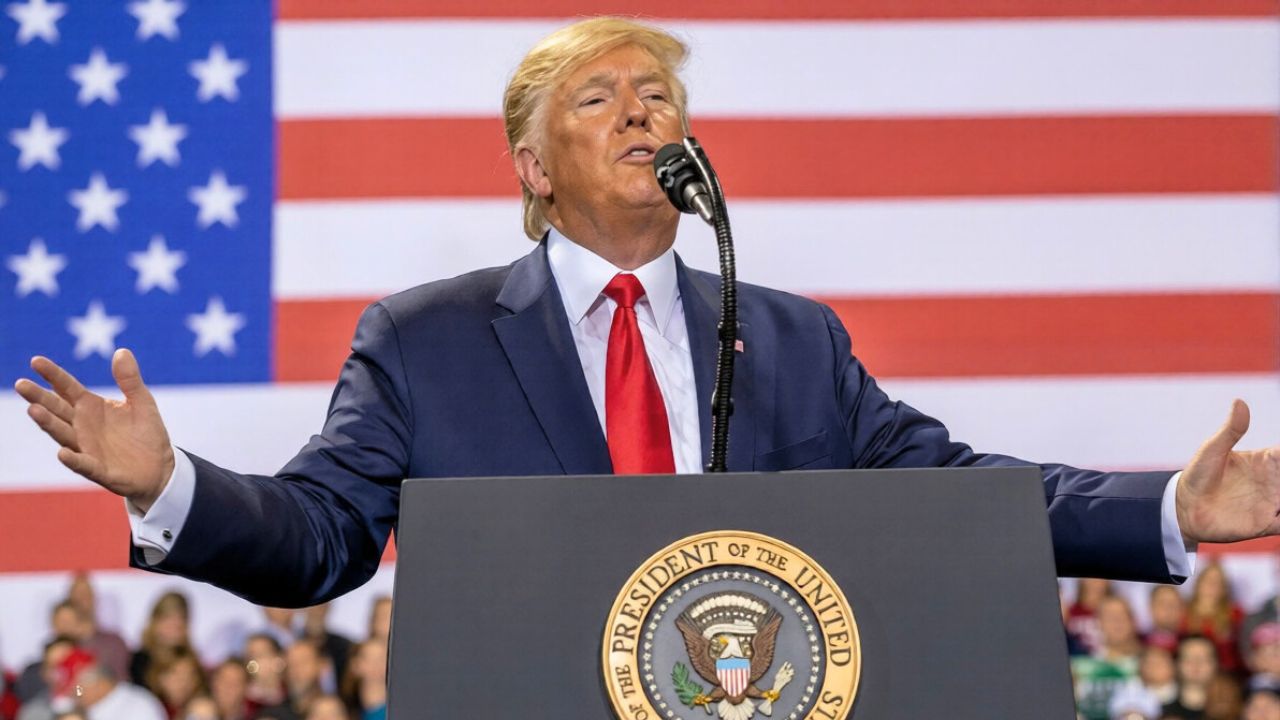
Trump calls GOP congressman a “nutjob” during rally, urges voters to back primary challenger
Photo credit: Maxim Elramsisy/Shutterstock.com
Donald Trump used a campaign stop in Kentucky to torch a member of his own party, branding Republican Representative Thomas Massie a “nutjob” and urging voters to replace him in the upcoming primary. The attack, delivered in Massie’s home district, turned what was billed as an economic message into a public loyalty test inside the Republican Party.
The intervention raises the stakes in a race that might otherwise have remained a low-profile intraparty contest, signaling that dissenting Republicans risk direct retribution from the party’s most powerful figure.
Trump’s swing through Ohio and Kentucky
Trump spent the day moving between Ohio and Kentucky, highlighting his record on prescription drug prices and the broader economy while trying to reassure voters about the impact of conflict with Iran on rising prices and growth. In Hebron, Kentucky, he paired that message with a pointed warning that Republicans needed to hold and expand their majorities in the midterms, arguing that his agenda depended on a compliant Congress that would not “slow walk” his priorities.
Addressing supporters in Massie’s district, Trump framed the election as a choice between backing his economic program or empowering internal critics. He cast himself as the leader who had pushed to lower prescription costs in Ohio and Kentucky and said that effort required lawmakers who would “stand with you” rather than challenge him on key votes.
Turning a policy rally into a personal feud
The most striking moment came when Trump shifted from policy to personal attack. He described Representative Thomas Massie as a “nut job” and “a disaster for our party,” according to accounts of the Kentucky stop, and complained that Massie had repeatedly broken with him on high profile issues. His language echoed earlier social media posts that had labeled Massie a problem for Republicans and hinted that he should be removed.
Nor did Trump limit himself to a single insult. He called Massie a “loser” and a “disaster,” language that matched his pattern of branding intraparty opponents with cutting nicknames. He told the crowd that Massie should be “voted out of office immediately,” turning the rally into an onstage endorsement of Massie’s primary challenger and a public demand that the district send someone else to Washington.
Why Trump is targeting Thomas Massie
The clash did not come out of nowhere. Tension between Trump and Thomas Massie has been building for months, fueled by Massie’s willingness to buck the administration on spending, foreign policy, and civil liberties. Massie has carved out a reputation as a libertarian leaning Republican prepared to vote alone, and he has often framed his opposition as a defense of constitutional limits and fiscal restraint.
Trump, by contrast, has treated those votes as personal slights. Advisers have privately complained that Massie complicates party messaging at sensitive moments, and Trump has publicly suggested that such dissent risks derailing his negotiating leverage on issues like sanctions, emergency spending, and national security measures related to Iran. The Kentucky visit gave him a stage to transform that simmering frustration into a direct call for voters to punish Massie at the ballot box.
The primary challenger and Trump’s message to voters
Trump used his speech in Kentucky to lift up Massie’s opponent, describing the challenger as a reliable ally who would not undercut the White House. Reporting from the event indicates that he praised the candidate’s background, including service as a former Navy SEAL officer, and framed him as the kind of tough, loyal figure he wants in Congress.
He told the crowd that Republicans in Washington did not need “a rubber stamp,” but then made clear that, in his view, loyalty to his priorities should be the baseline expectation. The message to Kentucky Republicans was blunt: a vote for Massie was a vote against Trump’s economic and foreign policy agenda, while a vote for the challenger would prove that the district “stands with you” and with the president.
Economic stakes and the Iran backdrop
Trump’s attacks on Massie unfolded against a backdrop of anxiety about the economy and the conflict with Iran. During his stops in Ohio and Kentucky, he argued that his administration had kept growth strong and unemployment low, even as war in Iran stirred concerns about gas prices and inflation. He insisted that the “excursion” in Iran was under control and that his team was working to limit the impact on American consumers.
Within that frame, Trump portrayed Massie as out of step with what he described as a winning economic strategy. He suggested that votes against administration backed spending or sanctions packages signaled weakness in the face of foreign threats and a lack of commitment to keeping prices down at home. In Trump’s telling, the primary in Kentucky had become a referendum not just on Massie, but on how Republicans should respond to economic pressure tied to foreign conflict.
How the feud fits into Trump’s broader party strategy
The confrontation with Massie fits a pattern that has defined Trump’s approach to Republican internal politics. He has repeatedly used rallies and social media to single out Republican lawmakers who stray from his line, then backed primary challengers who promise closer alignment. The Kentucky speech extended that strategy to a member of Congress known more for libertarian purism than for high profile criticism of Trump’s character or legal troubles.
By labeling Massie a “nutjob” and “disaster for our party,” Trump signaled that ideological disagreement on spending or surveillance can be as unforgivable as outspoken moral opposition. That approach encourages other Republicans to weigh the political cost of breaking with the White House, especially in districts where Trump remains popular. It also deepens the sense that policy debates inside the GOP are increasingly filtered through personal loyalty tests.
Massie’s brand and the risk of backlash
Representative Thomas Massie has long cultivated an image as an independent minded conservative who is willing to stand alone on the House floor. Profiles of Thomas Massie highlight his engineering background, his rural Kentucky roots, and his frequent clashes with both party leadership and Democratic opponents.
That brand could help him weather Trump’s attacks if voters in the district value independence more than presidential favor. At the same time, the repeated use of terms like “loser” and “disaster” from a figure as dominant in Republican politics as Donald Trump carries real risk. Primary electorates are often highly engaged and strongly aligned with Trump, and a direct call to “vote him out” can reshape a race overnight.
What the Kentucky fight signals for the midterms
Trump’s swing through Ohio and Kentucky was officially framed as an economic tour, focused on prescription drug prices and efforts to manage the fallout from Iran. Yet the sharpest headlines came from his decision to use a Kentucky stage to escalate his feud with Massie and to call for his defeat in the primary.
That choice suggests that Trump sees intraparty discipline as a central priority heading into the midterms. If he is willing to travel into a Republican district and publicly try to unseat an incumbent, other lawmakers who have occasionally sided with figures like Massie on spending or foreign policy may think twice.
For voters, the episode clarifies the choice in Kentucky. They are not only selecting between two Republicans on a familiar ideological spectrum. They are also deciding whether their representative should mirror Trump’s preferences or maintain an independent streak that has already drawn a presidential rebuke.
The road to Kentucky’s primary
As the primary approaches, both sides are likely to lean heavily on their core arguments. Trump and his allies will continue to tie Massie to obstruction of the president’s economic and foreign policy agenda, while emphasizing the challenger’s military credentials and promise of loyalty.
Massie, for his part, is expected to remind voters of his record as a consistent limited government conservative. Coverage of Massie has often highlighted his willingness to oppose large spending packages and broad surveillance powers even when doing so isolates him within the party.
Like Fix It Homestead’s content? Be sure to follow us.
Here’s more from us:
- I made Joanna Gaines’s Friendsgiving casserole and here is what I would keep
- Pump Shotguns That Jam the Moment You Actually Need Them
- The First 5 Things Guests Notice About Your Living Room at Christmas
- What Caliber Works Best for Groundhogs, Armadillos, and Other Digging Pests?
- Rifles worth keeping by the back door on any rural property
*This article was developed with AI-powered tools and has been carefully reviewed by our editors.