Neighbor Removes Boundary Trees Before the Survey — Then the Arborist’s Estimate Turns the Dispute Expensive
Photo credit: Fix it homestead
Boundary trees can cause tension even when everyone agrees where the property line is.
They drop leaves. They cast shade. They block views. They grow into fences. Sometimes one neighbor sees them as privacy and another sees them as a problem waiting to be cut down.
But for one homeowner, the issue became much bigger when a neighbor removed trees near the boundary before a survey had settled where the line actually was.
That timing mattered.
Because after the trees were gone, the survey question did not disappear. It became more important.
Then an arborist’s estimate showed just how expensive the damage might be.
The trees were removed before the line was confirmed
Property-line disputes often begin with assumptions.
A neighbor may believe a row of trees is on their side because they have always mowed around it. Another may think the trees belong to them because the branches lean over their yard. Someone may rely on an old fence, a ditch, or a memory from a previous owner.
But assumptions are not surveys.
That was the problem here.
The neighbor removed the trees before the boundary was professionally confirmed. If the trees were later found to be on the homeowner’s land, or even shared boundary trees, the neighbor’s decision could become far more serious than a landscaping disagreement.
Cutting first and checking later can turn a neighbor annoyance into a costly property damage claim.
The loss was not just cosmetic
To someone who wants trees gone, removal may seem like an improvement.
More sunlight. Less mess. Fewer roots. A clearer fence line. A wider view.
But to the homeowner, those trees may have served a real purpose.
They may have provided privacy from the neighbor’s house, blocked road noise, shaded part of the yard, protected against wind, held soil in place, or added value to the property. Mature trees are not easily replaced, and their loss can change the feel of a home immediately.
That is what makes tree disputes hit so hard.
Once a tree is cut down, the damage cannot be undone with an apology and a few small saplings from a hardware store.
A tree that took decades to grow can be gone in minutes.
The arborist’s estimate changed the conversation
The neighbor may have expected the homeowner to be upset.
They may not have expected the dollar amount.
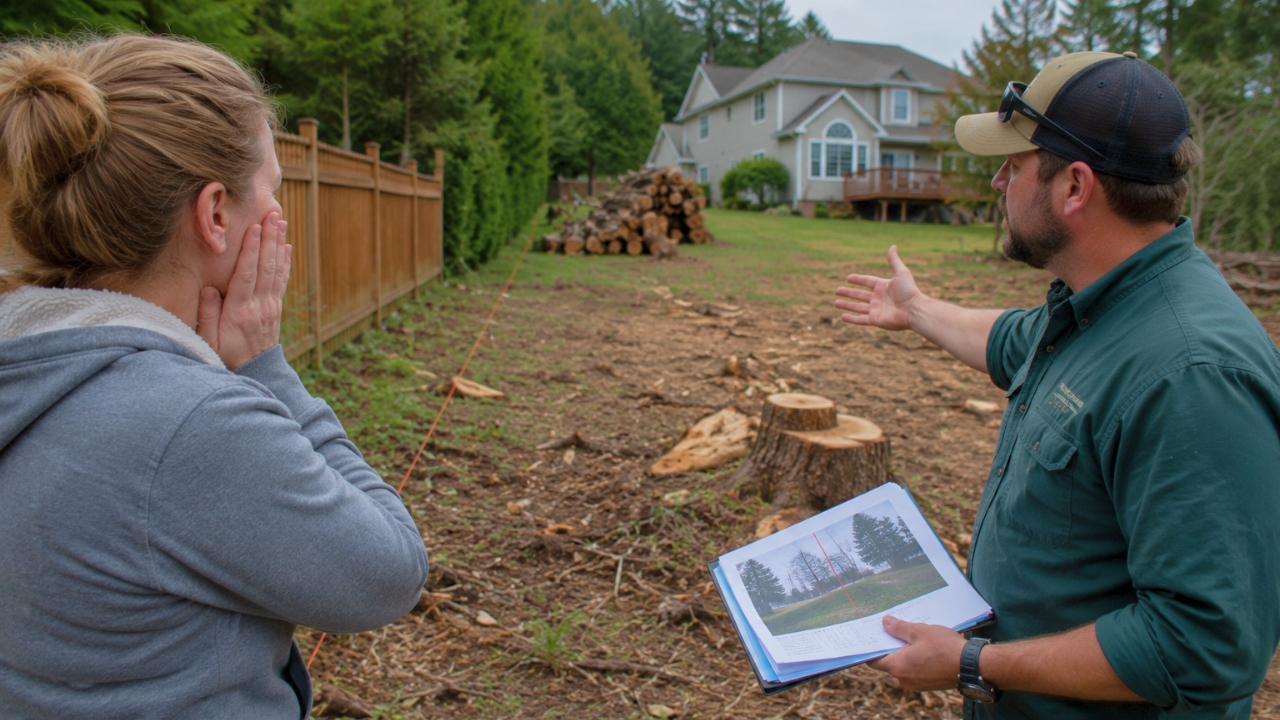
When an arborist gets involved, the dispute can move from emotional frustration to a documented estimate of loss. The arborist may consider the species, size, age, condition, location, replacement value, and impact on the property.
That number can surprise people.
Many homeowners underestimate the value of mature trees until one is removed without permission. Replacing a mature privacy screen, restoring a damaged landscape, or accounting for lost shade and property value can cost far more than the person with the chainsaw expected.
Once the estimate came back, the homeowner had something stronger than “I liked those trees.”
They had a professional assessment showing the loss could be expensive.
The neighbor’s intent may not save them
The neighbor may have believed they were acting within their rights.
Maybe they thought the trees were theirs. Maybe they thought they were on the boundary and could be removed. Maybe they were frustrated by branches, roots, or falling debris. Maybe they had been planning to clear that area for a fence or yard project.
But if the survey showed the trees were not solely theirs to remove, intent may not be enough to make the problem go away.
A mistaken property-line assumption can still cause real damage.
That is why surveys matter before cutting near a boundary. Tree removal is too permanent to base on guesswork.
The homeowner had to document everything quickly
After boundary trees are removed, evidence can disappear fast.
The stumps may be ground down. Logs may be hauled away. The area may be regraded or replanted. Without photos and records, it can become harder to prove what was there, where it stood, and how much was removed.
The homeowner needed to preserve as much as possible.
Photos of the stumps, the survey, the cut area, old listing photos, satellite images, security footage, and messages with the neighbor could all matter. The arborist’s written estimate would also be important, especially if the dispute moved toward insurance, mediation, an attorney, or court.
The homeowner also needed to know whether the removed trees were entirely on their property, entirely on the neighbor’s property, or straddling the line.
That detail could change everything.
Commenters focused on not accepting a casual replacement offer
When tree disputes come up, people often warn homeowners not to settle too quickly.
A neighbor may offer to plant a few small trees or pay for basic cleanup, but that may not come close to covering the actual loss. Young replacement trees do not instantly restore decades of shade, screening, and property value.
Commenters also tend to recommend getting the survey and arborist report in writing before negotiating. If local laws allow additional damages for wrongful tree removal, the homeowner may need legal advice before accepting any payment.
The key is not revenge.
It is making sure the homeowner does not absorb a major loss just because the neighbor acted before confirming the boundary.
The real issue was the neighbor making a permanent decision on uncertain land
The hardest part for the homeowner was likely the timing.
The survey was supposed to clarify the boundary. Instead of waiting, the neighbor removed the trees first.
That made the whole situation feel avoidable.
If the trees were the neighbor’s, the survey could have confirmed that. If they were the homeowner’s, the neighbor would have known not to touch them. If they were boundary trees, both sides could have discussed the next step.
But once the trees were cut, the only thing left to discuss was damage.
And when the arborist’s estimate turned that damage into a serious dollar amount, the neighbor’s decision to act before the survey no longer looked like a simple yard project.
It looked like a costly mistake.
Like Fix It Homestead’s content? Be sure to follow us.