New Homeowner Finds a Retaining Wall Built Over the Property Line — Then the Neighbor Says It Is Holding Up Their Yard and “Cannot Be Touched”
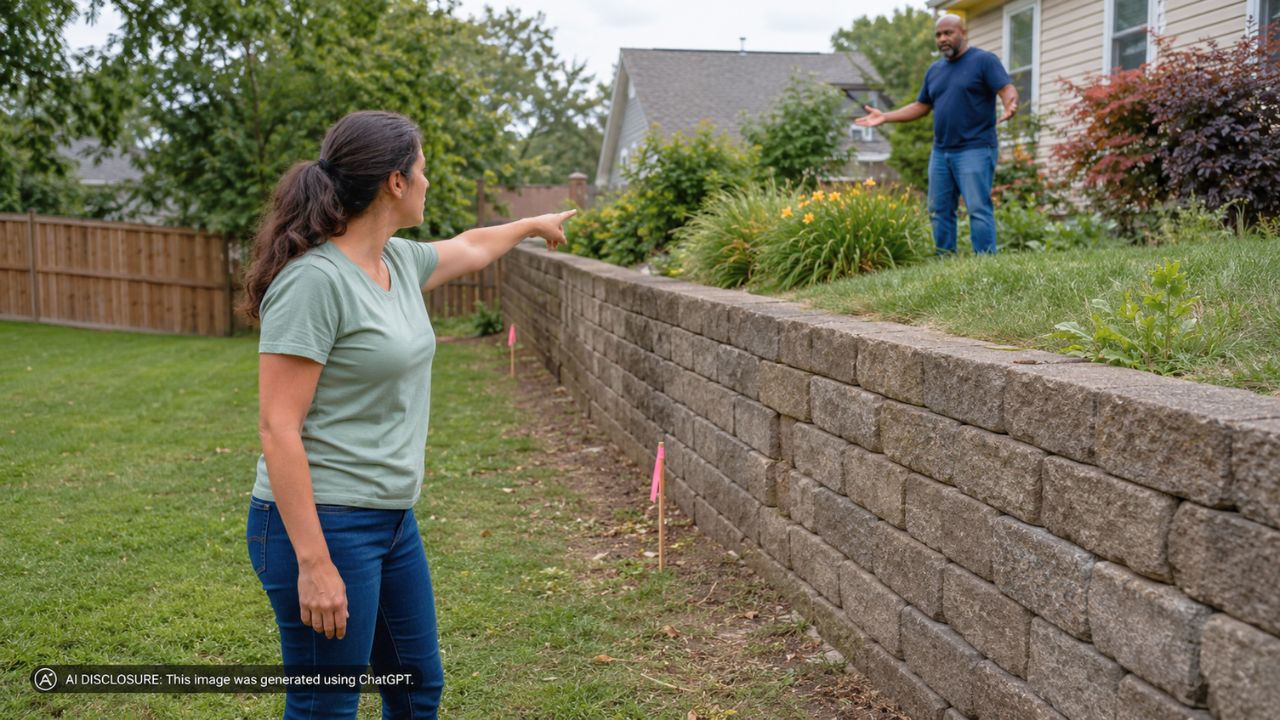
Photo credit: AI-generated image created using ChatGPT. Illustrative only
A retaining wall doesn’t feel like a “maybe” part of a house. It’s either there doing its job, or it’s not—and when it’s not, you start picturing soil shifting where it shouldn’t.
That’s the spot one Texas homeowner found themselves in after a neighbor announced the wall along the property line wasn’t theirs at all. In the original post, the homeowner described a hillside setup: their house was built in 1971 at the top of a hill, with an old retaining wall that had been in place for decades. The neighbor’s home came later, built in 1978. Both households had been living there peacefully—neighbors about a decade, the poster about five years—until the wall suddenly became a boundary fight.
A wall that “was never moved” suddenly became an argument
The homeowner’s understanding was simple: the retaining wall had always been there, and nobody had ever shifted it. They weren’t describing a new construction project or a fresh encroachment. This was legacy infrastructure, the kind you inherit when you buy an older home on tricky terrain.
Then the neighbor delivered a blunt message: the retaining wall was “100%” on her property. And she didn’t frame it as a question or a request for a joint review—she treated it like settled fact.
That’s when the anxiety kicks in for any homeowner on a slope. A retaining wall isn’t just decorative stone. If it’s doing real work, it’s tied to drainage, erosion control, and sometimes peace of mind about what’s happening beneath the surface.
The neighbor didn’t just complain—she removed the wall
The dispute escalated fast. According to the homeowner, the neighbor proceeded to remove the wall and then refused to rebuild it.
For the homeowner, the worry wasn’t abstract. They wanted the wall rebuilt to avoid foundation issues. When you live “on top of a hill,” you don’t need cracks in drywall to imagine where gravity wants to take everything.
But rebuilding brought a second problem: the neighbor’s claim implied the wall had been built on her land. If that were true, rebuilding it in the same spot could be treated as building on someone else’s property. The homeowner said they didn’t want to pay extra to excavate and “give back” the piece of land the neighbor said was hers.
The neighbor’s position was just as firm in the other direction. She told the homeowner they were “100% responsible for the wall.” In her view, it wasn’t her problem to replace something she insisted belonged to someone else, even though she was the one who removed it.
Splitting the cost sounded simple—until the survey question hit
In the middle of the standoff, the homeowner tried to find a middle path. Their instinct was diplomatic: split the cost, adjust the boundary issue, and move on. They even acknowledged the obvious next step: they needed a survey to confirm what land belonged to whom.
That’s the part that traps people. A shared repair on a shared problem sounds like the grown-up solution. But if one side is treating the property line as settled and the other side is unsure, every dollar spent can feel like you’re admitting something.
The homeowner noted they’d spent hours reading city codes and couldn’t find anything that clearly answered their main question: if a retaining wall sits on a neighbor’s land, who is responsible for maintaining it?
Meanwhile, the wall was already gone. Even if the dispute later got sorted out on paper, the physical reality had changed—and so had the urgency.
The update flipped everything: the wall was on the homeowner’s property
Then came the twist that turned a boundary disagreement into something sharper. The homeowner found the survey from when they purchased their house. According to that survey, the wall “was and has always been” on the homeowner’s property.
The neighbor, the homeowner wrote, still couldn’t provide proof for her claim beyond insisting it was true. And now, in the homeowner’s framing, the core problem wasn’t just the missing wall. It was that the neighbor removed a retaining wall that sat on someone else’s land.
That’s a different kind of panic. Before, the homeowner was worried about paying too much to rebuild on the “correct” side. After the survey surfaced, the homeowner was staring at the cost of rebuilding something that was allegedly removed without permission.
They started getting quotes to rebuild. But they also admitted their mindset had shifted: now they “kinda wanna make her pay” because, in their view, she had no business taking down the previous wall—especially since it “was not faulty at all.” They believed the neighbor removed it simply because she thought it was on her property.
What people zero in on in property-line fights like this
Even without a full comment thread included, the homeowner’s own instincts point to the usual pressure points people raise in disputes like this: documentation, surveys, and not relying on anyone’s “imagination” when the stakes are structural.
When the argument is “my property” versus “your property,” the boring paperwork becomes the only thing that matters. A survey from a home purchase can be the difference between a tense conversation and a claim that someone damaged or removed your improvements.
The other thing people tend to focus on is the order of operations. If you suspect a retaining wall matters for stability, you don’t want the hill to “vote” while the humans argue. Getting quotes, documenting the current condition, and moving toward a replacement is often the practical move—even if reimbursement or responsibility gets sorted later.
And finally, there’s the relationship fallout. Once someone has taken a shovel to something you believed protected your home, it’s hard to go back to friendly neighbor small talk. Even a “split the cost” offer can start to feel naïve after that.
The problem now is rebuilding without rewarding bad behavior
The homeowner ended up in a spot that feels familiar to anyone who’s dealt with property disputes: they need to fix the physical problem quickly, but they don’t want to set a precedent that the neighbor can make unilateral changes and leave them holding the bill.
Rebuilding a retaining wall isn’t like swapping a fence panel. It can mean excavation, drainage considerations, engineering, and a real chunk of money—especially on a hillside where mistakes show up later as movement, water issues, or cracks that never quite stop spreading.
At the same time, the homeowner’s update suggests their leverage changed when they found the survey. If the wall truly sat on their property the entire time, the neighbor’s “100% in my yard” claim stops being a misunderstanding and starts looking like an expensive decision made without confirmation.
For now, the homeowner is collecting quotes and trying to stabilize their situation. The wall is gone, the slope is still there, and the next build will likely be done with a lot more paperwork close at hand than the last one ever had. Sometimes the most stressful part of homeownership isn’t the repair—it’s the neighbor who decides the repair belongs to someone else.