Homeowner Finds the Neighbor’s New Retaining Wall Is Sending Runoff Straight Into the Yard — Then the Neighbor Says Their Contractor Assured Them the Drainage Would Not Affect Anyone
Photo credit: AI-generated image created using ChatGPT. Illustrative only.
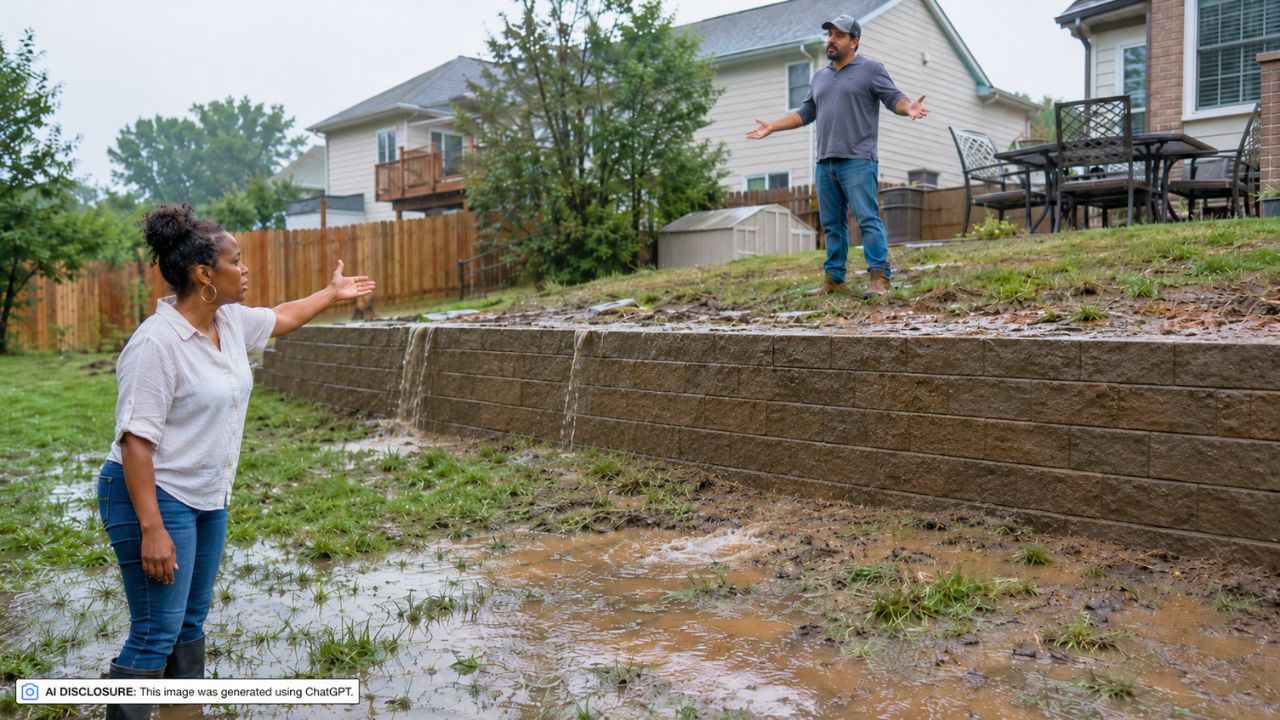
It started the way a lot of yard problems start: a rainstorm, a soggy patch of grass, and that nagging feeling that something “new” up the hill changed the way water moves. A homeowner watched their lawn turn into a wet mess and traced the path back to the neighbor’s recently built retaining wall.
When they brought it up, the neighbor’s response was basically a shrug with a receipt: their contractor had assured them the drainage wouldn’t affect anyone else. The homeowner, staring at a flooded yard, wasn’t feeling reassured—so they went looking for real-world options in the discussion where engineers and practical-minded commenters laid out the routes forward.
The yard didn’t just look wet — it felt like a warning
A flooded lawn is more than an eyesore. It’s that squishy, unstable ground that makes you avoid certain parts of the yard, the standing water that refuses to soak in, and the creeping worry about what it’s doing to everything nearby.
Once you start thinking about it, the stakes pile up fast: drowned grass, mud tracked into the house, and the possibility that water is heading somewhere worse than the lawn—like toward a foundation, a shed, or a fence line that’s already leaning.
In this case, the homeowner’s suspicion was focused: the neighbor’s retaining wall seemed to be sending runoff straight toward them. Whether it was a new outlet point, a changed grade, or simply water concentrating where it never did before, the timing made it hard to ignore.
The neighbor had an answer ready: “Contractor says it’s fine”
This is where a lot of property-line problems stall out. One side sees water showing up where it doesn’t belong. The other side points to a contractor and says it was handled, permitted, designed—pick your word—and that it “shouldn’t” be affecting anyone else.
But “shouldn’t” doesn’t dry out a yard.
The homeowner was left with that familiar, maddening gap between what someone promised during construction and what the weather is proving now. The retaining wall is up, the job is “done,” and the person dealing with the mess is the one who didn’t hire anybody.
Three paths kept coming up — and none were painless
Commenters boiled the homeowner’s options down into a handful of major routes, and none of them were magic.
One route is to make sure the water doesn’t flow onto the homeowner’s side in the first place. Commenters noted that this is “pretty difficult” and requires the neighbor’s cooperation. That’s the catch: the most direct fix often depends on the person who doesn’t currently feel the consequences.
Another route is to add a ditch or French drain on the neighbor’s side and send the water somewhere it won’t damage the homeowner’s property. Again, that’s cooperative work—either the neighbor acts voluntarily or you’re stuck with persuasion, persistence, and a lot of awkward conversations near the fence line.
The third route is the one several people kept circling back to: build the drainage solution on your own side. It’s not fair, and it can feel like paying to fix someone else’s problem, but it’s sometimes the only path that doesn’t require permission from someone who thinks the contractor already “handled it.”
The blunt take: the wall may not be the cause, just the visible change
One commenter pushed back on the idea that the retaining wall itself created the flooding. In their view, the water likely would have sloped that direction anyway, and the wall’s main job was preventing a mud slide or erosion—not necessarily redirecting runoff in the first place.
That’s not comforting if your yard is still soaked, but it does change how you plan a fix. If the grade naturally sends water your way, then “undoing” the neighbor’s construction won’t necessarily solve anything. The fix becomes about interception and controlled routing, not blame.
And that’s a tough pivot for a homeowner who feels like the timeline is obvious: the wall went in, then the flooding got worse. Sometimes both things can be true—water always wanted to go that way, but now it’s arriving faster or more concentrated than before.
The fix that sounds simple — and the detail that keeps it from becoming a disaster
The most practical suggestion in the thread was to dig a French drain on the homeowner’s side. That kind of solution is appealing because it’s actionable: you can plan it, price it, and do it without waiting for a neighbor to agree you have a problem.
But there was an important warning attached. The commenter recommended placing the drain at least a couple feet away from the base of the retaining wall to avoid undermining it and risking failure. That’s the part homeowners can miss when they’re desperate for anything that works.
Drainage fixes can cause damage if they’re too close to structural elements. Digging near the base of a retaining wall can destabilize the soil it’s depending on. And if that wall ever shifted or failed, now you’re not only fighting water—you’re potentially fighting gravity, mud, and a much bigger neighbor dispute.
So even when the “do it on your side” answer feels straightforward, it still comes with a careful planning step: keep the solution far enough away that you’re not accidentally creating a new problem that’s bigger than the flooded lawn you started with.
What people were really reacting to: control, proof, and avoiding a bigger fight
Under all the technical talk was something every homeowner understands: the stress of being stuck with damage you didn’t sign up for. The practical voices weren’t just giving drainage tips—they were steering the homeowner toward options they could control.
That’s why option three—draining on your own property—got the nod. Not because it’s the most satisfying, but because it can be the fastest to implement without turning the yard into a battleground of accusations about who changed what.
At the same time, the thread’s tone reflected a reality check: even if the wall is part of what’s making the runoff worse, the landscape is still the landscape. Water takes the path it takes. Your job becomes forcing it into a safer one.
For this homeowner, the next rainstorm will probably be the real deadline. Either they intercept the runoff before it turns the lawn into a sponge again, or they keep watching the same movie: storm clouds, pooling water, and a neighbor insisting the contractor said it wouldn’t be a problem.