Homeowner Comes Home to Find the Neighbor Cut Down Three Trees Along the Property Line — Then the Arborist’s Damage Estimate Makes the Loss Look Very Expensive
Photo credit: AI-generated image created using ChatGPT. Illustrative only.
It’s one thing to glance out and see a vacant lot next door getting cleaned up. It’s another to come home and realize the “cleanup” crossed the invisible line into your own yard—leaving three trees gone and a row of fresh stumps where shade and privacy used to be.
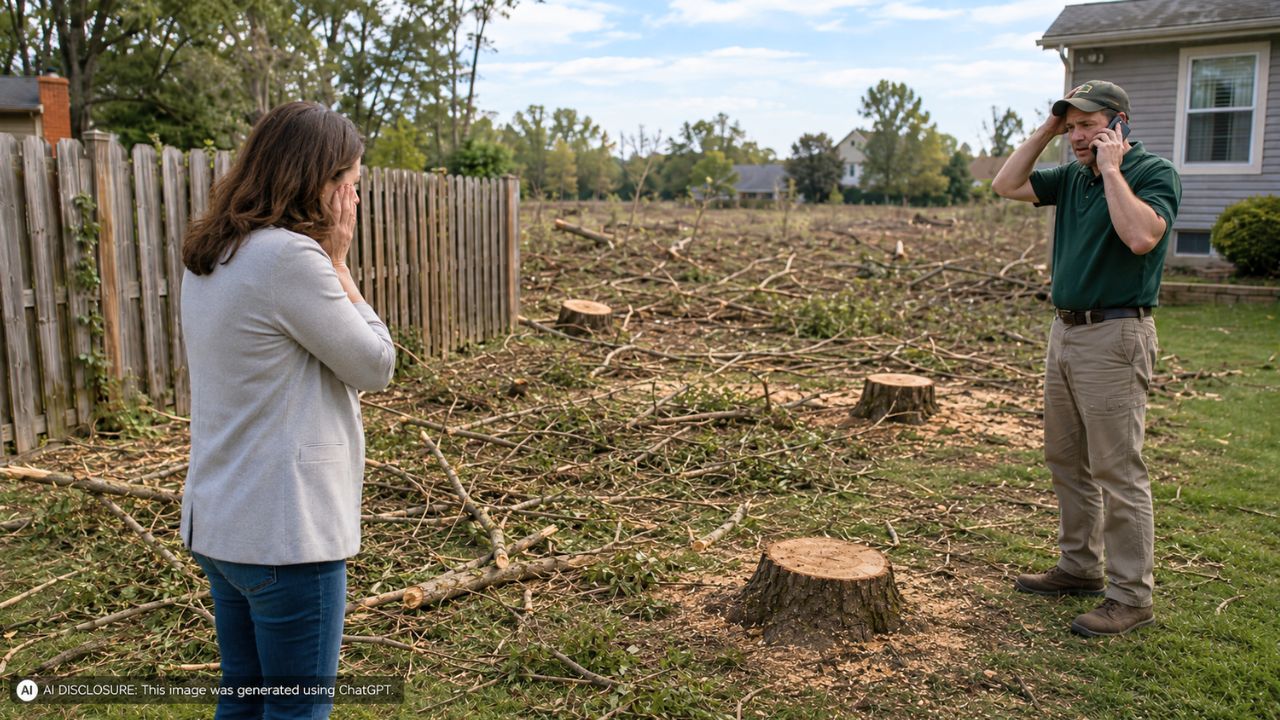
That’s the spot one Maryland homeowner found themselves in, laid out in the original post. The lot beside them had been bought about three years earlier and sat untouched until a tree crew showed up and clear-cut the property. Somewhere in that push to wipe the slate clean, three trees that the homeowner believed were theirs came down too.
A vacant lot finally gets “developed,” and the line gets blurry fast
The neighbor wasn’t another longtime homeowner. The poster said the current owner is a developer—exactly the kind of buyer who tends to move fast, bring in crews, and treat trees as obstacles instead of assets.
The homeowner didn’t claim to know the exact boundary markers. But they did have something that, in real life, most people treat as “close enough”: old fence posts in their yard from a previous fence line.
The trees that got cut were inside that old fence-post line. In other words, the loss didn’t feel like a maybe. It felt like a crew stepped into the wrong yard, dropped three trees, and kept going.
The worst part wasn’t the noise—it was the stumps
There’s a moment in these property-line messes where the problem turns from “annoying” into “permanent.” Here, it happened when the homeowner saw the aftermath and realized the trees were not coming back.
They didn’t have photos of the trees standing, which is a detail that instantly raises the stakes. A lot of homeowners don’t think to document their yard until something changes it. But once a tree is gone, you can’t easily prove what it was, how big it was, or what it was worth without some kind of record.
What they did have were photos of the stumps—taken before someone tried to grind them down. That matters, because grinding a stump can erase evidence quickly. Even if you’re not thinking “court case,” a stump is a physical timestamp: diameter, location, and the fact that a tree existed there at all.
The money question hit immediately: survey vs. tree value
The homeowner’s next thought wasn’t revenge. It was math.
They didn’t want to shell out for an expensive survey unless they could recover that cost along with the loss of the trees. That’s the catch with property disputes: even when you’re right, proving you’re right can be pricey.
And trees aren’t cheap in the way people assume. Between removal, potential trespass damages, replacement value, and the reality that mature trees can’t simply be “replanted” at the same size, the estimate on tree loss can jump from “this is frustrating” to “this is a real claim.” That’s why homeowners start thinking about arborists and small claims the minute sawdust settles.
The developer angle made it even more pointed. A developer typically has paperwork, plats, and surveys floating around—especially if they’re prepping a lot for future work. The homeowner suspected the developer should have a recent survey and didn’t love the idea of paying for a new one just to prove what the neighbor likely already had access to.
Before confronting the developer, they brought in the county
Instead of marching next door and starting a shouting match, the homeowner did something that tends to keep these situations from exploding: they called in the county.
A county inspector was scheduled to come out at the homeowner’s request. That step can change the tone instantly, because it moves the argument from “my word vs. your word” to “here’s a third party looking at what happened.”
It also buys time. When emotions are high, “pause and document” is often the only move that prevents people from saying the one thing they can’t take back—especially when the other party is a developer with contractors, deadlines, and money on the line.
The developer showed up, and the inspector didn’t mince words
The update is where the story shifts from helpless to fixable.
The county inspector came out and had the developer meet them on site. According to the homeowner, the inspector sharply reprimanded the developer for cutting trees without survey marks. That’s a big detail—not because it guarantees any specific legal outcome, but because it frames the mistake as preventable.
Then came the surprising part: the developer admitted they should have spoken to the homeowners first and agreed to replace the trees.
For anyone who’s dealt with a neighbor dispute, that’s a rare kind of clean ending. No posturing, no “prove it,” no months of letters. Just an authority figure pointing out the obvious—mark the line before you cut—and a developer choosing the cheaper route: make it right now rather than fight later.
And for the homeowner’s biggest worry, the outcome was even better. They said they didn’t need to pay for a new survey after all.
Reactions centered on proof, not payback
Even without a long comment thread included, you can feel the instincts that usually surface in these cases: document everything, don’t let anyone destroy evidence, and don’t assume a “property line understanding” will hold up once equipment rolls in.
The homeowner’s stump photos were the kind of quick thinking that can keep a dispute grounded in facts. Once the stumps are gone, it becomes much easier for a cutting crew to shrug and say they don’t remember—or to suggest the trees were “right on the line” when they weren’t.
The other practical piece was avoiding a one-on-one confrontation first. Getting an inspector involved created a controlled meeting where a developer couldn’t just brush the homeowner off. It also meant the conversation started with accountability instead of anger.
In the end, the homeowner got what most people want in a mess like this: recognition that the line wasn’t properly established, an acknowledgement that communication should have happened first, and a promise to replace what was taken. The trees won’t be the same overnight, but the dispute didn’t have to turn into a long, expensive fight to get there.
Like Fix It Homestead’s content? Be sure to follow us.