New Landowner Finds the Neighbor Cleared Trees Along the Property Line Without Permission — Then the Survey Confirms Every Stump Was on the Wrong Side of the Line
Photo credit: AI-generated image created using ChatGPT. Illustrative only.
The voicemail didn’t sound like a question. A neighbor said a tree service would be taking down “one or two” big pines along the property line the next morning, and framed it as a courtesy heads-up—done deal, no discussion.
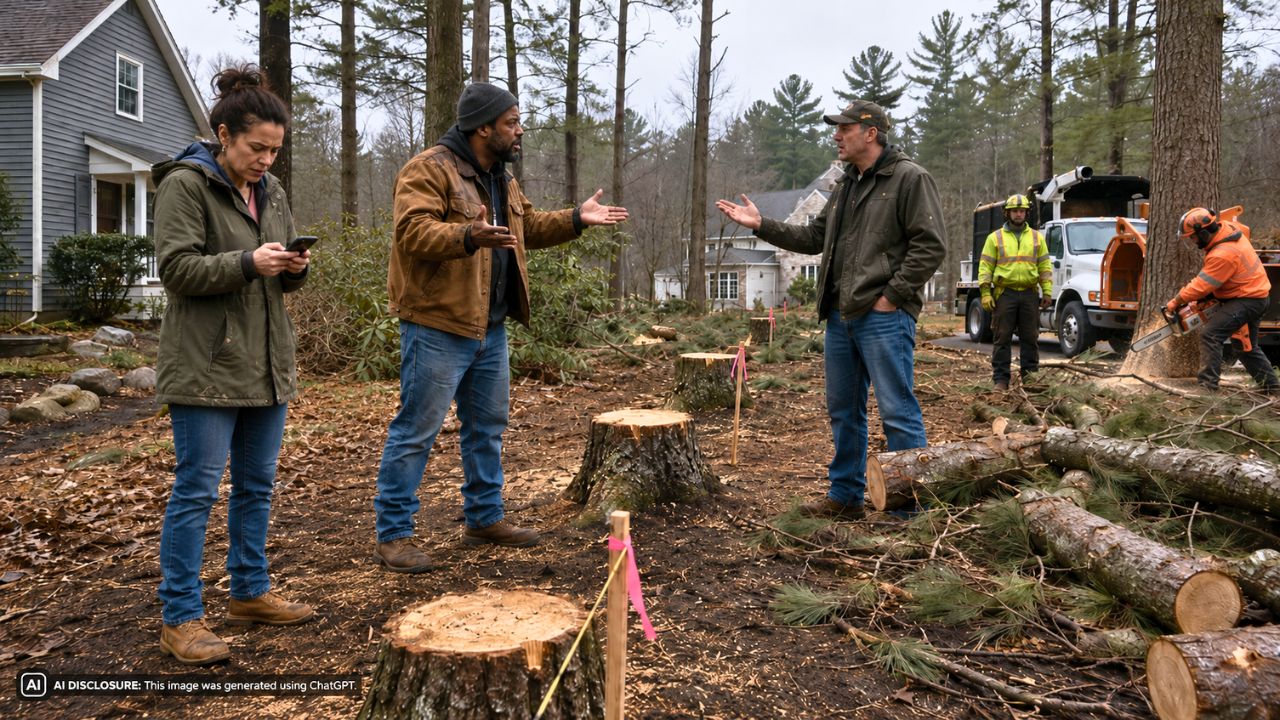
By the time the new-ish homeowners realized what was happening, trucks were already there and saws were already running. In the original post, the homeowners in Pennsylvania describe how that first cut turned into something bigger: a neighbor who insisted the trees were “theirs,” a tree crew willing to follow whoever was paying, and a property line that suddenly mattered more than it ever had before.
A “just letting you know” voicemail turned into chainsaws at breakfast
The homeowners say there were six tall pine trees—roughly 50 to 70 feet—running along the edge of their yard from back to front. The neighbor left a voicemail saying a tree service would be cutting down “one or two” of them the following morning.
That message landed the wrong way. The homeowners texted back asking to speak with the tree company first and requested the company’s name. They didn’t approve the work, and they say the neighbor didn’t respond.
The next morning, the crew arrived anyway. When the homeowners went outside, the boss reportedly told them, “the neighbor wants it cut so we’re cutting it.” When asked if the tree was sick or dead, the homeowners say the boss didn’t claim that it was.
The moment they tried to slow it down, the argument sped up
Here’s where a lot of property-line drama gets messy in real life: the homeowners suspected the tree was on shared property, but with a crew already on-site, they made a split-second decision. Believing it was just one tree, they agreed to let that work continue.
They also tried to put a boundary in place immediately—telling the crew to come to them before doing anything to the next tree. Instead, they say the crew cut branches off the second tree without asking.
While one homeowner was sitting out back, they overheard the neighbor talking loudly with the workers about how the homeowners “tried to shut them down.” The neighbor, according to the post, said, “too bad for them. We’re cutting down all of these trees.” That was the first time the homeowners realized this wasn’t a one-tree misunderstanding. It was a plan.
The fence made the line look obvious—until it wasn’t
The physical layout is part of what made this so tense. The homeowners described an old fence—20-plus years, they guessed—running between the neighbor’s house and the line of trees. From the homeowners’ perspective, that fence placement made the trees appear to be in their backyard and front yard.
But “looks like my yard” isn’t the same as “is my property.” The homeowners admitted they were first-time homeowners when they bought the place a few years earlier, and they didn’t fully appreciate how important a survey can be when you inherit old fences, old landscaping, and old assumptions.
Once the neighbor got aggressive, the homeowners’ focus shifted from arguing about etiquette to proving ownership. They didn’t want a debate. They wanted a line on paper that could stop another truck from pulling up.
When the neighbors came over, it stopped being polite
After the first tree came down and branches were clipped on the second, the homeowners went out front again and told the tree service they did not approve additional work. The crew’s response, as described in the post, didn’t offer much comfort: they said when they return, they’ll just cut the tree “from their property,” brushing past the problem that some trees can be jointly owned if trunks straddle the line.
Then the neighbors confronted the homeowners directly. The homeowners say they explained that permission was never given for the first tree, and the neighbors immediately raised their voices, cursed, and insisted the homeowners “don’t have a choice” about the rest coming down.
The neighbors also claimed the trees were theirs, but the homeowners say no proof was offered when asked. One homeowner recorded the exchange on their phone, which tells you how quickly the tone shifted from “we’ll figure it out” to “we need a record of this.”
Paperwork became the only realistic way to stop the next cut
Once the yelling starts, most people don’t want to keep having porch-to-porch showdowns—especially with contractors in the middle and equipment that can permanently change a property in minutes. The homeowners mapped out a plan that was part documentation, part containment.
First: go to the township to see what property-line information is already available and get guidance. Second: schedule a survey as soon as possible, even if it’s on their dime. Third: meet with a lawyer to draft a cease-and-desist letter to halt further cutting until ownership is settled.
They also tried to sound practical rather than purely emotional about it. While they’d prefer to keep the trees, they floated the possibility of flexibility if the trees were jointly owned—potentially allowing removal if the neighbors paid for it, proved the trees were unhealthy or hazardous, used a reputable insured company, and included stump removal.
That last detail matters. A felled tree is one thing. A line of stumps—especially on the wrong side of the property line—creates an ugly, expensive cleanup problem that can sit there like a reminder every time you mow.
What other homeowners pushed: survey first, then stop the bleeding
The discussion around the post leaned hard on a few practical points: get a survey, document everything, and don’t rely on a fence as proof of ownership. People also focused on the contractor angle—if a tree service is willing to proceed without confirming property rights, it puts the homeowners in a position where they have to physically intervene or escalate quickly.
Commenters also emphasized preserving evidence: saving the voicemail, keeping texts, recording interactions where legal, and getting the tree company’s information. When a dispute turns into “he said, she said,” the person with timestamps and paper trails usually has a clearer path forward.
And looming over all of it was the reality that tree removal isn’t a harmless weekend project. Mature trees are expensive to replace, and when they’re part of a boundary line, they’re also part of privacy, wind buffering, shade, and the way a yard feels. Losing one is noticeable. Losing six can change how a whole property lives and looks.
For the homeowners, the immediate problem wasn’t just the tree that already hit the ground. It was the fear that the next morning could bring another crew, another cut, and another argument—before the surveyor’s stakes ever made it into the dirt.
Like Fix It Homestead’s content? Be sure to follow us.