New Landowner Finds the Neighbor Landscaped and Fenced Part of the Property While It Sat Vacant — Then the Neighbor Says They Improved It and Should Be Allowed to Keep It
Photo credit: AI-generated image created using ChatGPT. Illustrative only.
When you buy a house, you expect to inherit the roof, the basement quirks, maybe an overgrown hedge out back. One new homeowner in Upstate New York says they inherited something else: a shrunken yard, because a next-door neighbor had been treating a big slice of their lot like her own for years while the place sat derelict.
In the original post, the homeowner explains they only learned the backstory recently—from a different neighbor—after ongoing tension about where their kids are “allowed” to play. Now they’re looking at what should be their side yard and realizing the property line might not match the way the ground has been used for a long time.
An “extra-skinny” lot that didn’t start that way
The homeowner describes their lot as “extremely skinny,” especially compared with other homes nearby. The neighbor next door, meanwhile, has “two gigantic side lawns” and, according to the post, doesn’t really use them. The imbalance bothered the homeowner even before they knew why it existed.
Then came the piece that made it all click: another neighbor told them the grumpy woman next door had, years earlier, “assume[d] property rights” to a large portion of what should be this homeowner’s lawn. The house was derelict back then, and the neighbor’s son—described as a landscaper—regularly mowed that section.
That steady maintenance, over time, appears to have helped cement the idea that the strip belonged to the neighbor. Whether it changed anything legally is a different question, but on the ground it changed the shape of the yard the new owner thought they’d bought.
Three kids, a porch, and a lot of yelling
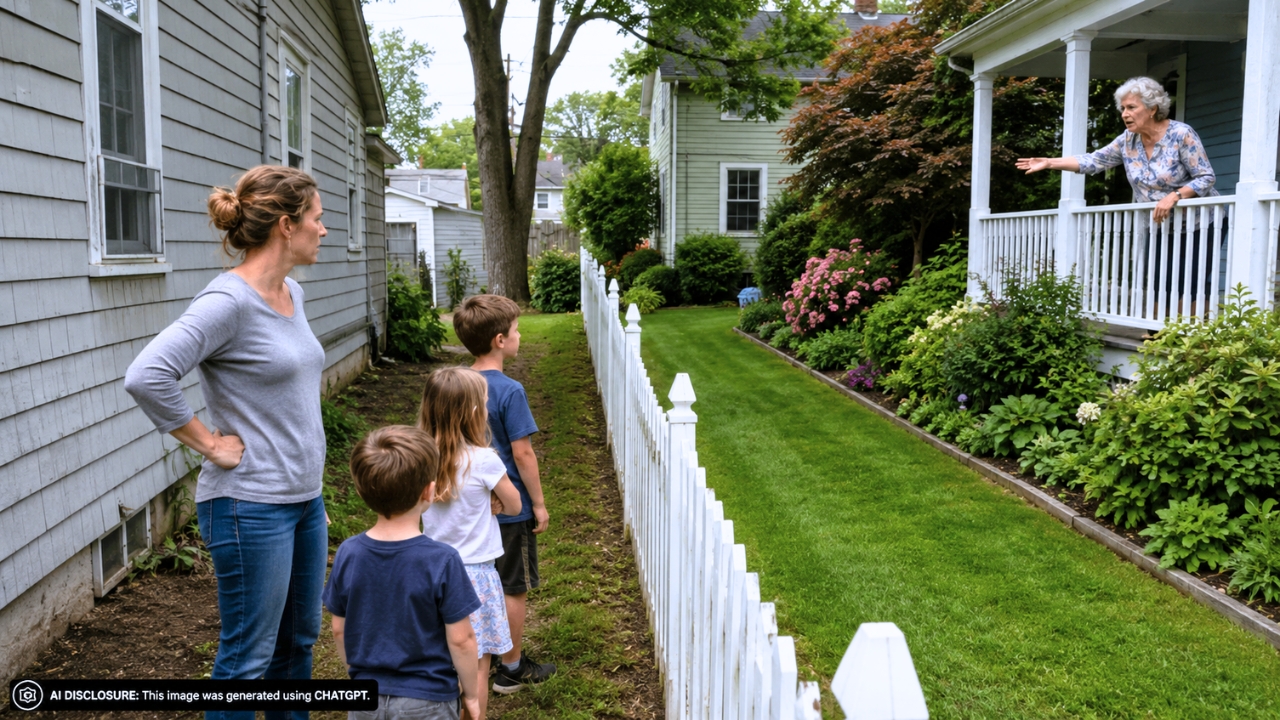
Property-line disputes can simmer for years until something makes them personal. Here, it’s kids. The homeowner has three children, and they say the neighbor “regularly tries to chase them off ‘her land.’”
The post paints a specific picture: the neighbor doesn’t come outside to garden or enjoy the yard, but will “plant herself on her front porch” to yell and threaten the kids when they’re on the disputed area. It escalated into “a big row,” not just about land, but about how an adult should address children in the neighborhood.
The homeowner’s stance is straightforward: if there’s a problem, talk to the parents, not the kids. And once they heard the area may have been part of their lot originally, the anger shifted into something sharper—feeling like they’re being pushed off their own property while trying to raise a family.
How “taking care of it” turned into “it’s mine”
This is the kind of neighborhood story that happens quietly: one home sits neglected, grass grows high, and the closest neighbor gets tired of looking at it. Maybe they start mowing “just to help.” Then it becomes a habit. Then it becomes a boundary in people’s minds.
In this case, the homeowner says the neighbor had her son mow the lawn regularly when the house was in bad shape. Over time, the neighbor acted like she had ownership of that portion of land. Now, the homeowner says she behaves like it’s unquestionably hers—and enforces that with yelling when the kids cross an invisible line.
The maddening part is that the lawn itself can become the “proof” in everyday life. If it’s been maintained by one household for long enough, other neighbors may start repeating the story as if it’s settled fact. The homeowner is now dealing with a lived reality—patterns of use and neighborhood expectations—that can be hard to unwind even if the deed says otherwise.
The moment it stops being a yard and starts being leverage
A side yard isn’t just grass. For a family, it’s play space, a spot for a swing set, room for a garden, or simply breathing room between houses. Lose a “large portion” of it and the property changes—how it feels, how it functions, even how private it is.
The homeowner’s frustration also comes through in the comparison: the neighbor has more yard than she uses, while the homeowner’s lot feels cramped. That inequality, paired with the neighbor’s aggressive enforcement, turns the strip of lawn into leverage. It’s not just about mowing; it’s about who gets to feel comfortable stepping outside.
And because the house was derelict before the current owner ever showed up, they’re stuck playing catch-up. They didn’t agree to any informal boundary. They didn’t watch it happen. But they’re the ones who have to live with the consequences—and possibly pay to fix it.
What people urged: measure first, argue second
Even without a flood of details in the post about replies, this type of dispute tends to draw the same practical refrain from other homeowners: don’t rely on stories or vibes—get the line on paper. When a neighbor claims a piece of your yard based on years of maintenance, the next step usually isn’t a shouting match over the porch railing. It’s documentation.
That often starts with the basics: deed descriptions, any existing survey, and visible markers. If those don’t answer it clearly, people typically recommend hiring a surveyor and getting the corners pinned so the boundary is physically marked in a way that doesn’t depend on anyone’s memory.
From there, the advice usually shifts to protecting yourself from escalation. If a neighbor is already yelling at children, homeowners tend to think about cameras, written communication instead of face-to-face confrontations, and keeping a record of incidents. Not because it’s fun to “build a file,” but because these fights can turn into bigger ones fast—especially when one party believes they already won the yard years ago.
A yard dispute that doesn’t stay in the yard
The homeowner ends their post with the question a lot of new landowners eventually face: can they “claim that land back,” and has anyone dealt with something like this before? They’re not just annoyed—they’re “even more pissed” now that they believe they’ve been pushed off land that was supposed to come with the house.
In neighborhoods where old habits became “property lines,” the hardest part is that you’re not only challenging one person—you’re challenging a routine that has been normalized. That’s why these disputes can feel so lopsided: one neighbor has years of confidently acting like it’s theirs, and the new owner has to start from scratch proving otherwise.
For now, the tension is still right there at the edge of the lawn: three kids trying to play, a neighbor on the porch enforcing her version of the boundary, and a homeowner realizing that fixing up a house sometimes means fixing what everyone else decided was true while it sat empty.