Rural Landowner Gets a Survey Done and Finds the Neighbor’s Stone Wall Runs Six Feet Into the Property — Then the Neighbor Claims It Has Stabilized the Embankment for Thirty Years and Moving It Would Cost More Than the Land Is Worth
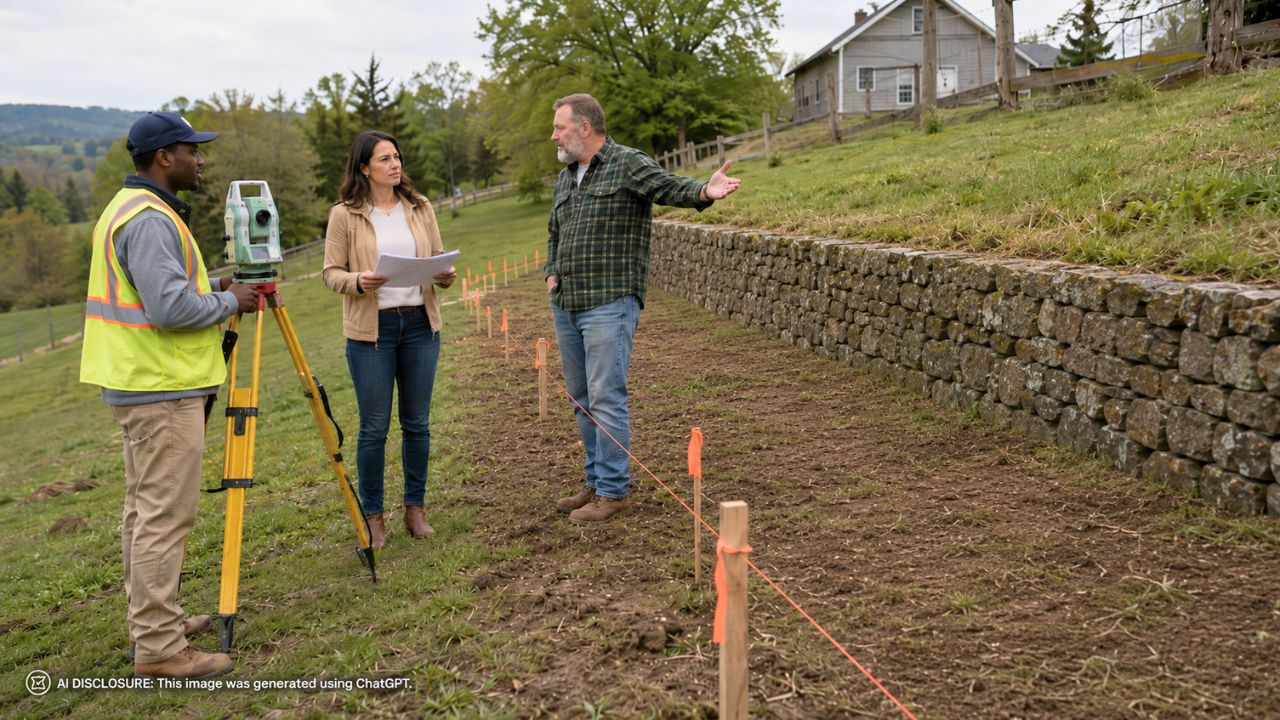
Photo credit: AI-generated image created using ChatGPT. Illustrative only.
It started like a lot of rural boundary questions do: a landowner finally paid for a proper survey because “about where the line is” stops feeling good enough once you’re planning improvements. The stakes didn’t seem huge at first—until the survey stakes went in and the old stone wall that everyone treated like the divider turned out to be sitting about six feet onto the surveyed property.
That’s when the neighbor’s tone shifted from casual to immovable. The wall, they said, wasn’t just a pretty border. It had “held the bank” for decades, and moving it now would be a disaster—expensive, disruptive, and potentially more costly than the strip of land it sits on. And as anyone who has dealt with slope, runoff, and shifting soil knows, a wall isn’t just a wall when it’s acting like a retaining structure. The legal basics behind who owns and maintains a boundary retaining wall—and why “it’s been there forever” isn’t the whole story—are laid out in the source post.
The survey made it real, fast
Before the survey, the wall was easy to ignore. It was old, it blended into the landscape, and it probably looked like it had always been “the line.” In rural areas, that’s how it goes: people inherit assumptions along with property.
But surveys don’t care about tradition. Once a licensed surveyor pins corners and marks a boundary, you suddenly have a measurable encroachment, not a vague neighborly understanding. Six feet doesn’t sound like much until you picture a long run of wall and what that adds up to in square footage, access, and future plans.
And the wall wasn’t some decorative stack of rocks you can nudge back on a weekend. The neighbor’s argument centered on the wall’s function: it stabilized an embankment. That changes the conversation from “move your fence” to “what happens to the hillside if this gets disturbed.”
When “boundary wall” turns into “retaining wall”
The biggest twist in these disputes is that the structure sitting near the line may also be doing a job the land depends on. Retaining walls exist to hold back soil, and once soil is involved, the consequences of failure get physical—slumping, sliding, drainage changes, even damage to nearby areas.
The source material lays out the first key question: where is the wall relative to the legal line? If a survey shows the wall is entirely on one owner’s property, that owner generally owns it and is responsible for maintaining it. If it’s entirely on the other side, the responsibility typically follows.
But it gets messy when the wall is on or near the line—or when people have treated it like a shared boundary for so long that they stop thinking about deeds and start thinking about “what’s always been there.” Add in the fact that footings and buried portions can cross the line even when the visible face looks innocent, and you can see why this spirals so quickly.
The neighbor’s strongest card: “It supports the land”
The neighbor’s claim wasn’t just sentimental. It leaned on a real concept: landowners have a duty of lateral support, meaning you can’t change your land in a way that causes your neighbor’s land (in its natural state) to slide or collapse without taking steps to support it. Retaining walls often exist because someone cut into a hillside, built up a grade, or otherwise changed the landscape.
That’s where the argument gets thorny. If the wall exists because one side altered their land—flattened a pad, cut into a slope, created a driveway bench—then responsibility for building and maintaining that support can follow the party who made the change, and it may even carry forward to later owners.
So now the landowner with the survey isn’t just thinking about reclaiming a six-foot strip. They’re also thinking: if I insist this wall gets moved, and the bank fails, does that turn into a much bigger problem? The neighbor’s warning might be self-serving, but it also might be a real engineering risk.
“It’s been there 30 years” doesn’t automatically settle it
This is the part that makes homeowners grind their teeth. A long-standing wall can feel like it should count for something—like time itself should convert an encroachment into a right.
But time alone doesn’t answer the practical questions that actually matter day-to-day: who maintains it, who pays when it fails, and who is liable if it damages something. The source material emphasizes that responsibility is usually tied to ownership and maintenance duties, and those often come back to the wall’s location and any written agreements recorded with the property—things like covenants or easements that spell out access and upkeep.
In other words, “we’ve always had it this way” may explain how the neighbors lived with it, but it doesn’t replace a survey, a deed, or a recorded agreement. And it definitely doesn’t stop gravity and water from doing what they do.
Everyone’s afraid of the same thing: a failure that ruins the hillside
Once a wall is framed as “holding the bank,” both sides have a new fear: what happens if it cracks, leans, or gives out. Retaining wall failure isn’t just cosmetic. It can move soil, alter drainage paths, and chew up usable ground.
The legal angle in the source comes back to negligence and maintenance. If the party responsible for the wall knew—or should have known—it was in a dangerous condition and didn’t take reasonable steps, they may be liable for resulting damage. That puts pressure on whoever “owns” the problem, because doing nothing can be its own kind of decision.
And here’s where the original landowner’s survey win starts to feel like a loss: even if the wall is technically on their side, that could also mean inheriting a structure that’s expensive to repair, hard to engineer correctly, and politically explosive to touch.
What people latched onto: paperwork first, talking second
The most common reactions in these neighbor wall fights tend to be less about bravado and more about documentation. Once you have a survey showing the wall encroaches, the next instinct is to lock down proof before emotions take over: photos, measurements, and written communication.
The source material specifically points to documenting damage with photographs and notes, then communicating in writing—especially if there’s visible deterioration or any sign the wall is failing. That advice fits even when the wall isn’t actively collapsing yet, because the moment someone starts talking about “moving it,” you want a clear record of its current condition.
People also tend to focus on whether there’s any recorded agreement that changes the default rules. A wall that “everyone shares” in conversation isn’t the same as an easement that grants access for repairs or assigns responsibility for maintenance costs. Without something in writing, neighbors can end up in a standoff where each side is waiting for the other to blink.
In the end, the landowner with the survey is stuck between two expensive realities: letting a six-foot encroachment sit there because disturbing it could trigger a bigger slope problem, or pushing the issue and risking a chain reaction of engineering, permits, and neighbor retaliation. Out in the country, where walls and banks can run long and memories run longer, a few survey stakes can turn “quiet coexistence” into a problem that doesn’t go away just because nobody wants to look at it.