HGTV keeps doing this with fireplaces and it rarely works in normal rooms
Photo credit: Joseph Hendrickson/Shutterstcok.com
Television makeovers keep selling you a fantasy fireplace wall that photographs beautifully but rarely behaves in a real living room. When you try to copy the same floor-to-ceiling stone, floating hearth, and TV combo in an average house, you often end up with a space that is hard to furnish, uncomfortable to use, and expensive to fix. Once you understand why those showpiece fireplaces misfire in normal rooms, you can borrow the drama without inheriting the daily frustrations.
The TV-over-fireplace problem you feel in your neck
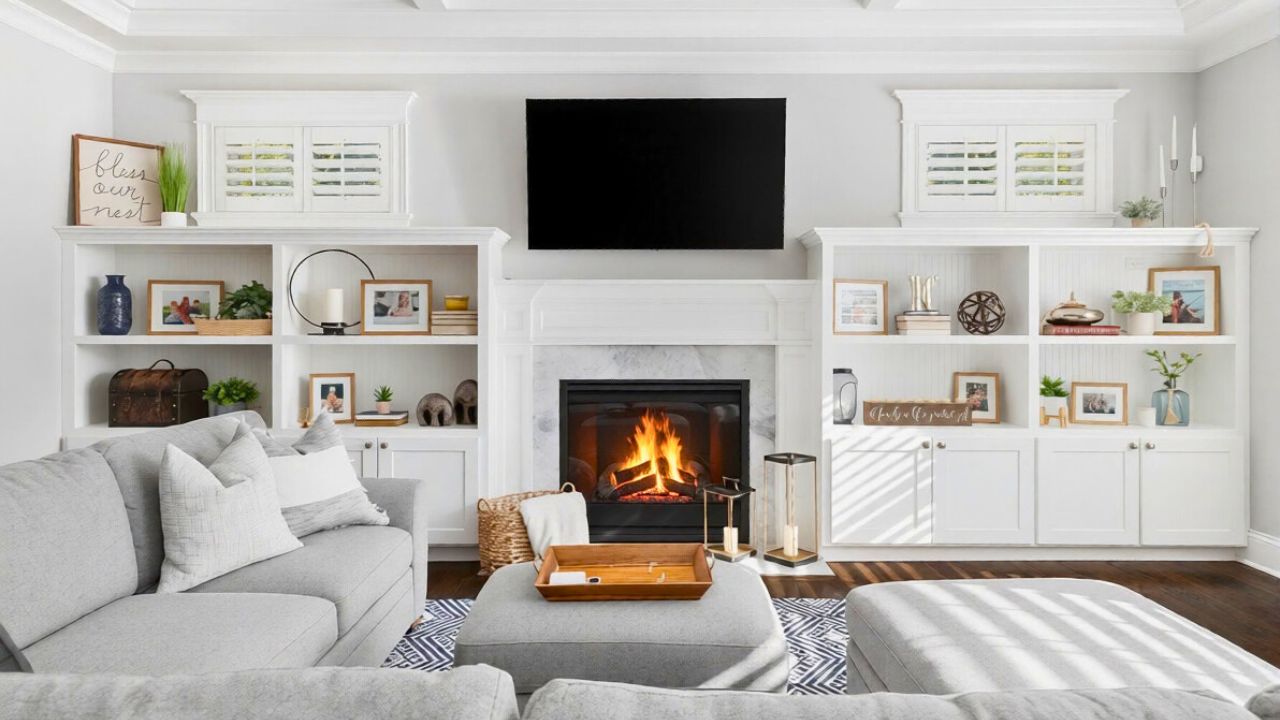
On HGTV-style reveals, the TV almost always lands above the firebox, framed by a perfect paneled wall or sleek slab. In a still photo, the symmetry looks clean and intentional. In a real living room, that same placement usually forces you to crane your neck, sit too far back, or push your sofa against the opposite wall just to see the screen. You are not imagining it when that layout feels uncomfortable, because your natural eye line when you sit is much lower than the average mantel height.
Designers who work with home technology point out that when there is no depth to recess the screen into the wall, the TV ends up looking like it is simply stuck on the surface, which is exactly what happens in many builder living rooms that copy TV shows without adjusting the framing. One viral clip bluntly notes that Most TVs over fireplaces look wrong and explains that when you cannot sink the unit back, the whole wall reads top-heavy and awkward. If you have a standard eight-foot ceiling or a shallow chimney bump-out, you feel that problem even more because you do not have the vertical room to soften the proportions.
Fireplaces that ignore how you actually live
Another pattern you see on HGTV is the fireplace treated as a pure styling moment rather than a working part of your daily routine. In glossy shots, the firebox is perfectly clean, the logs are artfully arranged, and the chairs are perched at photogenic angles that no one would ever choose for movie night. Try to copy that setup at home and you often discover that the seating faces away from the rest of the room, the coffee table is out of reach, and there is nowhere to put a laptop, a toy basket, or a dog bed without blocking the view of the flames.
Design specialists warn that Treating the Fireplace as Purely Decorative is one of the biggest layout mistakes, especially when you have limited square footage. When you let the fire dominate every decision, you often end up Ignoring Textural Balance and Interrupting the Fireplace Focal Point with random shelving or media units that compete for attention. In a modest living room, that kind of overemphasis leaves you with a space that looks like a set instead of a place where you can spread out a board game or plug in a phone charger.
Oversized fireplace walls that swallow small rooms
Show producers love a sweeping fireplace wall because it delivers instant drama on camera. Floor-to-ceiling stone, thick mantels, and massive built-ins photograph as luxurious upgrades that justify a renovation budget. In a typical starter home or condo, replicating that scale can throw your room completely out of balance. When the surround is too wide or too tall for the space, every other piece of furniture has to fight for visual attention, and your sofa and chairs start to feel like dollhouse pieces pushed up against a stage set.
Professional decorators flag this kind of scale problem as part of a wider pattern of Oversized Furnishings that leave a space feeling cramped and awkward. In one design guide that lists 32 common errors out of 71 examples, the authors highlight how a single outsized element can overpower everything else, especially when you ignore the relationship between ceiling height, window size, and major focal points such as a firebox. When you let the surround balloon beyond what your walls and windows can support, you recreate that Mistake of Oversized Furnishings in the most permanent part of your living room, which is far harder to swap out than a sofa.
Modern statement designs that clash with your house
You also see a steady stream of sleek, linear fireplaces framed in razor-thin black metal, even in older homes that still have traditional trim, paneled doors, and classic window proportions. On television, that contrast reads as bold and editorial. In your own 1950s ranch or 1920s bungalow, the same ultra-contemporary insert can look like it was dropped in from another building. When the firebox style, surround material, and mantel profile ignore the language of the rest of your architecture, the room never quite feels settled.
Fireplace specialists describe this as a Mismatch With the, which is one of the Top Mistakes To Avoid in Modern Fireplace Design. When you install a minimalist ribbon flame in a house full of ornate casing without adjusting anything else, the result can feel like two different projects colliding. The same experts caution that when you overcomplicate the design with too many finishes, niches, and ledges, the fireplace stops acting as a calm focal point and starts to look like a showroom display instead of part of a thoughtfully curated space.
Fake and purely decorative fireplaces that disappoint buyers
HGTV reveals often lean on electric or decorative units that can be installed quickly and turned on with a remote during filming. Those inserts create a cozy glow on camera with minimal construction mess. When you later tour renovated listings that copied the look, you sometimes find a pretty surround with no real heat output and no practical function beyond mood lighting. That kind of fake hearth can feel especially disappointing in colder climates where you expect a fireplace to contribute at least some warmth.
Home shoppers have started to notice a wider pattern of cosmetic upgrades that prioritize visual impact over everyday use. In one discussion about renovated homes, a buyer described walking through properties All over the country that featured fake, decorative fireplaces in the living room while skipping basic kitchen appliances entirely. When you see a nonfunctional firebox treated as a selling point while essentials are missing, you are looking at the downside of copying TV-ready styling without considering how you will actually live in the space once the cameras are gone.
When the TV and fireplace fight for the same wall
One reason the typical HGTV-style fireplace fails in normal rooms is that it tries to solve two competing needs on a single surface. You want a comfortable place to watch TV and a pleasant focal point for conversation, but stacking the screen over the fire rarely delivers both. If you sit close enough for an immersive viewing experience, the heat can feel intense and the vertical angle strains your neck. Move the seating back to reduce those issues and you risk turning the room into a bowling alley with furniture pushed to the edges.
Homeowners have been pushing back on this layout for years, arguing that putting the television above the fire is one of the worst interior trends because it forces you to compromise both comfort and aesthetics. Some point out that Homes are already designed poorly in many cases, and that Many living rooms simply do not have the depth to support two strong focal points on the same wall. Retailers that sell large screens echo the concern, explaining that when you hang a TV above a fireplace without adjusting height, distance, and angle, you create a setup that may look tidy from across the room but feels wrong the moment you sit down to watch.
Floor-to-ceiling stone that forgets safety and maintenance
Television projects love to wrap a fireplace in dramatic stone or tile from the hearth all the way up to the ceiling, often with a minimal mantel or no mantel at all. That continuous surface photographs as high-end and sculptural. In a real home, a full-height surround can be expensive to build safely and tricky to maintain. You have to think about how soot, dust, and seasonal cobwebs will look on a tall textured surface that you cannot reach without a ladder, especially if your room has a ceiling higher than eight feet.
Chimney and masonry professionals note that in many homes, yes, Floor to ceiling stone or tile is a common goal in fireplace redesigns, but it requires proper framing, fire-rated substrates, and careful attention to clearances around combustible materials. Stone specialists add that the very first element of fire safety is the initial construction, since Stone itself is very fire resistant but the way you build the hearth, wood burner, and surround determines how safely the system performs over time. When you chase a dramatic TV look without verifying what is behind the wall, you can end up with a heavy finish applied to framing that was never designed to carry that load or handle that heat.
Homeowners who regret TV-ready fireplaces
Because HGTV projects are built for a reveal, you rarely see what happens months later when the novelty wears off and the homeowners try to live with the design. Viewers who follow these shows closely have collected stories of clients who were unhappy with the results, sometimes because the work did not match their lifestyle, and sometimes because of workmanship concerns. In one discussion, a commenter summarized that Yes, some homeowners on HGTV home improvement shows have complained about damage or poor construction after filming wrapped, which is a reminder that what looks polished on screen can hide structural shortcuts.
Other viewers have zeroed in on specific fireplace choices that felt more like props than thoughtful upgrades. One person who watched a season of a popular renovation series described loving the mix of old and new and the warm wood textures, yet still wondered why the designer installed a particular feature wall instead of putting a real fireplace in. That kind of reaction captures the gap between a reveal that plays well for television and a layout that supports your daily routines, from heating to furniture placement to where you plug in a phone charger.
How to adapt HGTV inspiration so it works in your house
If you still love the drama of a television-worthy fireplace, you can adapt the ideas so they function in a normal room. Start by deciding whether the fire or the TV will be your primary focal point, then let that choice drive the layout. If the screen wins, consider placing it on a different wall at eye level and treating the fireplace as a secondary feature with a lower, simpler surround. If the hearth is the star, plan your seating around comfortable conversation distances and consider hiding a smaller TV in a cabinet or on a side wall instead of forcing both elements to share the same axis.
Next, match your fireplace style to your home’s architecture and your own habits. Use the guidance on Top Mistakes To Avoid in Modern Fireplace Design as a checklist, and avoid installing a feature that feels disconnected from your trim, windows, and flooring. If you are tempted by a floor-to-ceiling surround, talk with a qualified contractor about framing, substrates, and clearances, and review safety advice that emphasizes how the construction around a firebox matters just as much as the finish. Finally, when you browse social media clips that insist Most TVs over fireplaces look wrong or scroll through Design Mistakes You are Making Around a Fireplace shared via Making Around a Fireplace on Livingetc, treat them as prompts to question your assumptions rather than rules to copy blindly. You can still borrow the warmth, texture, and visual impact of a showpiece fireplace, as long as you let your own room and routines have the final word.
Like Fix It Homestead’s content? Be sure to follow us.
Here’s more from us:
- I made Joanna Gaines’s Friendsgiving casserole and here is what I would keep
- Pump Shotguns That Jam the Moment You Actually Need Them
- The First 5 Things Guests Notice About Your Living Room at Christmas
- What Caliber Works Best for Groundhogs, Armadillos, and Other Digging Pests?
- Rifles worth keeping by the back door on any rural property
*This article was developed with AI-powered tools and has been carefully reviewed by our editors.