New Homeowner Returns From Vacation to Find the Neighbor Removed Four Mature Maples From the Property Line Without Notice — Then the Neighbor Says the Roots Were Cracking the Foundation and the Work Was Legally Necessary
Photo credit: AI-generated image created using ChatGPT. Illustrative only.
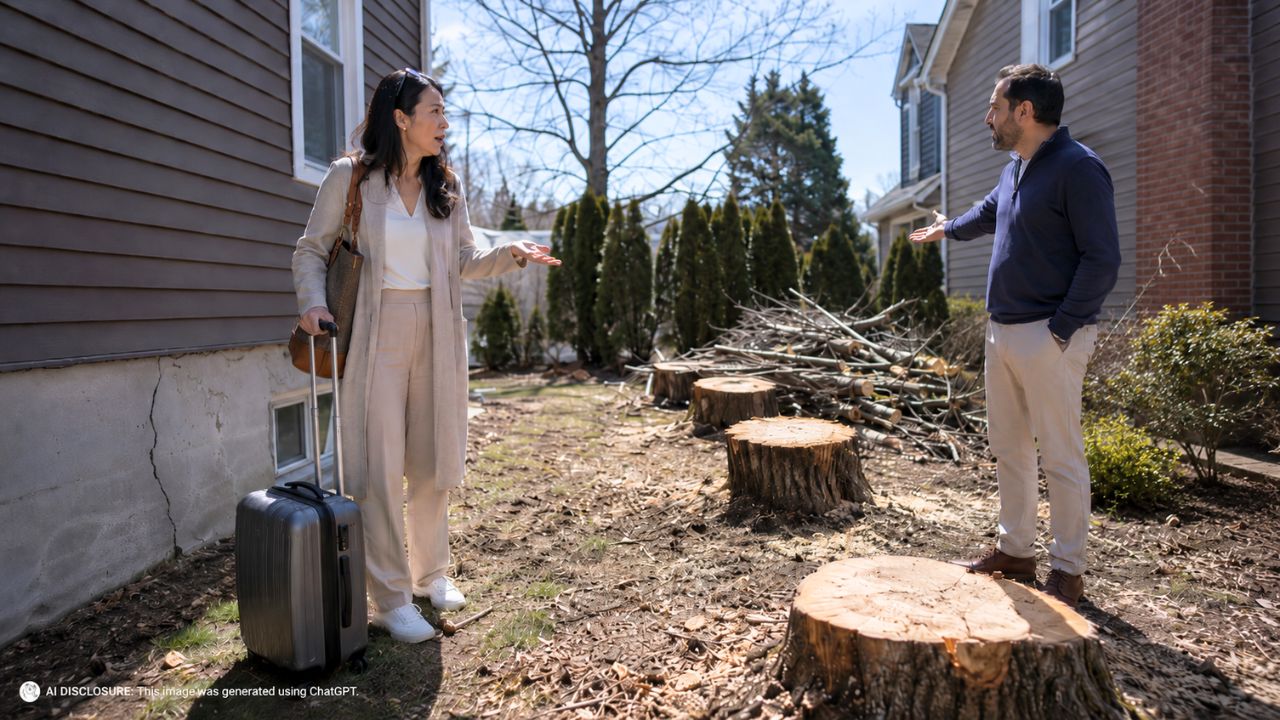
She left for a big trip and came back expecting the same backyard she’d been enjoying for decades — the same shade, the same quiet, the same “favorite place” to sit and breathe. Instead, she walked into a bare, sun-blasted edge of property where four mature maples used to stand along the line with the neighbor.
The story, shared through the source post, lays out a familiar kind of homeownership whiplash: you leave for a little while, and someone else makes an irreversible decision about your property. In this case, it wasn’t storm damage or a fallen limb. It was a neighbor deciding the trees had to go — without waiting for the homeowner to agree.
She came home to a yard that didn’t feel like hers anymore
The person asking for advice said their friend had been traveling in Europe when the next-door neighbor had the trees cut. The trees were described as mature maples that straddled the property line — not something small you replace with a quick run to the nursery.
There had already been talk about removing the trees. The neighbor had previously brought it up with the homeowner, and the homeowner didn’t agree to taking them down. Then, while she was away, the trees were removed anyway.
The emotional hit wasn’t subtle. The homeowner’s reaction, relayed in the post, was raw: “My favorite place that I’ve enjoyed for 22 years… now a hot baking environment, all my plants chosen for the shady conditions over decades… all [ruined]. I am devastated and furious.”
The property line sounded “simple” until the fence complicated it
Tree disputes are never just about a tree. They’re about control, boundaries, and what people think they’re allowed to do when a trunk sits close to a line on a map.
In this case, the tree was described as being on the neighbor’s side of a fence, which is exactly the kind of detail that causes real-world confusion. A fence can feel like the boundary even when it isn’t. People treat it like a legal wall, even if it’s just where someone once decided to place boards.
But the homeowner believed the survey mattered more than the fence line. According to the post, the property had been surveyed in the past, and that survey determined about 60% of the tree was technically on her side of the property line.
That detail changes the tone from “neighbor trimmed a branch” to “neighbor removed a shared asset.” And a mature shade tree isn’t just landscaping. It’s temperature control, privacy, and the kind of long-term value you can’t replace quickly.
Four maples isn’t just a view change — it rewrites the whole yard
People who haven’t lived with mature trees don’t always understand the chain reaction when they’re suddenly gone. Shade gardens are built over years, sometimes decades. Soil conditions shift. The sun hits the house differently. Wind comes through in new ways.
For this homeowner, the biggest immediate consequence was the sudden loss of shade. The backyard went from a long-established, cooler environment to what she described as “a hot baking environment.” That’s not a minor inconvenience when you’ve chosen plants for low light “over decades.”
It’s also the kind of change that can create a second round of costs and labor: replacing plants, rethinking irrigation, and trying to protect what survives while the yard adjusts. Even the simple act of spending time outside can feel different when you lose the canopy that made the space comfortable.
And because the trees were removed while she was away, she didn’t even get the small mercy of being present for the decision, the contractor conversation, or the moment it happened. She came home to the aftermath.
The neighbor’s justification: roots and “necessary” work
The headline version of these stories often includes a justification that sounds practical: the roots were damaging something, the tree was a threat, the work had to be done. In the source material here, the neighbor’s earlier complaints about the tree are mentioned, and the idea of damage — like roots impacting nearby structures — is the kind of argument neighbors lean on when they want to frame removal as unavoidable.
What made this one combustible is that there was no shared plan and no notice that the work was happening. The homeowner didn’t get a chance to see whatever the neighbor claimed was wrong, ask for documentation, or propose less extreme options.
Even if someone is worried about roots, most neighbors at least try to handle it in daylight: written requests, quotes from arborists, and a conversation when both parties are home. Doing it while the other owner is overseas turns it into something that feels less like maintenance and more like a property line power move.
Commenters zeroed in on proof: surveys, photos, and what “shared” really means
The person who posted was looking for guidance, and the responses in spaces like this tend to gravitate to the same core idea: prove everything before you argue about anything.
In a dispute over a tree that straddles a line, the first question is always where the trunk sat, not where the fence runs. The post’s mention of a prior survey — and the claim that 60% of the tree was on the homeowner’s side — is exactly the kind of fact people cling to when deciding whether this is a handshake disagreement or a court-worthy problem.
The homeowner’s plan, as described, was to sue. That’s not a small escalation, but it tracks with what happens when the harm can’t be undone. Once the tree is gone, there’s no trimming it back, no negotiating about future pruning, no resetting the boundary with better communication. The only “remedy” left is money and accountability, and those tend to require documentation.
Even without getting into legal weeds, the practical reactions are predictable: people want to see the survey, the photos, and any record that the neighbor had asked and been told no. Because the story isn’t just about a tree — it’s about whether one homeowner can unilaterally erase something that partially belonged to another.
Now the backyard has to be rebuilt, and the neighbor relationship may not recover
The hardest part of this kind of dispute is that it creates two separate messes at once. One is physical: a yard that no longer functions the way it did, and plants that may fail because the microclimate changed overnight.
The other is social: you still have to live next to the person who made the call. Every future project — fences, sheds, landscaping, drainage — gets filtered through the new reality that one side believes the other will act first and explain later.
For the homeowner, the loss was immediate and personal. She didn’t just lose trees. She lost a place she’d built over 22 years, and she came home to find the most permanent part of it removed while she was gone.
Whether the next steps happen through attorneys, surveys, or tense face-to-face conversations, the yard won’t go back to what it was. The only thing left to decide is who pays for that change — and how a property line can feel so thin until someone crosses it with a chainsaw.