Rural Property Owner Hires an Arborist Who Confirms the Neighbor’s Logging Operation Cut Thirty Feet Into the Property — Then the Neighbor Says the Timber Company Marked the Boundary From the Wrong Starting Point
Photo credit: AI-generated image created using ChatGPT. Illustrative only.
It starts with a sound that doesn’t belong on a quiet rural property: chainsaws. Then comes the light. A once-thick strip of trees that used to swallow noise and block sightlines is suddenly opened up, and you can see straight through to the neighbor’s place.
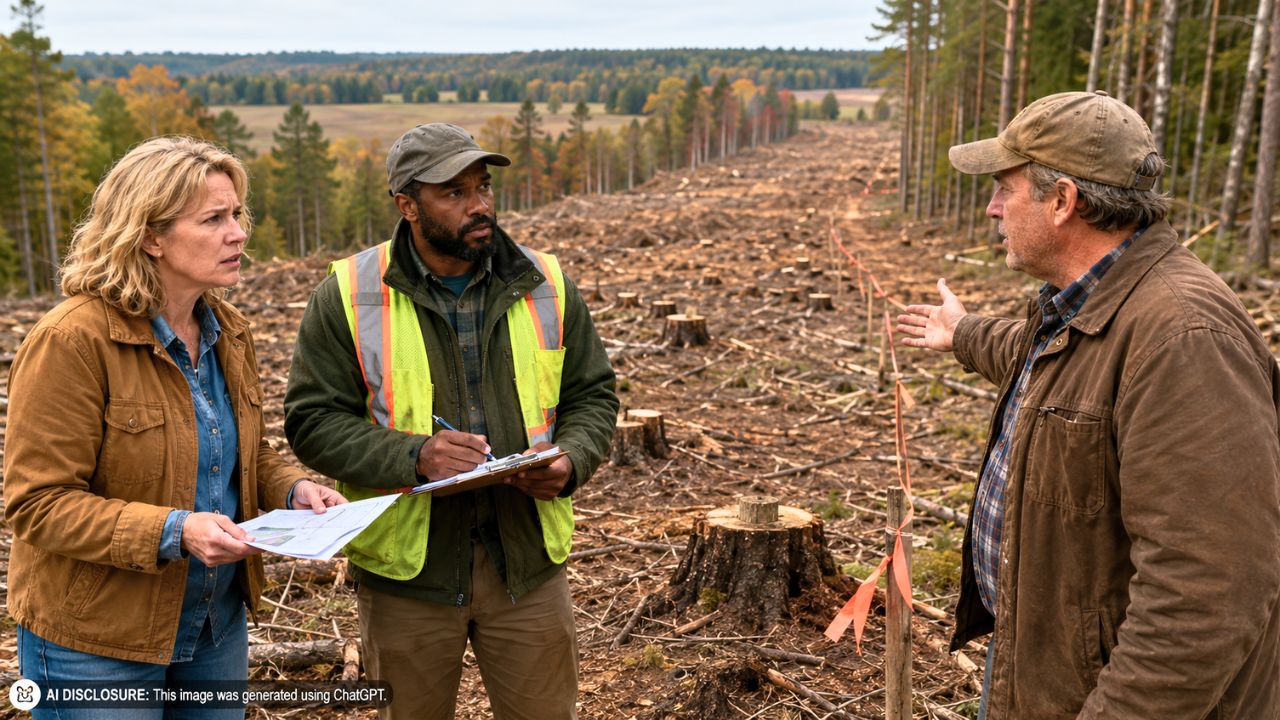
That’s the moment one rural homeowner described in the discussion, after neighbors cut trees close to what everyone assumed was the boundary. Only after the trees were on the ground did the neighbors get a survey—one that reportedly showed the cutting didn’t just “get close.” It went roughly 30 feet onto the homeowner’s side.
A tree line isn’t just landscaping out here
In town, losing a few trees can be frustrating. In the country, that tree line can be the whole reason the property feels livable. It’s privacy, wind break, shade, and a buffer from headlights, dogs, dust, and day-to-day neighbor activity.
The homeowner said the change “severely compromised the aesthetics” and removed “all privacy between our homes.” That’s not just about how it looks. It’s the feeling of being exposed on your own land, with no quick fix that brings back decades of growth.
They cut first—then proved where the line really was
The detail that made this sting worse was the order of events. The neighbors cut down the trees near the property line, and then had the land surveyed after the fact.
That survey, according to the homeowner, showed the logging went about 30 feet into their property. Thirty feet doesn’t sound huge until you picture it as a long, cleared strip—one that can erase a mature screen of trees and change the entire view from your windows, porch, or driveway.
In rural settings, people often rely on “everybody knows where the line is.” Old fence remnants. A ditch. A row of trees. A memory. But when equipment shows up and the work starts, assumptions don’t protect your side of the boundary.
The neighbor’s explanation: blame the starting point
Once the survey came back, the neighbor didn’t deny the cut happened. Instead, the homeowner describes the neighbor shifting the explanation: the timber company marked the boundary from the wrong starting point.
That kind of claim is the sort that can set a dispute on rails. Because even if it’s true that a contractor started from the wrong corner, the result is still a visible, measurable loss on the homeowner’s property. The stumps don’t move. The view doesn’t revert. And “we thought it was ours” doesn’t replant mature trees.
It also raises the immediate question most property owners dread: if someone else did it, who is actually on the hook? The neighbor? The logging crew? Whoever directed them? That’s when a tree dispute stops being a handshake problem and turns into documentation, liability, and money.
The damage you can’t ignore once the screen is gone
The homeowner focused on aesthetics and privacy, but anyone who has lived with a lost tree line knows the secondary problems start piling up quickly.
Suddenly, there’s no barrier between homes. Noise carries. Lights travel. Pets spot each other. The “back acreage” that used to feel tucked away feels like an open side yard. If the cut area was on a slope or near drainage, it can change how water moves across the ground, too—even if that part wasn’t mentioned directly.
And even if the neighbor agrees it was a mistake, the fix isn’t simple. A line of saplings doesn’t replace a wall of mature timber for years. If the homeowner plants, they may be planting near a boundary that’s now disputed. If they don’t plant, they live exposed.
What people told the homeowner to focus on: proof, paper, and timing
In these kinds of property-line tree messes, the most common advice is usually boring—and urgent. Save proof. Keep everything in writing. Don’t let it turn into a shouting match across the yard.
Even with only the homeowner’s short description available, the practical priorities are easy to guess because they’re the same ones that come up in almost every rural boundary dispute: confirm the boundary with a survey you can rely on, document the extent of the cutting, and start treating it like a damage claim instead of a neighborly misunderstanding.
The reason timing matters is simple. When trees are gone, the evidence disappears fast. Logs get hauled. Brush gets burned or chipped. Stumps get ground. And once the site is “cleaned up,” it becomes harder to show what was taken and how far the cut went onto your land.
People also tend to push homeowners to think beyond the emotional loss of privacy and focus on measurable damages—because the only way to get paid back, or to force a remedy, is to translate “my property feels ruined” into something that can be proven and valued.
The part that keeps neighbors from moving on
There are some disputes that cool off after a week. This isn’t one of them. A 30-foot incursion doesn’t fade into the background; you see it every day. And the neighbor’s “wrong starting point” explanation practically guarantees tension, because it frames the homeowner’s loss as an accident caused by someone else.
That leaves the homeowner staring at a raw edge where the tree line used to be, while the neighbor points to a contractor, and the contractor (if they’re involved at all) points back to whoever told them where to cut. Meanwhile, the homeowner still has no privacy and no easy way to replace what was removed.
For rural property owners, the lesson is harsh but familiar: boundaries aren’t real until they’re verified, and trees don’t give you a second chance. Once they’re down, you’re not arguing about where the line “always was.” You’re arguing over a scar that will take years to heal—if it ever does.