New Landowner Has the Land Surveyed and Finds the Neighbor’s Chicken Coop Has Occupied a Corner of the Property for Over Fifteen Years — Then the Neighbor Says the Structure Is Grandfathered and Cannot Be Forced to Move
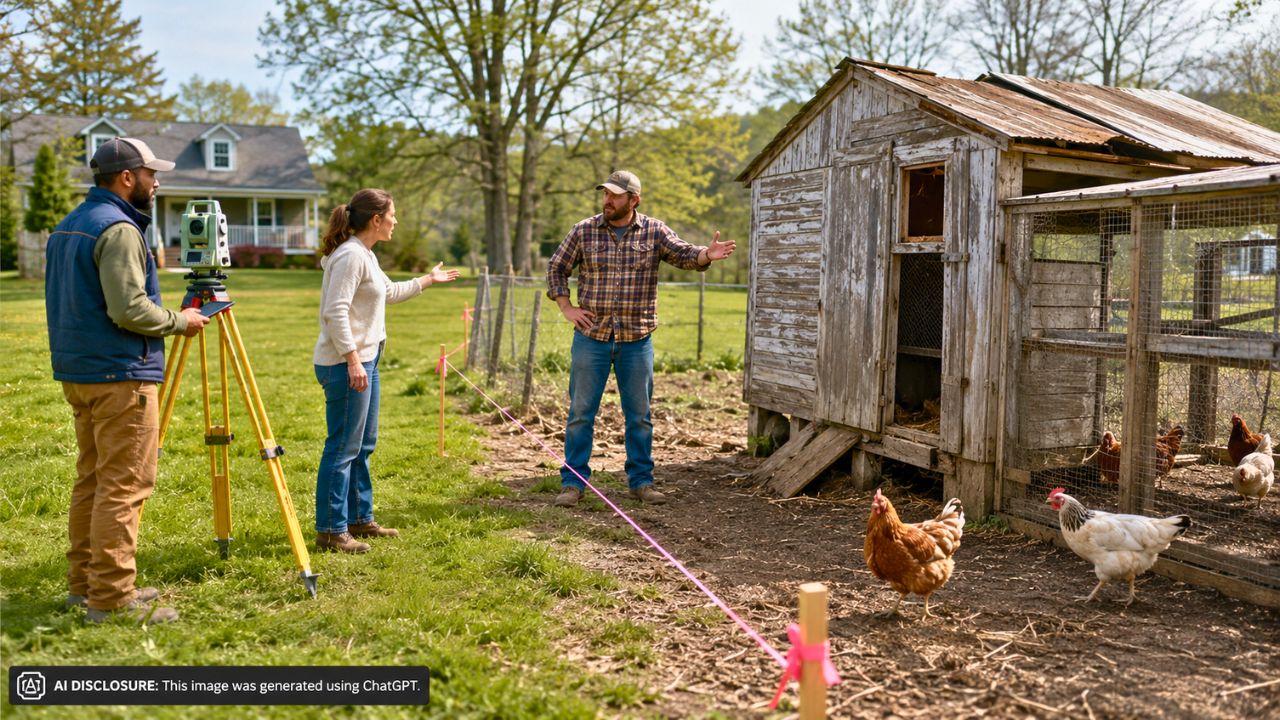
Photo credit: AI-generated image created using ChatGPT. Illustrative only.
The new owner thought the survey would be a quick formality—just paperwork to go with a closing, another box checked on the way to finally calling the place “home.” Instead, the survey lines brought an old, half-forgotten boundary issue back to life: a neighbor’s structure sitting where it shouldn’t, right over the property line.
In a similar real-world question posted online, a homeowner described discovering that a neighbor’s garage was encroaching onto their land while the property was in escrow, and they had already disclosed it to the other side’s realtor—only to be told everything was fine. The details come from the source post, where the person also pointed out a detail that makes these conflicts feel extra personal: they pay the property taxes on that land.
The survey didn’t just find a line—it found a problem
Property-line disputes have a way of hiding in plain sight. A shed corner, a fence that “always looked like it belonged there,” a coop tucked behind some brush. For years, nobody brings it up because nobody wants to start a feud over a few feet of dirt.
But a survey doesn’t care about the local peace treaty. It pins the corners, draws the line, and suddenly the question isn’t “Does this bother me?” but “What do I own, and what is sitting on it?”
That’s the moment the new landowner in this kind of story runs into the classic neighbor response: the structure has been there forever, it’s “grandfathered,” and it can’t be forced to move. In the JustAnswer post, the homeowner was dealing with a garage rather than a coop, but the knot is the same—an encroachment discovered during a time when the property is changing hands and everyone wants it smoothed over fast.
Escrow pressure makes everyone want it to disappear
Escrow turns normal problems into urgent problems. Timelines tighten. Money is on the line. Lenders, agents, and sellers all want a clean file with no surprises that could delay closing or scare off financing.
In the posted question, the homeowner said the property was currently in escrow and they disclosed the encroachment to the realtor. The response they got—“everything is fine”—is the kind of sentence that can make your stomach drop, because it sounds less like a solution and more like a hope.
“Fine” for whom, exactly? If a structure sits on land you’re paying taxes on, it doesn’t feel fine. It feels like you’re funding someone else’s footprint. And if you’re the one trying to sell or buy, “fine” can also mean “not my problem,” which is how these things get passed from owner to owner for another decade.
“Grandfathered” is the neighbor’s favorite word for “don’t touch it”
The neighbor’s argument in these disputes is often simple: it’s been there so long that it’s basically legal now. People call that “grandfathered,” like the structure aged into a protected status the way an old ordinance might.
But in real life, that word gets used loosely. Sometimes it’s about zoning or permits. Sometimes it’s about adverse possession or prescriptive easements. Sometimes it’s just a way to say, “We’ve always done it this way, and I’m not changing.”
The JustAnswer homeowner wasn’t asking for revenge or a shouting match. They asked a practical question: since they pay taxes on the property, what actions can they take? That’s the core tension—this isn’t just about whether a neighbor is being difficult. It’s about what rights come with ownership, and what can happen when those rights are ignored long enough that everyone starts treating the encroachment like it’s normal.
The real stakes aren’t aesthetic—they’re access, liability, and resale
A chicken coop or garage sitting over the line isn’t just an eyesore. It can block access to a corner of your property you may need for maintenance, fencing, drainage work, or future building. A few feet can matter when you’re trying to put in a gate, run utilities, or keep animals contained.
Then there’s liability. If someone gets hurt around that structure—slips, trips, or a fire starts—neighbors can end up pointing fingers about whose land it was on and who should have prevented it. Even if you “win” an argument later, dealing with the mess is the punishment.
Resale is where it bites hardest. Buyers don’t like cloudy boundaries. Lenders don’t like surprises. Title companies don’t like disputes. If an encroachment becomes an acknowledged issue, it can turn into the kind of disclosure that keeps showing up every time the house changes hands.
And when you’re in escrow, you can feel the pressure to accept a shrug instead of a fix—because the fix might mean negotiations, surveys, legal letters, or delaying closing while everyone figures out what “fine” is supposed to mean.
Most people zeroed in on one thing: proof first, talking second
When homeowners share these disputes online, the most common advice tends to be less about dramatic confrontation and more about documentation. A survey is usually the starting gun, not the finish line. People want a clean, dated paper trail that shows exactly where the line is and exactly how far the structure crosses it.
In stories like this, the practical-minded crowd usually pushes for keeping everything in writing—especially when a realtor is downplaying it. Not because realtors are villains, but because their job is to close deals, and boundary disputes are deal-killers.
There’s also a quiet warning that experienced homeowners tend to repeat: don’t rely on friendly verbal promises when land is involved. Today’s handshake can become tomorrow’s “I never said that,” especially after a sale, after a family member inherits, or after a neighbor decides they don’t like your new fence line.
The hardest part is choosing your next move without lighting the fuse
The homeowner in the source post asked what actions they could take, and that question lands because it’s where every new landowner gets stuck. Push too hard and you risk turning a neighbor into an enemy you’ll see every week. Do nothing and you risk losing practical control of a piece of your property—or at least living with a permanent headache that will resurface when you sell.
It’s also emotionally lopsided. The person with the structure on the line may feel they’re being attacked for something that “has always been there.” The person who just bought the land feels like they’ve inherited a problem that should have been addressed years ago, yet now it’s their responsibility to clean up.
And when escrow is in the mix, the clock is always ticking in the background. The paperwork wants a simple answer. The property line doesn’t care. The neighbor’s building doesn’t care. You either accept it, negotiate it, or fight it—but none of those options feel like the quick, clean version of “everything is fine.”
In the end, that’s what makes these encroachment stories so tense: it’s not just a corner of land. It’s a test of what ownership means when “mine” and “yours” have been blurred for years, and the only thing that finally draws the line is a surveyor’s stake in the ground.