Rural Landowner Finds a Sixty-Year-Old Fence on the Wrong Side of the Survey Line — Then the Neighbor Says Six Decades Is Long Enough to Make It His
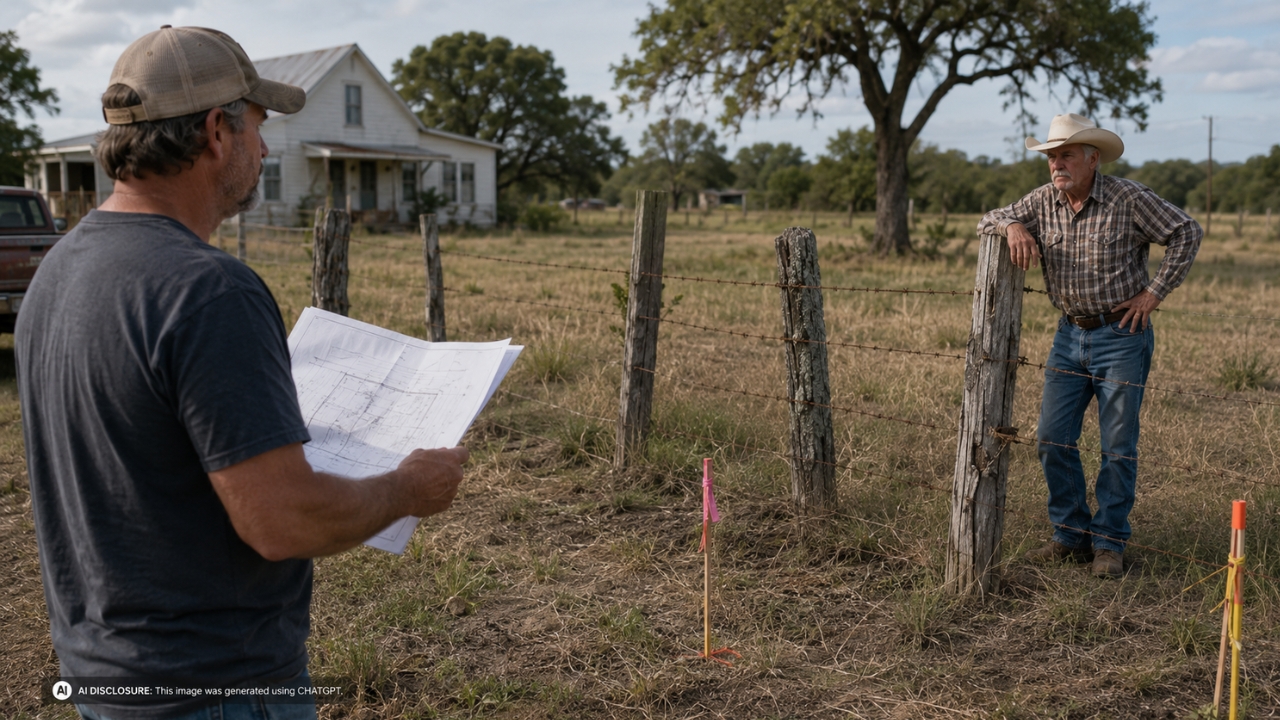
Photo credit: AI-generated image created using ChatGPT. Illustrative only.
The fence had always been “the line.” Not just a piece of wire and posts, but the quiet agreement that told everyone where one yard ended and the other began. Then a relative passed away, the house shifted into an estate process with living heirs, and a neighbor suddenly claimed that old fence wasn’t just old—it was wrong.
In the original post, a Texas family member described a rural-feeling problem that hits hard when a property changes hands: the neighbor wants to buy the house, says the fence is “multiple feet” over on his property, and insists that because it’s been that way for 62 years, the land on the house side should now be considered his.
A quiet boundary line suddenly became the main issue
For decades, the fence sat where it sat. No arguments, no adjustments, no urgent letters in the mailbox. The heirs’ assumption was simple: if it was truly on the wrong side, someone would’ve brought it up a long time ago—especially over a span of 62 years.
But the timing is what made this feel less like a neighborly “heads up” and more like a tactic. The neighbor reportedly wants to purchase the property and is raising the fence location now, when the original owner has passed and the family is already juggling grief, paperwork, and decisions.
That’s the kind of moment where a “property line” stops being an abstract concept and becomes money. If the fence is several feet off, that strip could change a future sale, a driveway plan, a garden spot, or even access for repairs and maintenance.
The neighbor’s pitch: sixty-two years makes it his
The neighbor’s core claim wasn’t just that the fence was misplaced, but that time itself sealed the deal. Sixty-plus years, in his view, is long enough that the land effectively became his, regardless of what anyone thought the boundary used to be.
That idea often shows up in rural fence disputes because people have seen it happen in real life. A boundary is treated one way for so long—mowed, maintained, fenced, grazed—that someone eventually says, “That’s the line now.” It’s also the kind of claim that can sound convincing in a casual conversation, especially to families trying to settle an estate and keep everything moving.
The heirs immediately questioned whether a property changing ownership would “reset” anything. In plain terms: if adverse possession (or a similar concept) could apply, does it start over when heirs inherit? Or does it carry forward like the fence itself?
Why estate timing makes fence disputes feel sharper
When a homeowner dies, everything gets slower and more fragile at the same time. The deed may still be in the deceased person’s name, heirs may not have full authority yet, and everyone’s trying to protect the value of the home while also deciding what to do with it.
That’s exactly when a boundary fight becomes a practical threat. A neighbor who says the fence is wrong can complicate a sale, spook a buyer, or push heirs to accept a cheaper offer just to avoid conflict. Even if the claim is shaky, the mere existence of a dispute can create a cloud that feels expensive to clear.
And “multiple feet” isn’t a tiny measurement error. If it’s true, it’s enough to change how people perceive the yard and enough to trigger a bigger question: if the fence is off, then what else is off—setbacks, sheds, drive access, utilities, and who’s been maintaining what all these years?
The real-world consequences go beyond a few feet of dirt
Fence lines aren’t just lines on a map. They affect daily habits. Who trims the grass? Who repairs posts after a storm? Who keeps animals in—or out? Over decades, people build routines around that boundary without thinking about the paperwork behind it.
If the neighbor is right and the fence is inside his property, the heirs could face pressure to move it, give up the strip, or sign something acknowledging his ownership. On the flip side, if the fence has been treated as the boundary for more than half a century, the heirs may feel like they’re being asked to surrender a piece of the property based on a claim that only surfaced when the neighbor wanted to buy the place.
Even the possibility of a dispute can mean delays. Buyers hate uncertainty. Title work can get complicated when neighbors argue about where a property ends. And if either side starts “fixing” the fence without agreement—moving posts, pulling wire, changing gates—it can go from awkward to hostile fast.
Commenters pushed the same theme: stop arguing and start documenting
Although the post itself was short, the reactions this kind of story usually draws are predictable because the stakes are predictable. People tend to focus less on the neighbor’s confidence and more on what can actually be proven.
In fence-and-line fights, the most practical advice tends to be: don’t take the other person’s word for it, and don’t rely on “it’s always been that way” either. If the heirs treat this like a handshake dispute, they can get cornered into bad decisions—especially during an estate transfer when emotions and timelines are already strained.
And if the neighbor is also a potential buyer, commenters typically get suspicious of the leverage play: raise a boundary issue, create stress, then offer to “solve it” by buying the property—often with the fence claim hanging over the price.
A fence can last sixty years, but paperwork is what decides the next sixty
The hardest part of these fights is that everyone feels like they’re talking about the same thing when they’re not. One person is talking about where the fence physically sits. Another is talking about where the legal boundary is. Another is talking about what decades of use and maintenance should count for.
For this Texas family, the fence isn’t just an old structure—it’s now a question mark attached to an inheritance. And the neighbor’s timing turned it from a dusty, taken-for-granted boundary into a high-pressure negotiation point.
No matter how long a fence has been standing, estate transitions have a way of flushing out every unresolved line in the dirt. Sometimes that leads to a clean agreement. Other times, it turns a quiet neighbor relationship into the one problem everyone wishes had been handled years earlier—when the people who put up the fence were still around to say why it’s right where it is.