New Homeowner Finds the Neighbor’s Fresh Asphalt Extending Across the Boundary by Four Feet — Then the Paving Company Says the Neighbor Pointed to the Wrong Stakes
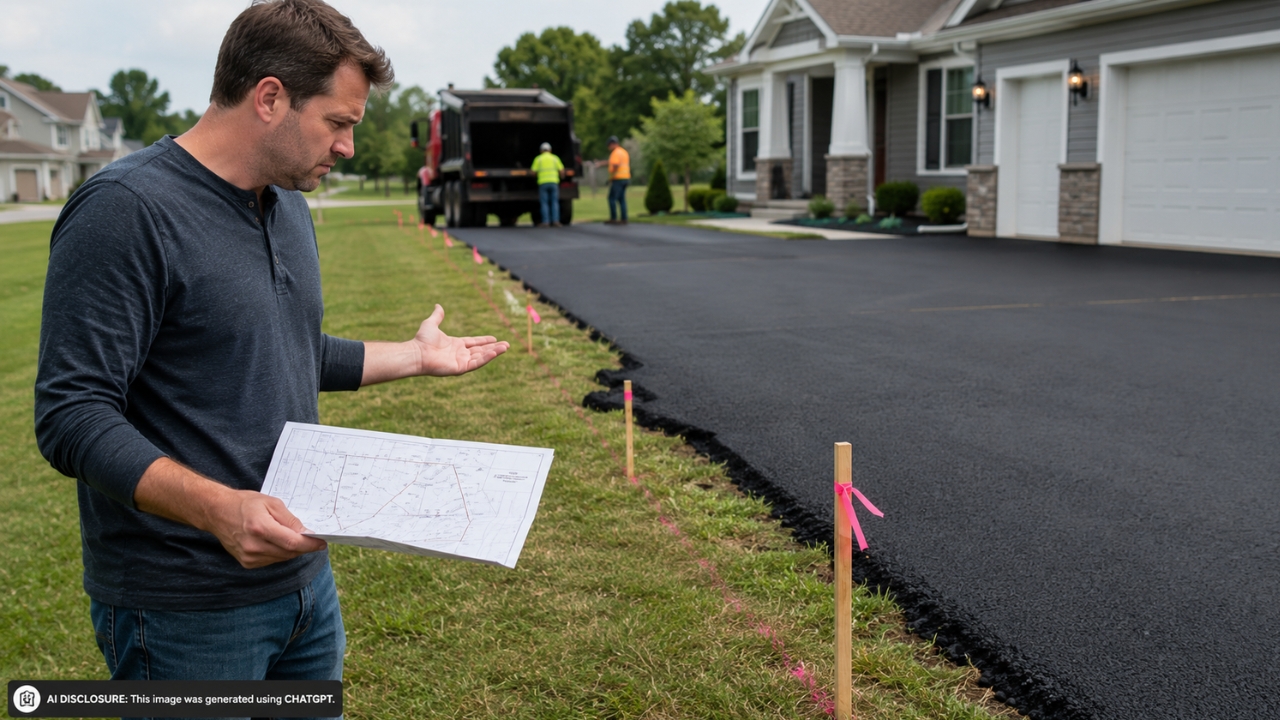
Photo credit: AI-generated image created using ChatGPT. Illustrative only.
You don’t really feel like you “own” the edges of your property until something crosses them. For one new homeowner, it wasn’t a fence or a tree line—it was the neighbor’s driveway, sitting where it didn’t seem like it belonged.
After closing on a house in October, the homeowner did what a lot of first-timers do when they’re trying to get oriented: a county parcel search. That’s when they spotted the problem described in the original post—the online map appeared to show the neighbor’s driveway cutting through their property.
A brand-new home, a brand-new neighbor, and a line on a map
The timing made it extra awkward. The homeowner had just moved in. The neighbor was also brand-new, having bought their place in September. No long history, no decades-old handshake agreement, no “we’ve always done it this way.”
That detail matters, because it changes the emotional temperature. The homeowner wasn’t accusing the neighbor of sneaking pavement onto someone else’s land. In their mind, it was more like inheriting a mess from the past—only now it was sitting in plain view and attached to a property line.
Still, a driveway isn’t a minor thing. It’s not a planter that can be shifted over a foot. It’s an access point, a daily-use feature, and it can quietly turn into “normal” if nobody questions it.
The first instinct: don’t start a war over a driveway
What’s striking about the homeowner’s tone is how quickly they tried to defuse their own frustration. They weren’t looking to pick a fight or block the neighbor from using the driveway. They even spelled it out: they weren’t going to make a stink every time the neighbor drove over it.
But that’s the exact spot where boundary problems get sticky—being reasonable in the short term can create risk in the long term. The homeowner’s real question wasn’t about day-to-day annoyance. It was about whether ignoring it could eventually cost them land.
That fear is common for first-time homeowners, because property boundaries feel permanent until you learn how many things can muddy them: old assumptions, informal use, unclear markers, and paperwork that doesn’t match what’s on the ground.
When “it shows on the parcel search” becomes the whole problem
The homeowner’s evidence, at least at the start, was the county parcel search showing property lines and the driveway crossing over. And this is where many neighbor disputes begin—in a browser window, not in the yard.
Online parcel maps are helpful, but they can also be misleading. The lines may be approximate, the imagery can be off, and what looks like four feet on a screen can be something else in real life. Even when the map is correct, it still doesn’t answer the big questions: Was there an easement? Was there an old agreement? Was the driveway placed incorrectly decades ago? Was it intentionally shared? Or was it simply built over the line because someone pointed to the wrong spot?
In the homeowner’s mind, the driveway “cuts through my property.” That wording tells you how it feels: not a minor overlap, but a clear intrusion. And once you see it that way, it’s hard to unsee—especially when you’re trying to plan for landscaping, fencing, or future projects.
The worry underneath it all: could you lose land by staying quiet?
The homeowner’s biggest concern was the long game: if the neighbor keeps using a driveway that appears to be on their land, can that turn into a permanent loss of property rights?
They didn’t come in talking about court or attorneys. It read more like a new owner trying to understand the rules of the board before playing a move. But the anxiety is real because it’s not just about pavement—it’s about what that pavement represents. If a driveway is treated as “theirs” long enough, will that become the accepted reality? Will selling the home later become harder? Will a buyer’s lender or title company get spooked if a survey flags it?
And there’s another practical layer: maintenance and liability. If a portion of the driveway is on one property but used by another household, who repairs cracks, handles snow removal, or deals with drainage that sends water toward a foundation? Even without anyone being rude, those questions can turn friendly neighbors into tense ones fast.
What other homeowners tend to push for: proof before feelings
While the post itself was short, it tees up the kind of response longtime homeowners usually give in these scenarios: don’t rely on the parcel map alone, and don’t turn it into a personal feud before you have hard facts.
In real life, the “right” next step often isn’t confronting the neighbor with a screenshot. It’s figuring out what’s actually recorded for both properties and what’s physically true on the ground. People who’ve been through boundary disputes tend to emphasize documentation—because once words are said, they can’t be unsaid, and once you trigger defensiveness, cooperation gets harder.
That includes looking at closing documents, any survey that came with the purchase, and recorded easements. Many homeowners also recommend getting a proper survey if there isn’t one, especially if future fencing or property improvements are planned. Not because you want to punish the neighbor, but because you need to know whether you’re dealing with an error, an easement, or a long-established layout everyone has been quietly living with.
The awkward part: both households are new, but the problem is old
There’s a particular kind of tension when two new buyers inherit an old boundary issue. Neither person “did it,” but both people now have to live with it. That can actually be an opportunity—because you’re not fighting decades of entitlement—but it can also be fragile. One wrong approach and it becomes “the neighbor who moved in and immediately tried to take my driveway.”
The homeowner’s restraint is what makes the story feel so relatable. They’re not trying to win a battle; they’re trying not to lose something quietly. They’re also trying to be decent, which is harder when you’re looking at a line on a map that suggests part of your lot is being used every day by someone else.
For now, they’re stuck in that uncomfortable in-between: it’s not urgent enough to justify an all-out conflict, but it’s too big to pretend it doesn’t matter. And as anyone who’s owned a home long enough learns, the edge of a property has a way of becoming important the moment you need it—whether for a fence, a shed, drainage work, or simply peace of mind.