Buyer Finds a Drainage Pipe the Neighbor Installed a Few Inches Onto the Property — Then the Neighbor Says Moving It Would Flood His Own Basement
Photo credit: AI-generated image created using ChatGPT. Illustrative only.
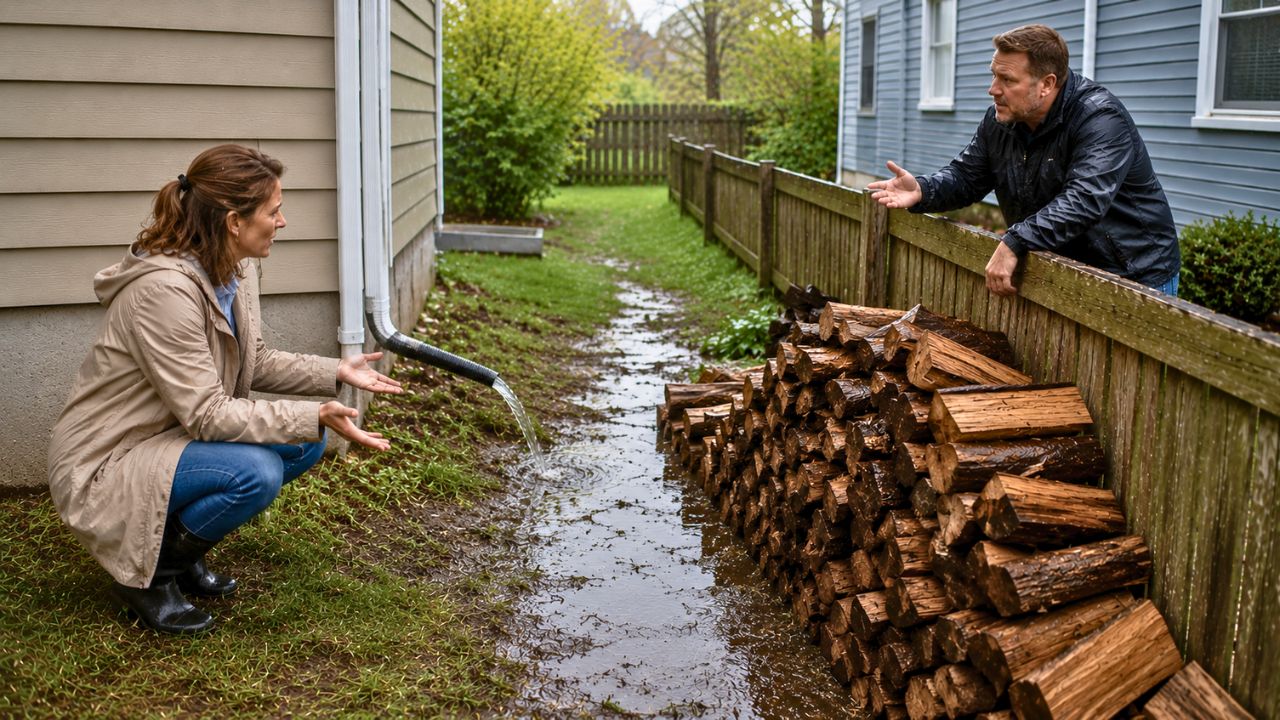
It started with a wet spot that didn’t make sense. A new homeowner had just moved in, only to find rainwater being pushed off a neighbor’s yard through a drainage pipe that ended right where it shouldn’t: against the edge of the property, into a stacked firewood pile meant for an indoor wood stove.
In the original post, the buyer described a PVC drain that appears to have been installed recently, close enough to the line that it’s effectively dumping runoff onto their side. The water didn’t just make the ground soggy. It soaked and “ruined” multiple stacks of firewood that were supposed to be kept dry for burning inside, and it created other smaller headaches that come with constant moisture where it doesn’t belong.
The pipe wasn’t just “near” the line — it was aimed at something valuable
The homeowner’s main frustration wasn’t simply that a neighbor had redirected stormwater. It was where the discharge ended up: straight into a firewood pile. Anyone who heats with wood knows the problem isn’t just inconvenience—wet wood doesn’t burn right, smokes more, and can cause a mess indoors when you’re trying to keep a stove going.
There’s also the timing. The new owner couldn’t say exactly how long the pipe had been there, because the property used to belong to their mother. But they said it looked fresh, and one detail made it feel unmistakably intentional: overgrown bushes along the property line on the homeowner’s side had been “hacked out” around the pipe, leaving a telltale opening where there used to be cover.
What made it sting: there was an easy alternative
The homeowner wasn’t arguing that the neighbor had no options. In fact, they pointed out what felt like the simplest fix: an elbow joint and a few more feet of PVC could have sent the water in a different direction—down the hill in the backyard—where a small drainage ditch could help carry it away.
That’s not just theory, either. The neighborhood sits on a significant hill, with a dead-end street and a creek at the bottom of the woods. The homeowner said many neighbors already route water downhill in a way that makes sense for the terrain.
Instead, the pipe stopped where it did—right at the edge of the neighbor’s property—so the discharge landed on the new homeowner’s side. The result: one yard stays drier, the other gets soaked, and the damage shows up in the most visible place possible.
A warning was given during installation, but it didn’t change the outcome
The backstory adds another layer. The homeowner said their mother remembered hearing the neighbors talking about “just hide it under the wood pile” while they were installing the drainage. She told them not to do it.
From the homeowner’s perspective, that matters because it suggests the neighbors understood exactly where the pipe would send water—and what it would hit. The homeowner also believed that’s why the neighbors were careful about one technicality: they made sure the pipe itself stopped on their property, even if the water didn’t.
That kind of hair-splitting is where these disputes tend to live. A pipe ending on one side of a line can still cause real damage on the other side, and a “barely on my side” installation can still function like a direct dump onto someone else’s land.
When the borough “can’t do anything,” the problem doesn’t go away
After the homeowner’s mother raised concerns, they said the borough told her they “can’t do anything.” Whether that was a misunderstanding, a brush-off, or simply the wrong department, it left the homeowner in the worst possible place: responsible for the consequences, with no clear enforcement help.
And water problems don’t wait politely for a solution. Constant discharge can soften soil, create muddy channels, and spread moisture into places it never used to reach. Even if the homeowner called the issues “minor” beyond the firewood damage, water has a way of turning minor problems into expensive ones—especially if it begins affecting grading, landscaping, or anything stored near the ground.
The homeowner’s question was blunt and practical: if the neighbors refuse to redirect their rain drain, what can be done?
Homeowners online pushed the same theme: document first, then escalate carefully
Even without a long comment thread included in the source material, this kind of drainage dispute tends to trigger the same set of seasoned homeowner reactions: don’t rely on verbal promises, and don’t make it a shouting match over a few inches of pipe. Make it about facts.
In situations like this, people typically focus on proof—photos showing where the pipe sits, where the water flows, and what it’s damaging. Dates matter, especially when the homeowner believes the installation is recent and the bushes were cut back to make it happen.
Another common line of thinking: establish the property line clearly. When something is “about an inch” from the line, the exact line becomes everything. A professional survey can settle whether the pipe and disturbed vegetation are actually on one side or the other, and it also helps if the dispute ends up in a formal complaint process later.
Homeowners also tend to recommend taking the emotion out of the initial outreach. A written request to redirect the discharge, paired with a simple proposed solution (like adding that elbow joint and extending the PVC downhill), can be harder to ignore than a heated conversation over the fence.
The real tension: fixing his water problem might create yours — or vice versa
The headline version of this story hits a nerve for a reason: drainage is one of the few home issues where “solving it” can genuinely move the damage somewhere else. If the neighbor is saying they can’t move the pipe because it would flood their own basement, that’s not just stubbornness—it’s an admission that their home may have a water management problem they’re trying to outrun.
But that doesn’t make it acceptable to push that risk onto the next yard, especially when the discharge is damaging stored fuel meant for indoor use. It also raises a bigger concern for the new homeowner: if the neighbor’s basement is that close to flooding without this workaround, how much water is moving through the area during storms, and where else might it be going?
The most frustrating part is that there’s no clean “do this once and it’s over” moment. Redirecting stormwater can require rethinking grading, extensions, splash blocks, buried lines, or a path to daylight that doesn’t soak a neighbor. If the neighbor’s current setup depends on dumping water at the edge of the line, they may resist any change unless they’re forced to address the underlying drainage on their own property.
For the new homeowner, the stakes are immediate and personal: dry firewood, a usable yard edge, and the feeling that their new place is being treated like overflow space. Whether the next step is a survey, a firmer written demand, or another attempt to get the borough to pay attention, the water is already running—right into the spot that was supposed to stay dry.