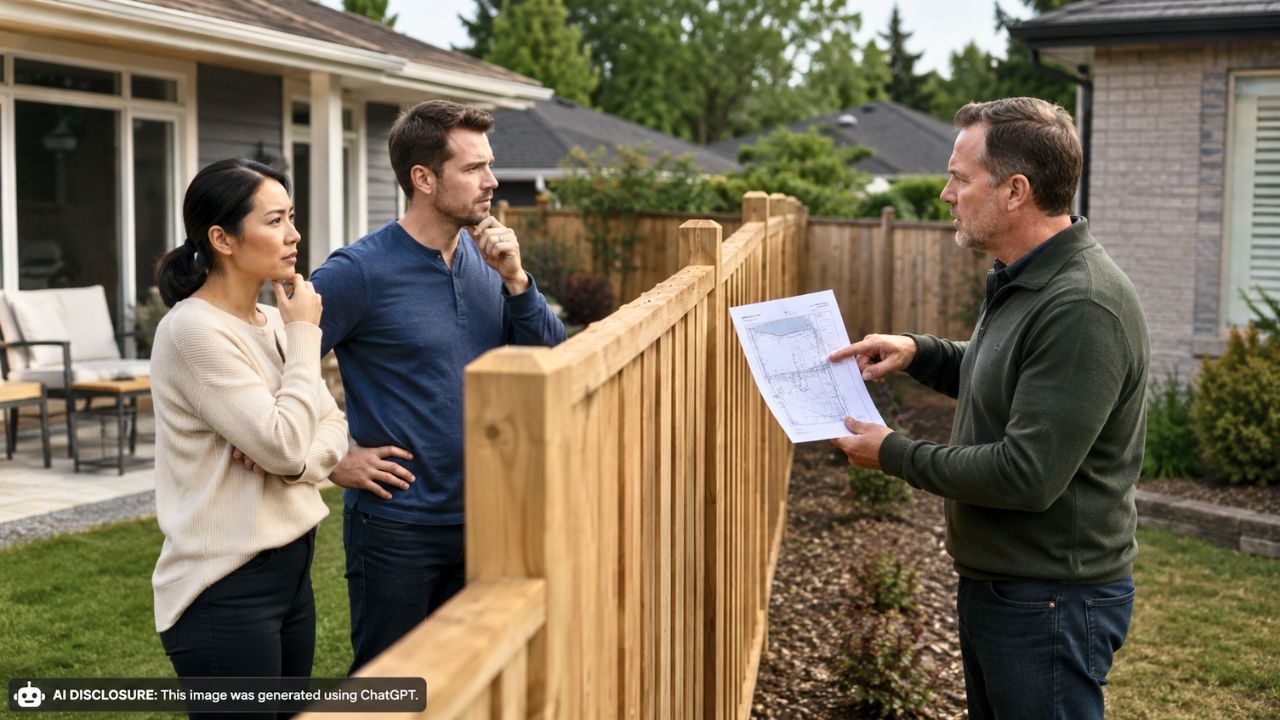
New Homeowner Rebuilds a Fence on the Original Line — Then a New Neighbor’s Survey Claims It’s Six Feet Over and Threatens a Lawsuit
Photo credit: AI-generated image created using ChatGPT. Illustrative only.
The fence was supposed to be the easy part. A new owner of a rental property decided to replace an aging fence with a brand-new one, keeping it right where the old fence had always been. Same line, same footprint, just cleaner boards and fresh posts—one of those upgrades that usually disappears into the background once it’s done.
Then a new neighbor moved in next door and turned that “simple replacement” into a property-line standoff. Through the property manager, the neighbor sent over a survey claiming the rebuilt fence sits about six feet onto his land, and he’s demanding it be moved—or he’ll sue. The details come from the original post, where the homeowner asked what, if anything, they could do now that the fence is already up.
It started like a routine upgrade on a rental
The owner had held the property for a few years and was operating it as a rental. The fence line, they said, was the same fence line that existed when they bought the place. There hadn’t been some grand redesign or push into the neighbor’s yard—just a replacement.
That detail matters because it’s the kind of thing landlords do all the time: maintain what’s already there, reduce liability, keep tenants happy. A worn, leaning fence becomes a new fence. Nobody expects it to become a boundary dispute.
And for a while, it didn’t. The previous neighbors never objected when the fence was replaced on that same line, which likely reinforced the owner’s assumption that the line was understood and accepted.
The new neighbor arrived with a survey and a threat
The trigger wasn’t the construction itself. It was the change next door. Someone new purchased the neighboring property, and soon the owner’s property manager started hearing complaints and demands.
Adding fuel to the tension, the new neighbor had parked a rusted junk car in the backyard—something the owner described as an eyesore. It’s the kind of detail that doesn’t change a legal boundary, but it does change the temperature of a conversation. When one side already feels the other is being inconsiderate, every interaction feels sharper.
Then came the paperwork: a survey copy showing the fence is roughly six feet over the line. Not inches. Not a “maybe.” Six feet is the kind of number that makes people dig in, because it suggests real yard space and real value. The neighbor’s message was blunt: move it or get sued.
The sinking moment: their own documents matched the bad news
At first, the owner hoped there might be a defense—something about the fence’s long-standing location, or the fact that nobody complained before. They even drew a quick sketch: solid line for the fence, dotted line for where the survey claims the property line really is.
But the biggest twist came in an edit. The owner found a copy of a survey done by their title company, and it matched the neighbor’s survey “unfortunately.” That’s the moment a lot of homeowners recognize: this isn’t just a cranky neighbor with a tape measure. This might be a legitimate encroachment that’s now documented on both sides.
And because the home is a rental, everything funnels through a property manager. That can help keep emotions out of it, but it also means the dispute isn’t happening face-to-face; it’s happening through messages, scans, and deadlines. That distance can make threats feel even more formal.
Six feet isn’t a “trim the bushes” kind of problem
A fence being in the wrong place is not like a branch crossing the line or a sprinkler head spraying too far. A fence is a structure that signals possession. People buy houses assuming fences mark the yard they’re paying for, even when that’s not technically true.
If the survey is right, the neighbor may be looking at a chunk of yard that has been treated like it belonged to the rental for years. That can create a strange sense of theft—even if nobody intended to take anything. The owner’s side is just as frustrated: they rebuilt based on what was already there, and now they’re being told they may have to undo a major project.
The money part is immediate. Moving a fence isn’t just shifting panels; it’s pulling posts, resetting corners, dealing with gates, and repairing whatever gets torn up in the process. And with tenants involved, the timing becomes its own headache: access, noise, scheduling, and keeping the property secure while work is underway.
People focused on proof, not yelling across the fence
In disputes like this, the most practical advice tends to revolve around documentation and verification. Here, the neighbor already produced a survey, and the owner discovered their own survey aligns with it. That pushes the next step away from “argue the facts” and toward “figure out the consequences.”
The owner’s original question was straightforward: do they have any recourse or defense, and if not, are they responsible for the cost of moving it? That’s the core fear behind these property-line disputes—because even when the mistake was inherited from a prior owner, the person who built or maintains the fence is often the one staring at the bill.
Even without getting into courtroom specifics, the tension is clear: one neighbor has a document, a demand, and a threat. The other has a brand-new fence built in good faith—and now proof that the fence line may never have been right in the first place.
The awkward reality: fixing it could make everything worse
There’s also the human side of what happens next. Once the word “lawsuit” enters the chat, normal neighborly problem-solving tends to collapse. It’s no longer about, “Hey, could we talk about this?” It’s about who’s at risk and who’s going to pay.
For the rental owner, there’s a second layer of pressure: tenants don’t want to be caught in the crossfire. A fence dispute can mean temporary loss of privacy, a yard that’s suddenly smaller, or contractors coming through to rip out something that was just installed.
And while the junk-car detail might be unrelated to the boundary itself, it hints at a neighbor relationship already headed downhill. That’s what makes a property-line fight so draining: even if you solve the fence location, you still have to live next to the person who threatened to sue you over it.
The owner went into this expecting a straightforward maintenance upgrade. Instead, they’re now holding two surveys that appear to agree the fence is over the line—and facing the possibility that the “right” fix is to move a brand-new fence they just paid to build. In homeowner math, that’s one of the worst kinds of wrong: expensive, inconvenient, and hard to undo without leaving scars on the ground and in the neighbor relationship.
Like Fix It Homestead’s content? Be sure to follow us.