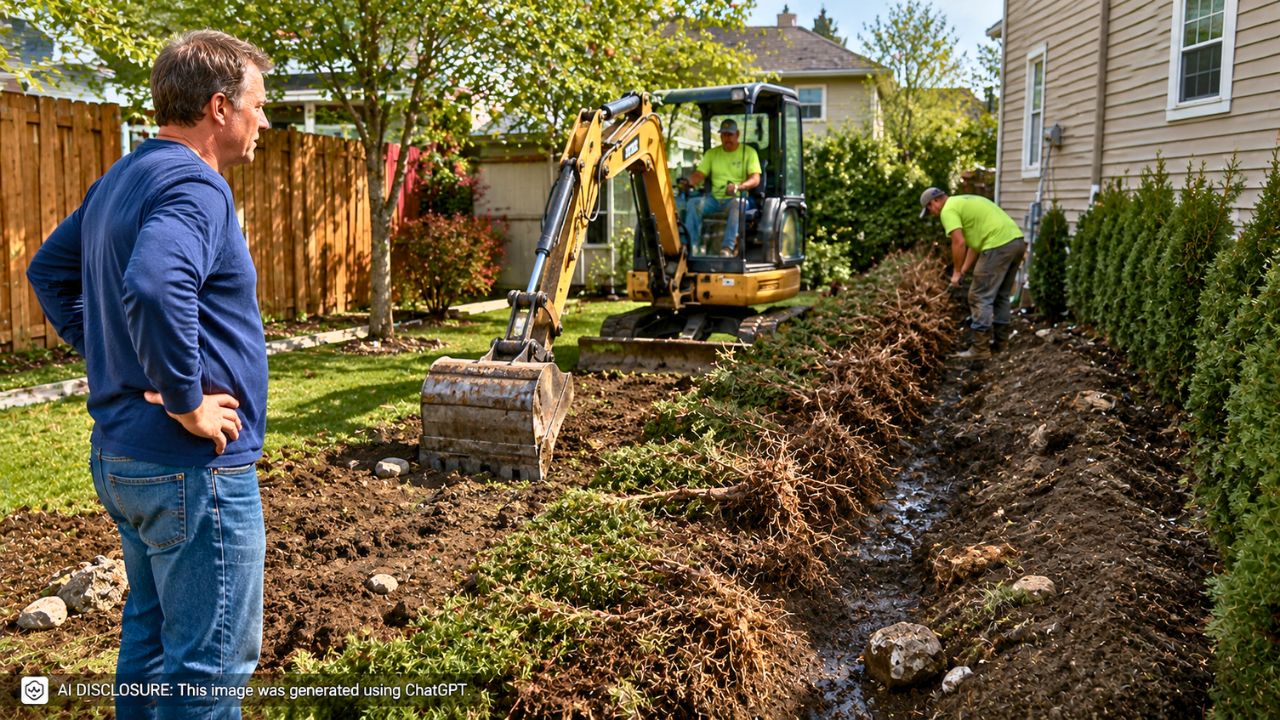
Wisconsin Homeowner Traces Water Surfacing in the Yard to the Neighbor’s Water Line With No Easement — Then His Repair Crew Parks a Backhoe in the Yard and Destroys Forty Feet of Privacy Bushes
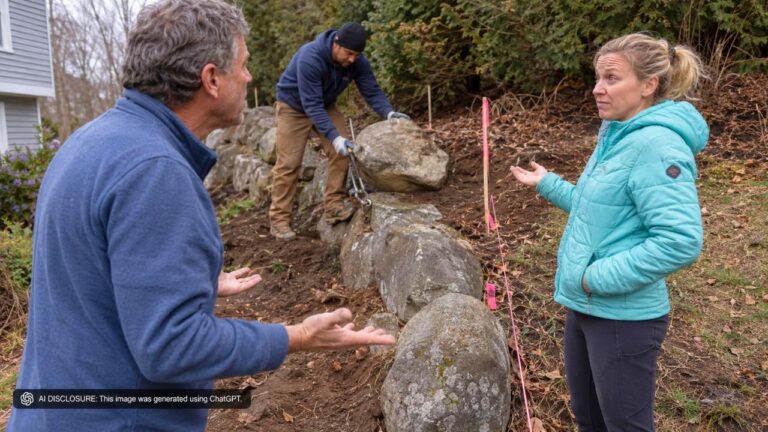
Photo credit: AI-generated image created using ChatGPT. Illustrative only.
It started the way a lot of yard problems start: a patch of ground that won’t stay dry. About three and a half years ago, a Wisconsin homeowner noticed water surfacing in the corner of his yard and called the city to take a look. What he thought would be a routine fix turned into a property-line headache that chewed up his privacy landscaping and left him staring at a neighbor’s utility line he never agreed to host.
In the original post, the homeowner describes learning from the city’s investigation that the water wasn’t his at all—it was coming from his neighbor’s water line, which had been run along the edge of his yard. The neighbor, he says, had no easement on record. And when the neighbor brought in equipment to repair the leak, the “small” repair became a much bigger mess.
The first sign was water bubbling up in the corner
The homeowner’s first clue wasn’t a letter from the utility company or a surveyor’s note—it was the ground itself. Water was “coming up in the corner” of the yard, enough to raise alarm and get the city involved. Once city staff investigated, they pointed him toward an unexpected source: the neighbor’s water service line.
From the homeowner’s perspective, the discovery had two immediate problems. One was practical—someone else’s water line was affecting his property. The other was personal—he hadn’t agreed to it, and it wasn’t recorded as a formal right for the neighbor to be there.
Still, he tried to be cooperative. He describes himself as “good (naïve)” and says he gave the neighbor permission to fix the line because the work was “only…in 10 feet,” and the neighbor promised to repair the part of the yard that would be disturbed.
A “10-foot” repair turned into heavy equipment in the yard
The corner of the yard wasn’t empty. It was lined with privacy bushes, described as about 8 to 10 feet tall—exactly the kind of landscaping that takes years to establish and becomes part of how you live in your space. When a neighbor’s line needs repair, that kind of mature planting is the first thing at risk.
The homeowner expected disruption in a limited area, followed by restoration. Instead, he says the repair crew parked a backhoe inside the yard and destroyed an additional 40 feet of privacy bushes. Suddenly, what had been “the corner” was a long open stretch, and the yard felt exposed.
It’s the kind of moment that makes a neighbor dispute stick. Fixing the leak is one thing. Rolling in heavy equipment and flattening privacy landscaping is another. Even if the crew wasn’t trying to be careless, the result is what counts: forty extra feet of damage, and a homeowner left with a yard that no longer blocks the view.
The replacement shrubs felt like an insult, not a fix
The neighbor did replace plantings, but the homeowner says the replacements were 18-inch shrubs. That’s a far cry from a wall of 8–10 foot bushes. In his mind, a fair replacement would have been something closer to 4–6 feet—still not the same as mature privacy screening, but at least an attempt to restore function, not just greenery.
This is where landscaping disputes get expensive fast. Tall privacy bushes aren’t just decorative. They’re a boundary you can’t measure with a tape: the ability to sit outside without feeling watched, to let kids play, to use your yard as an extension of the house. When that gets stripped away, the “repair” doesn’t feel like restoration. It feels like losing part of your home’s livability.
And even if the neighbor believes he “made it right” by replanting something, the homeowner is left with a long-term gap that may take years to grow back—if it ever grows back the same way.
No easement on file, but the pipe is still there
The homeowner’s bigger worry is the line itself. He started looking into Wisconsin property law because he doesn’t want this to become the new normal—his neighbor’s water line running through or along his property with repair crews returning whenever there’s another break.
In updates, he says city hall told him there is no easement, and he also checked multiple places: the deed, a plat survey, and the water utility’s records. In other words, he did what a lot of homeowners do when they’re trying to separate “this feels wrong” from “this is legally allowed.” Everything he found pointed to the same thing: no documented right for that water line to be there.
But the presence of the line raises a second issue: time. He references Wisconsin statutes on actions concerning real estate and prescriptive rights, trying to figure out how long someone has to challenge a neighbor’s use of land. He’s confused by language that seems to point to different time windows—30 years in one place, 20 years in another—and wants to know when the clock starts for pushing back.
Reactions centered on proof, paperwork, and the cost of “restoring” privacy
Even without a full thread of comments included, the homeowner’s questions show the direction people tend to push in these disputes: document everything, confirm what’s recorded, and treat landscaping damage like real property damage, not a casual misunderstanding. He already took one of the most important steps by checking with city hall and comparing the city’s position with his deed and survey records.
Once it reaches the point of heavy equipment and destroyed shrubs, homeowners also tend to get very practical. It’s not just “my bushes are gone,” it’s: what would it cost to restore the same level of privacy? What size and species were the original bushes? How many linear feet? Were they on your side of the line? Did you give written permission for access, or was it a verbal “go ahead and fix it” that got stretched into a much larger work zone?
The messy truth in cases like this is that replanting small shrubs can be a token gesture, not a real replacement. If the homeowner wants the yard back the way it functioned—screened, enclosed, private—he’s likely looking at either larger plantings, fencing, or years of waiting. And that’s before even touching the larger question of whether a neighbor’s utility line should remain on the property at all.
Now it’s not just a leak—it’s an access problem waiting to happen again
The homeowner’s frustration isn’t only about what happened during this repair. It’s about what happens the next time something breaks. Water lines don’t fail once and retire. If this line remains where it is, the same corner of the yard could become a recurring worksite—with more digging, more tire tracks, and more “temporary” damage that never really gets undone.
That’s why the easement question matters so much. He’s not asking for money alone; he’s asking whether he can force the neighbor to remove the line or stop using it across his property. The difference between “I allowed a one-time repair” and “I’ve effectively granted ongoing access” is where neighbor relationships—and property values—can quietly get wrecked.
For now, he’s left with a ruined corner, a long bare stretch where privacy used to be, and the uneasy feeling that being accommodating once may have invited a permanent problem. In a quiet neighborhood, it doesn’t take much to turn a simple water leak into a long-running boundary dispute—and once the backhoe has been in your yard, it’s hard to unsee what the next repair could look like.
Like Fix It Homestead’s content? Be sure to follow us.