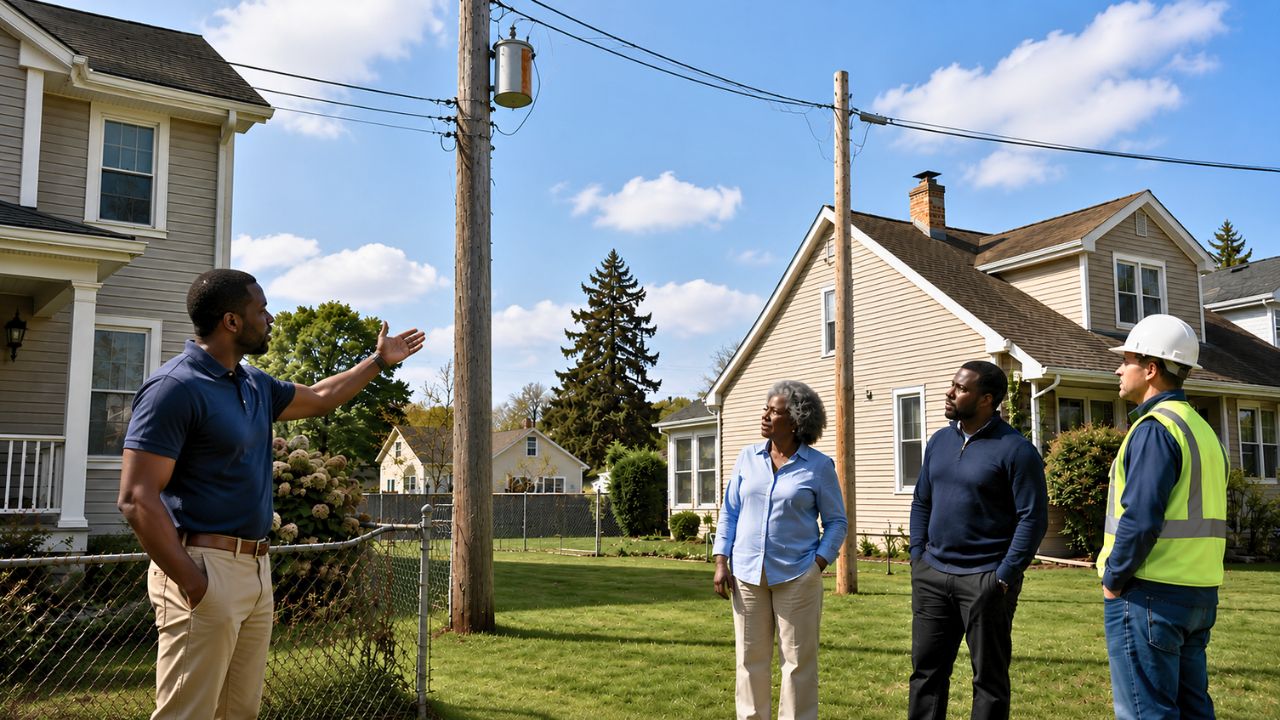
Homeowner Wants to Bury Utilities and Remove an Eighty-Year-Old Wooden Pole Serving the Neighbor’s House — Then Learns a Newer Pole Already Sits Unused on the Neighbor’s Own Property
Photo credit: AI-generated image created using ChatGPT. Illustrative only.
It started as a simple modernization project: trench the yard, tidy up the service lines, and finally get rid of an ancient wooden utility pole that’s been sitting on the property for decades. But the homeowner quickly learned that “their” pole wasn’t really theirs at all in day-to-day practice—it’s the one still feeding the neighbor’s electric and cable.
In the original post, the homeowner lays out the detail that makes the whole thing sting: the neighbor already has a newer steel utility pole at the street on his own property, only about four years old, and it’s apparently sitting there unused for this service. Instead, the neighbor’s lines cross his driveway, cut over to the old wooden pole in the poster’s yard, then cross back again to reach the neighbor’s roof.
An eighty-year-old pole that won’t go away
The old pole is more than a visual annoyance. The homeowner is trying to bring utilities underground, and the long-term plan depends on clearing the pole out completely. That’s hard to do when the pole is still carrying someone else’s service.
This isn’t a case of someone wanting to move a neighbor’s stuff just to “win” a boundary argument. The homeowner says utility companies have already indicated there are options to transfer the neighbor’s service so it originates from the street pole on the neighbor’s property, not the aging wooden one in the middle of the poster’s plans.
And while it’s tempting to treat any yard project as cosmetic, utility infrastructure changes the way you can use your land. A pole dictates where you can dig, plant, build, and sometimes where you can even drive equipment. It’s not just in the way; it’s a permanent “nope” zone.
The newer pole next door makes the request feel obvious
What makes this feel especially lopsided is the presence of that newer steel pole at the street on the neighbor’s property. From the homeowner’s point of view, the neighborhood already has the hardware to simplify the run—no more crossing into someone else’s yard, no more dependency on an 80+ year-old structure.
The homeowner isn’t even trying to stick the neighbor with a bill. They say they offered to pay for whatever work is needed to make the transfer happen so the neighbor wouldn’t incur costs. That’s a rare move in neighbor disputes, where money is usually the spark that lights everything on fire.
But instead of progress, the homeowner describes a long string of objections that never really ends. One concern gets answered, then another appears: first it was one provider, then another, then “future possibilities,” then timing. The homeowner says it feels like moving goal posts—delay tactics dressed up as “just one more thing.”
The easement changes the power dynamic
There’s a key detail that keeps this from being a clean, satisfying “tell him to move it” story: the homeowner says there’s an easement with the power company. That matters because it means the pole isn’t simply “on my land, my rules.”
When an easement is in play, utilities aren’t only allowed to exist there—they’re often protected from casual removal. Even if the homeowner is willing to pay and even if the neighbor’s service can be rerouted, the process can still get slow because it becomes a coordination problem: power, cable, scheduling, approvals, and whatever standards the utility requires.
And that’s where the neighbor’s resistance becomes more than an annoyance. If the pole will “soon only exist to serve him,” as the homeowner puts it, then every delay means the poster’s project stays stuck. Trenching and undergrounding is the kind of work you plan carefully, and you don’t want to do it twice because someone wouldn’t commit to a switchover date.
It’s not just wires—it’s the relationship fraying
The homeowner says they’ve tried to stay respectful because they want to keep a decent neighbor relationship. But you can hear the fatigue in how they describe the conversations: perpetual objections, shifting reasons, no firm yes or no.
Then there’s the side drama that makes it feel less like a normal utility discussion and more like living next to someone who’s always looking for a fight. The homeowner adds a postscript: the neighbor complains about WiFi signals and says they’re affecting him. When the electric company came out to measure requirements, the neighbor even complained that the company upgraded his meter to one with WiFi and that the signal was affecting him.
That kind of complaint can turn a straightforward coordination issue into something else entirely—because you’re no longer negotiating with someone who’s focused on logistics. You’re negotiating with someone who might interpret any change as a threat, a plot, or a personal attack.
The homeowner admits they’re tempted to escalate on that front, joking about installing WiFi pointed right at the neighbor’s house just so it’s visible and “he can see it and squirm.” It’s half vent, half warning sign: this has gone on long enough that petty impulses are starting to look like stress relief.
Reactions leaned practical: document everything and let utilities lead
Even without a long comment thread included in the source material, the bones of the advice practically write themselves because of the easement and the multi-company coordination. When a neighbor won’t cooperate, homeowners tend to get the best results by shifting the conversation away from “you vs. me” and toward “here’s the utility’s plan and schedule.”
In conflicts like this, people often push for everything in writing: what the utility companies said, what options are on the table, and what each provider needs to complete a cutover. Not because anyone loves paperwork, but because written timelines and documented plans reduce the chances of a last-minute reversal after contractors are already booked.
And while the homeowner is trying hard not to inflame the relationship, the WiFi-meter argument is exactly the kind of thing that can tempt someone into doing something spiteful. Most experienced homeowners will tell you the same thing: if you’re already dealing with easements and utility companies, don’t add a separate provocation that turns a slow problem into an ugly one.
A modern yard plan meets an old-school obstacle
At the center of this is a very relatable homeowner moment: you finally have a plan to clean things up and do it right—underground utilities, fewer hazards, a more usable property—and then you find out your timeline depends on someone else’s willingness to stop using your space as their infrastructure shortcut.
The homeowner’s request isn’t exotic. They’re not trying to cut power, block access, or force a downgrade. They’re pointing to a newer pole on the neighbor’s own property and asking why an 80-year-old pole in the middle of their yard should remain the default.
But with an easement involved and a neighbor who keeps raising new objections, the project is now less about digging a trench and more about endurance: keeping the communication civil, keeping everything documented, and pushing for a utility-driven path that doesn’t require constant personal negotiation. In the meantime, that old wooden pole stands where it always has—waiting for the day everyone finally agrees it doesn’t need to be there anymore.
Like Fix It Homestead’s content? Be sure to follow us.