Homeowner Agrees to Let the Neighbor Build a Retaining Wall Along the Line — Then He Builds the Wall Eight Inches Onto the Property, Well Beyond the Surveyor’s Buffer Stakes
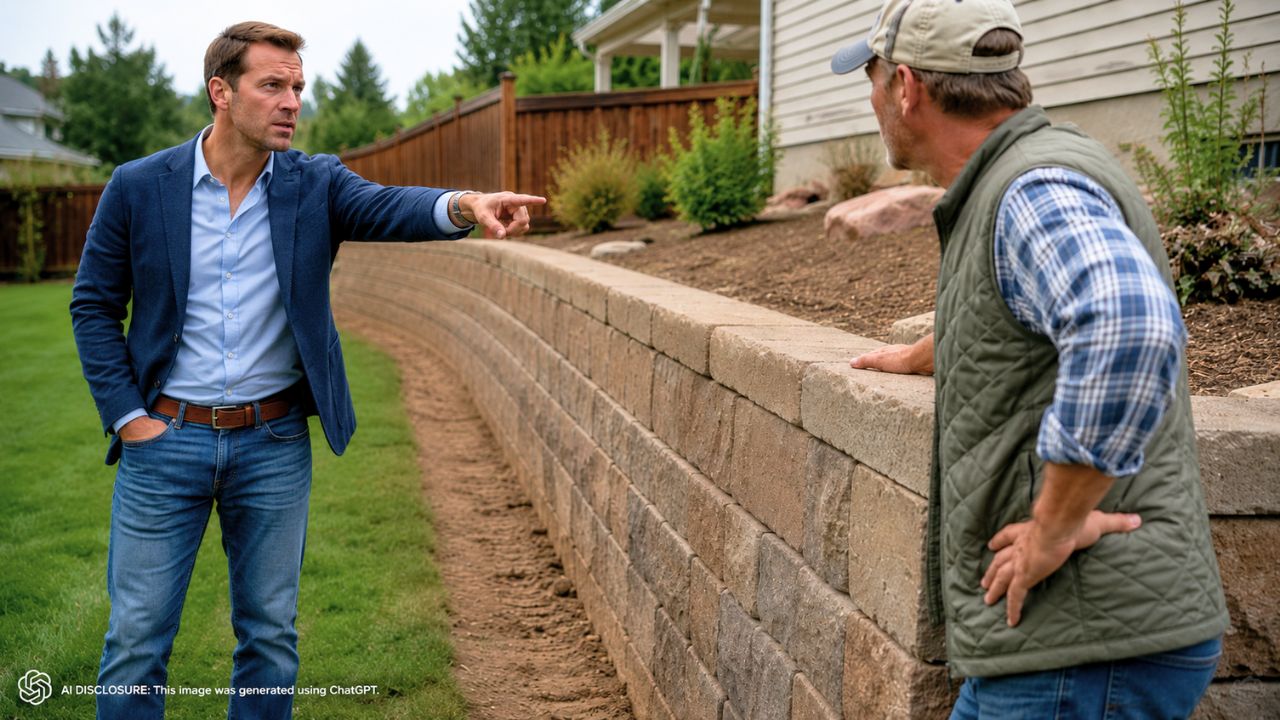
Photo credit: AI-generated image created using ChatGPT. Illustrative only.
In the hills where every square foot feels like money, a property line isn’t a theoretical concept. It’s the difference between “my yard” and “your improvement.” One homeowner thought they were being reasonable: a neighbor wanted to build a retaining wall right on the line, dress it up with plants, and clean up a slope.
So the homeowner agreed—on one condition. A survey would be done first to keep everything clean and drama-free. What happened next, described in the original post, is the kind of neighbor project that can quietly turn into a title headache.
He said yes, but tried to do it the right way
The setup is familiar if you’ve ever lived on a grade: the homeowner’s fence sat a couple feet inside the property line because of the slope. From the neighbor’s perspective, that unfenced strip looked like “extra” space—open, unused, and basically up for grabs if you don’t think too hard about paperwork.
When the neighbor floated the idea of a retaining wall “on the line,” the homeowner didn’t immediately shut it down. Instead, he said it was fine and paid for a survey to establish the boundary so there wouldn’t be any confusion later.
The surveyor marked things clearly. Two stakes went in: one about two feet back from the property line, and another farther along set about three feet back. They weren’t subtle hints. They were buffer stakes meant to make it easy for anyone building near the line to stay on their own side.
The wall went up anyway, and it didn’t land where it was supposed to
The neighbor built the retaining wall with the outer edge about eight inches inside the homeowner’s property line. The wall itself was described as six to eight inches thick, and it included planters on top—meaning the finished look wasn’t a clean vertical boundary. It was a landscaped feature that visually reads as part of the neighbor’s yard.
On paper, eight inches can sound petty. In real life, a wall changes the map. It changes how people walk the space, where dirt and water move, and what future buyers assume they’re getting when they look at a yard.
The homeowner even admitted they weren’t agonizing over the raw area—roughly sixteen inches of “lost” property depending on how you measure the wall and its footprint. What bothered them was the longer shadow it can cast: the risk of an easement-like claim down the road and a cloud on title when it’s time to sell.
The neighbor’s response: shrug, smile, and “we’re ok with it right?”
Once confronted, the neighbor didn’t come in hot with threats. Instead, he alternated between playing dumb and trying to brush it under the table. The homeowner described him as acting like it was no big deal and repeatedly steering the conversation toward implied consent: “we’re ok with it right?”
That’s the part that makes homeowners’ stomachs drop, because it turns the wall from a mistake into a narrative. If the neighbor can later frame it as something you allowed, it becomes harder emotionally—and sometimes practically—to unwind.
And walls aren’t like patio furniture. Once it’s stacked, planted, and settled, it starts to feel permanent. The longer it sits there, the more it looks like it belongs.
In the Hollywood Hills, “flat land is expensive” isn’t just a saying
This wasn’t happening on a wide suburban lot where you can relocate a project without anyone noticing. The homeowner emphasized the setting: the Hollywood Hills, where usable land is limited and valuable, and where a retaining wall can be doing real work holding soil back.
That adds another layer of tension. If the wall is holding back grade, it isn’t only about the line on the survey. It’s also about who owns the improvement, who maintains it, and who’s responsible if it fails.
A retaining wall also tends to affect drainage. Water doesn’t care whose property it’s on. If the wall and planters shift runoff patterns, the homeowner could be looking at erosion, seepage, or saturated soil right along the boundary—exactly where problems can spread quietly before they show up as movement, cracking, or soggy landscaping.
The homeowner’s fear wasn’t framed as paranoia. It was framed as resale reality: a buyer’s agent notices a wall, asks where the line is, and suddenly you’re digging through old paperwork trying to explain why a neighbor’s permanent structure sits inside your legal description.
The practical fork in the road: let it ride or force it back
Even in the homeowner’s own telling, you can feel the fork forming. One path is informal: accept the wall, keep the peace, pretend the stakes didn’t mean what they meant. That’s the path the neighbor was nudging toward with casual reassurances.
The other path is the one nobody enjoys: put objections in writing, insist the encroachment be corrected, and risk turning a neighbor relationship into a cold war fought with measurements and paperwork.
The homeowner’s question was simple—“what are my options?”—but the underlying problem was bigger than eight inches. It was about stopping a story from hardening. Once a structure is treated like it’s been “allowed,” homeowners worry they’ll be the one explaining it later, possibly under pressure, possibly during a sale when timelines are tight and everyone wants clean answers.
And because the fence was already set back, there’s an extra psychological trick here: outsiders may assume the fence is the line. The neighbor builds near the fence, plants it, and the brain files it away as “their side.” That’s how small encroachments become invisible over time.
What readers zeroed in on: proof, paper trails, and not letting it get normalized
Even without a long comment thread included, the direction of homeowner-to-homeowner feedback in these disputes tends to converge fast: document everything and don’t let a casual “we’re good, right?” become the final word.
The stakes the surveyor placed matter because they show intent and notice—this wasn’t a handshake boundary. The homeowner tried to make the line obvious before construction started. When a wall ends up past that, it looks less like confusion and more like a decision someone hoped would slide by.
The other thing people tend to flag is the visual takeover. A planter-topped wall doesn’t just sit there; it advertises ownership. It invites the neighbor to garden it, maintain it, and treat it as theirs—exactly the kind of day-to-day behavior that can make a future dispute uglier.
The homeowner wasn’t asking for a feud. He was asking how to protect his property and his future sale without getting steamrolled by “it’s only a few inches.” The frustrating part is that a few inches is how these things start, and a permanent structure is how they become hard to undo.
For now, the wall is there, the stakes were ignored, and the neighbor is still trying to wrap the whole thing in a friendly tone. The homeowner is left standing on a slope in expensive terrain, looking at a clean line on a survey and a very real wall that doesn’t match it.
Like Fix It Homestead’s content? Be sure to follow us.