Massachusetts Homeowner Watches an Unpermitted Addition Rise Less Than Two Feet From the Shared Fence — Then the City Issues a Stop-Work Order and the Neighbor Accuses Them of Reporting It
Photo credit: AI-generated image created using ChatGPT. Illustrative only.
It started as one of those normal, nosey-neighbor moments: pull into the driveway after work, glance over, and realize the house next door looks different. Not “new mulch” different. More like “there’s a fresh slab and framing where there wasn’t yesterday” different.
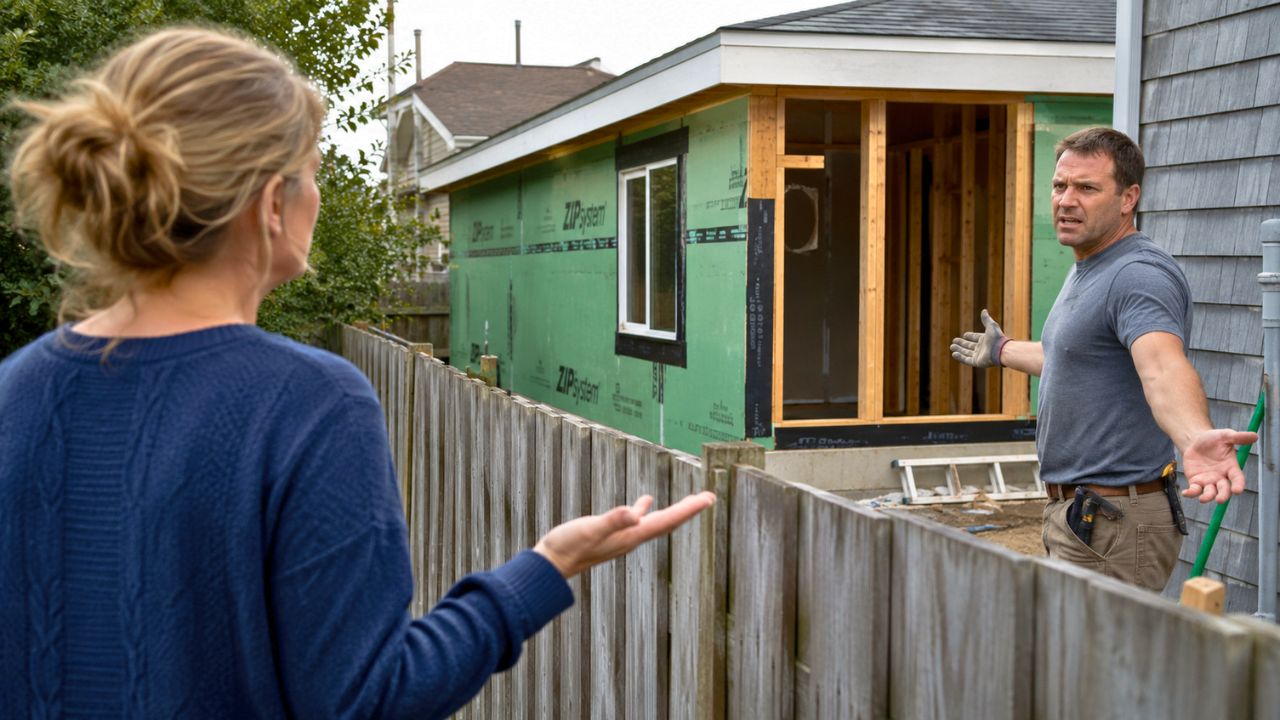
In a Massachusetts neighborhood full of modest capes, a homeowner described watching a new side addition go up so close to the shared fence that it looked to be less than two feet away—then, just as quickly, a red flag appeared in the form of a city stop-work notice. The details come from the original post, where the homeowner says they didn’t report anything… but still ended up in the crosshairs.
The first sign was easy to brush off
The neighbors weren’t new strangers. They’d moved in about four years earlier and had been “really nice people,” the homeowner wrote. Late the previous year, the neighbors pulled off a big, polished-looking expansion: a two-car garage, roughly 800 square feet of additional living space, a master bedroom and bath, plus new siding across the home.
From the outside, it read like a classic upgrade story—more space, better curb appeal, investment in the property. The homeowner even said it looked great. Nothing about that kind of work screams “incoming neighborhood feud” at first.
Then, about two weeks before the post, the second round began—this time on the side closest to the poster’s home. The slab was already poured, framing was already going up, and the shape suggested another bedroom, possibly a bathroom, and maybe even a second story stacked on top.
Then the addition landed almost on the fence line
The detail that changed the whole mood was distance. This new build appeared to be less than two feet from the fence dividing the properties. The homeowner wasn’t initially angry about it, but it felt off—tight enough to raise practical questions even if you’re not a code expert.
With that little space, everyday homeowner worries start to stack up fast. How will exterior work get done later—painting, flashing, siding repairs—without someone needing to step onto the other property? Where does roof runoff go if the structure’s tight to the line? What happens if the neighbors ever need to dig for utilities, drainage, or footings?
Close construction has a way of making small mistakes expensive. And even when nothing goes wrong, it can make a yard feel boxed in overnight.
A quick permit search made things feel worse, not better
The homeowner did what a lot of people do once something doesn’t pass the “seems odd” test: they checked city building records. They weren’t looking for a fight, just an explanation that would make it make sense.
Instead, they couldn’t find permits or approvals for the new addition. And what really added to the unease: they also couldn’t find permits or variances for the major addition completed the year before.
That’s the kind of discovery that makes a person replay everything they’ve seen. Contractors in and out. Major structural work. A finished result that looks legitimate from the street. And yet, nothing obvious in the records to match it.
The homeowner didn’t report the work. But they also understood the risk of letting it slide if something was genuinely out of bounds—because once a structure is built, neighbors are the ones who live with the consequences.
The stop-work notice arrived, and the suspicion followed
Soon after, the city posted a stop-work notice on the neighbor’s door. The homeowner says it was clear “someone in the neighborhood” had reported it, but it wasn’t them.
And that’s when the interpersonal part turned sharp. Not long after the notice appeared, the neighbor came over and asked—bluntly—whether the homeowner was the one who called it in.
The homeowner said no, because they didn’t. But they also walked away feeling like the denial didn’t fully land. In a tight neighborhood, being labeled “the person who reported you” can shift the tone fast, even if it’s wrong.
Now the homeowner is stuck managing two tracks at once: the practical worry about what’s being built inches from their fence, and the social fallout of being suspected of causing a costly shutdown.
Can a city make someone tear it down? That’s the question hanging in the air
The homeowner’s big question wasn’t about winning an argument. It was about what happens next when work is already underway: can the city make the neighbors remove the new addition if it wasn’t permitted or approved?
And then the bigger, scarier follow-up: what about the first addition—the garage and extra living space completed last year? If there really were no permits filed for that either, could the city force changes there too?
That’s where the stakes go from awkward to enormous. A stop-work order can mean delays, engineering reviews, and a scramble to “legalize” work after the fact. But the homeowner is staring at the worst-case scenario: partial tear-down, redesign, or a requirement to bring the structure into compliance—especially when the build appears extremely close to a property line.
Even without getting deep into legal weeds, homeowners know the basic reality: cities don’t post stop-work orders for fun. They do it when something is missing, unsafe, noncompliant, or all of the above.
Reactions focused on paper trails and property lines
In the discussion around the post, the most practical theme was documentation—because once tempers flare, memories get edited. People focused on the value of keeping interactions calm and keeping records clean: what’s built, where it sits, and what the city has on file.
The other theme was the property line itself. When construction is extremely close to a boundary fence, it’s not just about aesthetics. It’s about access, drainage, future repairs, and whether any part of the build crosses into a setback requirement or encroaches where it shouldn’t.
And then there’s the human factor: once a stop-work order goes up, somebody becomes the villain in the story. If the neighbor is embarrassed or panicked, the closest target is often the person living right next door—the one who “must have noticed,” even if they stayed out of it.
That’s what makes this kind of dispute so sticky. The homeowner can be truthful, sympathetic, and hands-off, and still end up treated like the cause of the problem.
For now, the addition sits in limbo: framed up, close to the fence, and suddenly frozen by a notice on the door. The homeowner says they feel bad if the neighbors skipped the red tape and now it’s catching up to them—but they also don’t want to spend the next few years living next to someone who thinks they made that call. In neighborhoods, walls aren’t the only things that go up fast. Sometimes it’s the tension.
Like Fix It Homestead’s content? Be sure to follow us.
- Man Says He Found Out the Fence He Paid For Wasn’t Actually on His Property
- Woman Says Her Neighbor Started Taking Mulch From Her Delivery Pile Before She Could Even Spread It
- I made Joanna Gaines’s Friendsgiving casserole and here is what I would keep
- What Caliber Works Best for Groundhogs, Armadillos, and Other Digging Pests?