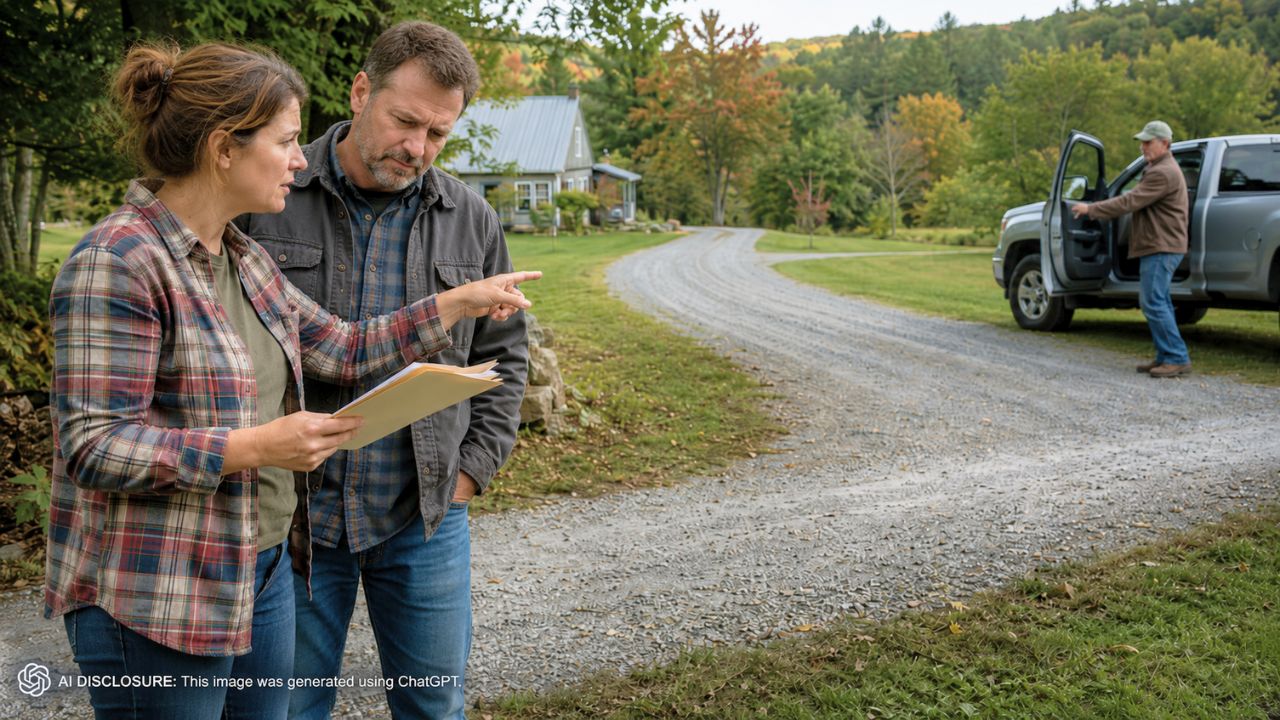
Vermont Buyer Discovers a Driveway Cutting Across the Corner of Newly Purchased Land — Then a Deed Search Confirms the Neighbor Has No Right of Way to Use It
Photo credit: AI-generated image created using ChatGPT. Illustrative only.
It’s one thing to inherit an old shed in the back corner or a mystery pipe no one mentioned. It’s another thing to realize a working driveway—used by someone else—clips through your land after the closing papers are already filed.
That’s what a new Vermont property owner said happened after they bought their place and later discovered a neighbor’s driveway cuts across a corner of their parcel. In the original post, the buyer described doing what most homeowners do when something feels off: they went looking for paperwork, not drama.
The corner of the lot wasn’t supposed to be “shared”
The buyer said they hadn’t known the driveway crossed onto their property at all. It wasn’t flagged in the seller’s disclosure, and they didn’t see anything in their deed suggesting anyone else had legal permission to use that slice of land.
Once the buyer noticed the cut-through, it wasn’t just a theoretical property-line issue. They said the neighbor actively uses that section of driveway, including towing a pop-up camper across the corner. That detail matters, because “using it once in a while” can look very different than “this is part of how they access and move things on their property.”
And once a new owner sees tire tracks and routine use, they’re forced into a choice: ignore it and hope it never becomes a bigger problem, or address it and risk souring the relationship with the person living next door.
Then came the deed search—and the surprise got sharper
Instead of marching over and starting a confrontation, the buyer said they went to town hall and pulled the neighbor’s deed too. Their goal seemed simple: confirm whether an easement or right-of-way existed and, if it did, figure out what it allowed.
What they found only raised the stakes. According to the buyer, neither their deed nor the neighbor’s deed mentions a right-of-way. The seller’s disclosure also did not indicate any rights of way.
That’s the kind of discovery that turns a minor annoyance into a real anxiety spiral. If there’s no recorded right to use it, why is it being used like one? And if there actually is some other legal basis—older documents, a prior agreement, a mapping error—why didn’t it show up during the purchase?
A friendly neighbor chat sounds easy—until you’re the new person
The buyer made it clear they weren’t eager to go to war. They said they want to be careful, have a conversation with the neighbor, and “try to figure something out.” Their end goal wasn’t revenge; it was a peaceful resolution with something more formal in place.
That’s the tricky part: the most neighborly approach is often the one with the most risk if you don’t do your homework first. If you start with “Sure, no problem,” you might accidentally signal permission you didn’t mean to give. If you start with “You’re trespassing,” you might lock both sides into defensiveness before anyone even compares maps.
And there’s the everyday-life factor. This isn’t an abstract line on paper. It’s the route someone uses to move a camper—meaning the use may be tied to routines, storage, or access patterns that have been in place for years.
The paperwork question turned into “Who missed this?”
After realizing the driveway wasn’t disclosed and didn’t appear in either deed, the buyer started looking backward as much as forward. They asked whether they should consider legal action against someone for not catching the problem—listing the seller, their realtor, the title company, the closing attorney they used, or even the neighbor.
That’s a very homeowner reaction: the moment you suspect you bought a problem, you start mentally replaying every step of the transaction. The disclosure form. The closing. The stack of documents you initialed in a hurry. The assumption that if there were a driveway crossing your land, surely someone would have mentioned it.
But there’s also a practical reason buyers ask this. If resolving the driveway issue requires a survey, legal help, or a negotiated agreement, the costs can pile up fast. When that happens, people naturally want to know whether someone else should be paying for the mess.
Readers pushed “document first, talk second”
The buyer said they planned to speak with a real estate attorney, and the overall tone of the responses they received leaned into that same order of operations: gather facts, then engage. Even without quoting specific replies, the common-sense theme is familiar to anyone who’s dealt with property lines—don’t wing it when the fix could follow you for decades.
In disputes like this, homeowners tend to focus on proof that holds up outside a friendly conversation: what the recorded deeds say, what the town has on file, and what a professional survey shows on the ground. A corner-cutting driveway can look obvious in person and still be messy on paper, especially in older areas where boundaries, historic use, and past handshakes don’t always match modern documentation.
The buyer’s own instincts mirrored that. They weren’t asking for the best comeback line; they were asking how to handle it carefully—how to do the homework first, then approach the neighbor in a way that keeps the peace while protecting their new investment.
The tension: stop the use, allow it, or put it in writing
At the heart of the story is a problem that doesn’t have a single “right” emotional answer. If the neighbor has been using that corner for a long time, they may feel entitled to it whether or not the paperwork agrees. If the new owner says yes informally, they may worry about what that means long-term. If they say no, they may end up living next to someone who feels cut off or accused.
The buyer hinted at the path they’d prefer: not a blowup, but a more formalized agreement. That’s the homeowner sweet spot when it’s possible—something that sets boundaries clearly and reduces the chance of future misunderstandings, especially as properties change hands again.
For now, the buyer is still in that uncomfortable early stage: they’ve found the problem, checked the obvious records, and are trying to decide how to approach a neighbor who’s already using part of the land like it’s theirs. It’s a small corner of a property, but it’s also the kind of corner that can take over your whole first year of homeownership if it isn’t handled carefully.
Like Fix It Homestead’s content? Be sure to follow us.