Rural Arkansas Landowner Checks His Property After Months Away and Finds the Neighbor Paved an Entire Road Onto His Land — Then He Refuses to Remove It Because He “Already Paid for It”
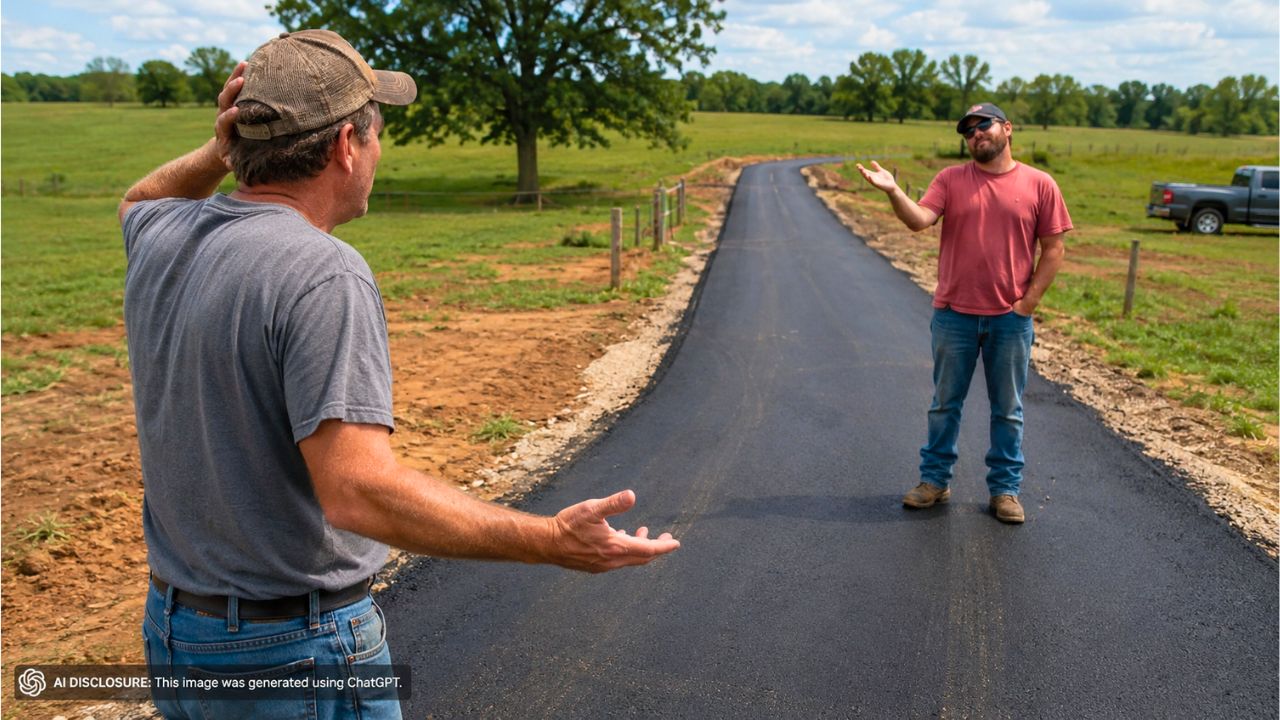
Photo credit: AI-generated image created using ChatGPT. Illustrative only.
He hadn’t been out to his rural Arkansas property in a few months, the kind of place where “neighbors” can mean someone half a mile away and the loudest thing you hear is wind through open space. When he finally checked in, the change wasn’t subtle. A freshly paved path now cut across the land—clean edges, dark asphalt, the sort of work that looks permanent.
The landowner posted the details in the original post: a nearby neighbor wanted a paved run from the main road to his own driveway, but didn’t realize the property line reached farther than he thought. The neighbor’s new “road” ended up on someone else’s land. And when asked to remove it, the neighbor’s answer was blunt—he already paid for it, and he planned to keep using it.
When “middle of nowhere” turns into “someone’s using my yard”
Rural property can feel like it’s on pause when you’re not there. No sidewalks, few paved roads, mostly open space. That’s part of the appeal. It’s also why problems can grow legs while you’re away.
This landowner wasn’t watching day-to-day. He checked on the property every few months, which is common for people with land they aren’t living on full time. The neighbor, meanwhile, made a major upgrade—paving a path from the main road—and only after the paving was complete did the landowner discover a chunk of it was built over the line.
That’s when the rural calm snapped into something sharper: a neighbor treating someone else’s property like an extension of his own, with asphalt to prove it.
The neighbor’s logic: you don’t use it, so I can
According to the landowner, the neighbor didn’t frame it as a hostile takeover. He framed it as a practical choice. The landowner “doesn’t use” that portion of the land, so what’s the harm?
But that argument doesn’t stay small. In places with long sightlines and few landmarks, property lines are the whole game. If somebody can improve your land and then claim the improvement gives them the right to keep using it, you’re no longer talking about a driveway. You’re talking about access, control, and precedent.
The neighbor also leaned on the sunk-cost argument: he’d already paid for the paving. In his mind, tearing it out would be wasting money. In the landowner’s mind, leaving it in place could be letting someone set up a permanent corridor across his property.
The moment it turns from “annoying” to “don’t touch anything yet”
The landowner’s first instinct was the one a lot of people have when they feel cornered on their own land: can I just remove it? Call a crew, tear up the pavement, restore the lawn, and then go after the neighbor for the cost?
But that’s where property disputes get tricky fast. Even if the asphalt is on your side of the line, physically destroying something your neighbor paid to install can pull you into a second fight—one about damage, retaliation, and who acted “reasonably.” The landowner understood the risk enough to ask whether he needed to take the neighbor to court before doing anything that dramatic.
He also floated another escalation that feels more “normal” to rural landowners: fencing. If he couldn’t rip it up immediately, could he at least fence his property and block the neighbor from using the paved strip?
That question says a lot. He wasn’t just bothered by the pavement existing. He was worried about ongoing use—tires wearing it in, the neighbor treating it like a right-of-way, and the reality that once someone has a route they like, they tend to keep taking it.
The practical fallout nobody thinks about until there’s asphalt involved
A paved lane isn’t like a misplaced shed you can drag back six feet. Asphalt changes drainage. It changes how water moves during storms and where runoff goes. It can create ruts at the edges, encourage erosion, and turn one patch of land into a “path” that others start using too.
Then there’s the access question. In rural areas with limited paved roads, a nice paved strip can attract more than the person who paid for it. Friends, delivery drivers, hunters, whoever is trying to reach the neighbor’s place without getting stuck. That’s not just annoying—if someone gets hurt while using it, landowners start thinking about liability and insurance even when they’d rather not.
And even if the landowner never planned to build on that section of land, a permanent-looking improvement can complicate future plans. Selling property is harder when the buyer sees someone else’s road crossing it. Even a casual drive-by makes it look like the neighbor has a legitimate claim.
The landowner included that he had an image of what it looked like “now,” suggesting the change was obvious on the ground—enough that it felt like a fait accompli.
What readers pushed: prove the line before you move a shovel
Even without a long comment thread included in the material here, the predictable homeowner-to-homeowner response in disputes like this is consistent: don’t guess. Prove the boundary.
On rural land, people rely on old markers, fences that drift over time, tree lines that feel “about right,” and the neighbor’s confidence. But confidence isn’t a survey. Before anyone blocks access, tears out pavement, or calls a crew, the smart move is usually to get documentation in hand—where the line is, what was built, and how much of it crosses over.
Once you start moving dirt or cutting off access, you’re no longer just the person protecting your land. You’re also the person who took action first. That can matter in a dispute, especially if the neighbor decides to dig in and insist the paved strip stays because it’s “already there.”
Another practical theme people tend to emphasize: document everything. Photos of the pavement, the edges, where it meets the main road, any markers that show alignment. And keep communication clear. Rural arguments can turn into years-long feuds, and vague conversations at the mailbox don’t age well when everyone suddenly cares about exact words.
A quiet property can still come with loud decisions
The landowner’s story lands in that uncomfortable middle ground: he didn’t catch it in time to stop it, but he caught it early enough that doing nothing feels dangerous. Letting a neighbor keep using a paved strip across your land might feel like “being nice” in the moment, until it starts looking like something more permanent.
At the same time, going scorched-earth—ripping it up immediately or blocking it without preparation—can escalate the fight into something bigger than the asphalt itself. In rural places where you can’t just switch neighbors, every next step has weight.
For now, the landowner is left staring at a brand-new road that shouldn’t be there, deciding whether the fix is physical, legal, or both. And the neighbor’s stance is clear: he paid for it, and he intends to use it.
Like Fix It Homestead’s content? Be sure to follow us.