British Columbia Homeowner Watches the Neighbor Raise a Six-Foot Retaining Wall to the Property Line Without Notice — Then a Fencing Company Says Her Own Leaning Fence Can Never Be Reset Because of the Wall’s Buried Support Zone
Photo credit: AI-generated image created using ChatGPT. Illustrative only.
A backyard project can feel like background noise until it starts changing your own property in ways you can’t undo. That’s where one British Columbia homeowner says she landed after watching her neighbors raise and expand their yard right up to the boundary line, capped with a tall retaining wall that left her fence listing and her side of the property suddenly “off limits.” She laid out the details in the original post, looking for a course of action before this turns into a permanent loss of use along her lot line.
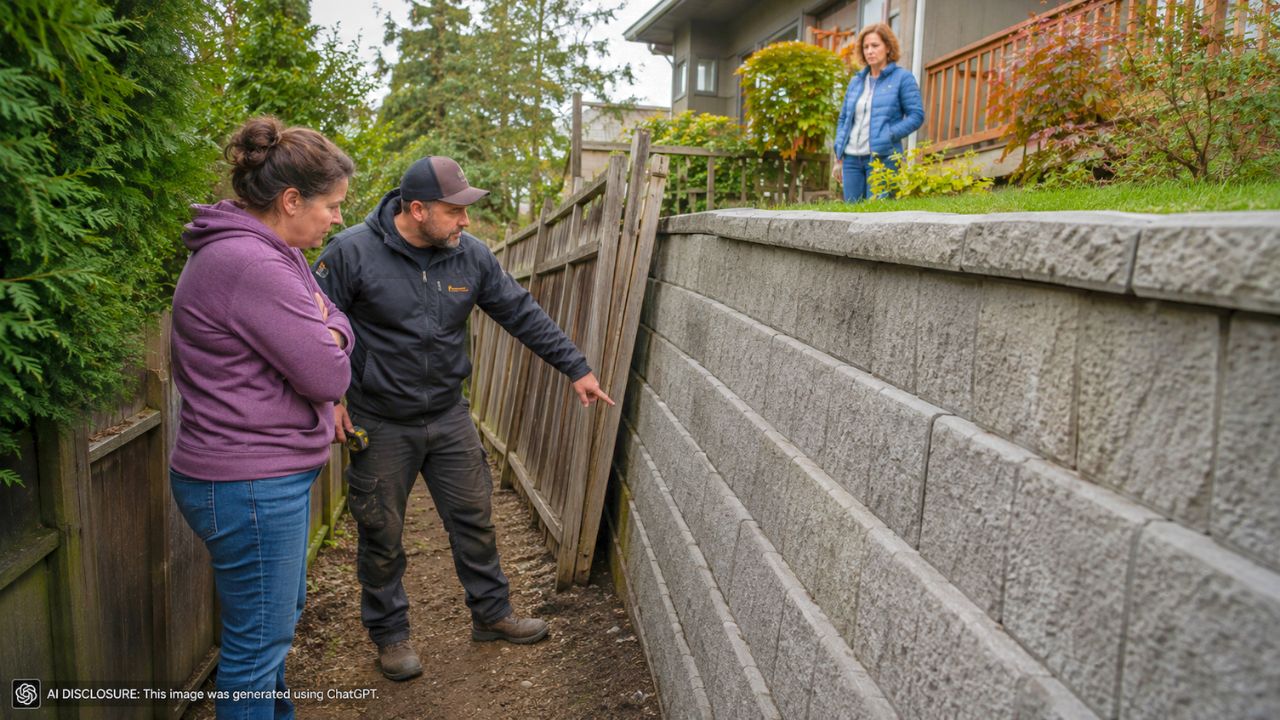
The wall, she says, is six feet tall in total—about four feet above ground, with two feet buried below finished grade. The problem isn’t just how close it is. It’s what she was told happens on her side because of what’s buried on theirs.
The wall went in fast, and the warning came late
According to the homeowner, the neighbors didn’t ask permission or give advance notice before raising the grade of their yard and building the wall to the boundary. Once construction was underway, she says she did speak up and asked that the structure be set back far enough to avoid trespass, prevent damage, and allow future maintenance without stepping onto her land.
Instead, she says she was told not to interfere with the work. The exchange escalated into threats—she alleges the neighbor said she would be sued for “stress and anxiety” if she delayed the project.
That kind of moment is where a lot of property-line disputes get their permanent edge. Once concrete is poured and soil is compacted, the “can you please move it back?” phase ends, and the “how do I live with this?” phase begins.
Then her fence started leaning—and the fix turned into “we can’t”
After the construction, she says her fencing was damaged and began leaning toward the neighbor’s side. She also reports damage to an irrigation system and says the grade on her property was altered. And between the fence and the new wall: leftover construction gravel.
Trying to deal with it like a normal homeowner, she brought in a landscaping and fencing company to reset the fence. That’s when she got the answer that changed the whole story: they said they couldn’t reset it because the retaining wall would have an area in front of it that shouldn’t be disturbed.
She recalled the company using a term like “geotechnical allotment.” Whether or not that was the exact phrase, the practical message was clear: there’s a buried support zone and they won’t touch the ground near it.
The part that stings: losing usable space on her own side
In her telling, the wall was built right up to the boundary, while her fence sits entirely on her property—about a foot in from the line. That means the fence now occupies the strip of land that, in theory, is the easiest place for her to access, maintain, and repair.
But after hearing what the contractors said about disturbing soil near the wall, she started researching typical safety practices. What she found led her to believe that work should not be done within a distance of roughly half the wall’s height—meaning about two to three feet of her property along the wall could be treated as “hands off.”
That would swallow the very zone where her leaning fence sits. It also complicates removing the construction gravel she says was left behind. She wants it gone, but she’s been told it’s best not to disturb the area—another version of the same message: your land, but not really.
When “support” turns into a property-rights fight
What she’s wrestling with isn’t just repair logistics. It’s the idea that the below-ground portion of the wall effectively relies on her property for support, and that she’s now restricted from altering her own land because of a structure she didn’t approve.
She pointed to British Columbia’s concept of lateral support, describing her understanding that neighboring land can provide support if it remains in a natural state. In her view, the neighbors changed the equation by raising and expanding their yard—meaning they altered the land rather than leaving it “natural,” and therefore shouldn’t be able to demand that her property function as part of their engineered solution.
Once you start thinking about it that way, the question isn’t “how do I straighten my fence?” It’s “did they effectively create an easement over my property without asking, paying, or recording anything?”
She also worried about the long-term reality: even if the wall holds, it will eventually need maintenance. If it’s right at the boundary, how does that happen without workers stepping onto her land, digging near her fence, or causing more damage?
Her proposed remedies weren’t about revenge—they were about control
The homeowner didn’t sound eager to start a courtroom war. She sounded stuck. Moving a retaining wall after the fact can be an enormous job, and she acknowledged it would likely be difficult to get an order forcing it to be relocated farther back onto the neighbor’s property.
But she also didn’t accept the idea that the neighbors could build to the line and then, by necessity, claim a strip of her yard as a permanent “do not disturb” buffer. She floated the idea of charging rent for the area if, functionally, it becomes theirs to rely on—and letting them access it for maintenance under that arrangement.
She also asked whether damages could include loss of enjoyment of property, since she believes she may no longer be able to alter or use a section of her lot that is entirely on her side of the boundary.
At the day-to-day level, her immediate needs are simple: remove the gravel, fix the fence, repair irrigation, and restore the grade. The problem is that every one of those tasks now runs into the same wall—literally and legally.
Readers pushed the same theme: document first, then pick the lever
Even without seeing a full thread of replies, this kind of dispute tends to draw very practical reactions, and the homeowner’s own approach already hinted at that mindset: she started by researching the relevant doctrine, and she brought in professionals to assess the fence.
In conflicts like this, homeowners commonly focus on proof that can’t be argued away later: dated photos from before and after construction, notes of conversations, and written assessments from contractors explaining why work can’t proceed. People also tend to recommend confirming the exact property line and whether any part of the wall or its footing crossed it, because “built to the boundary” and “built on the boundary” are not the same thing when you’re talking about buried structures.
And when contractors say an area shouldn’t be disturbed due to engineering concerns, that often triggers a second layer of documentation—getting an engineer or qualified professional to define what the actual setback should be, and who is responsible for accommodating it. Otherwise, “don’t touch it” becomes an informal rule that quietly sticks forever.
The homeowner in this case is at that uncomfortable point where the physical build is finished, but the consequences are still unfolding. Her fence is leaning, gravel is sitting where she doesn’t want it, and a strip of her property may now come with unspoken restrictions because someone else raised their yard. The wall may look like a clean new boundary from the neighbor’s side, but from hers, it looks like a permanent claim on space she can’t afford to lose.
Like Fix It Homestead’s content? Be sure to follow us.