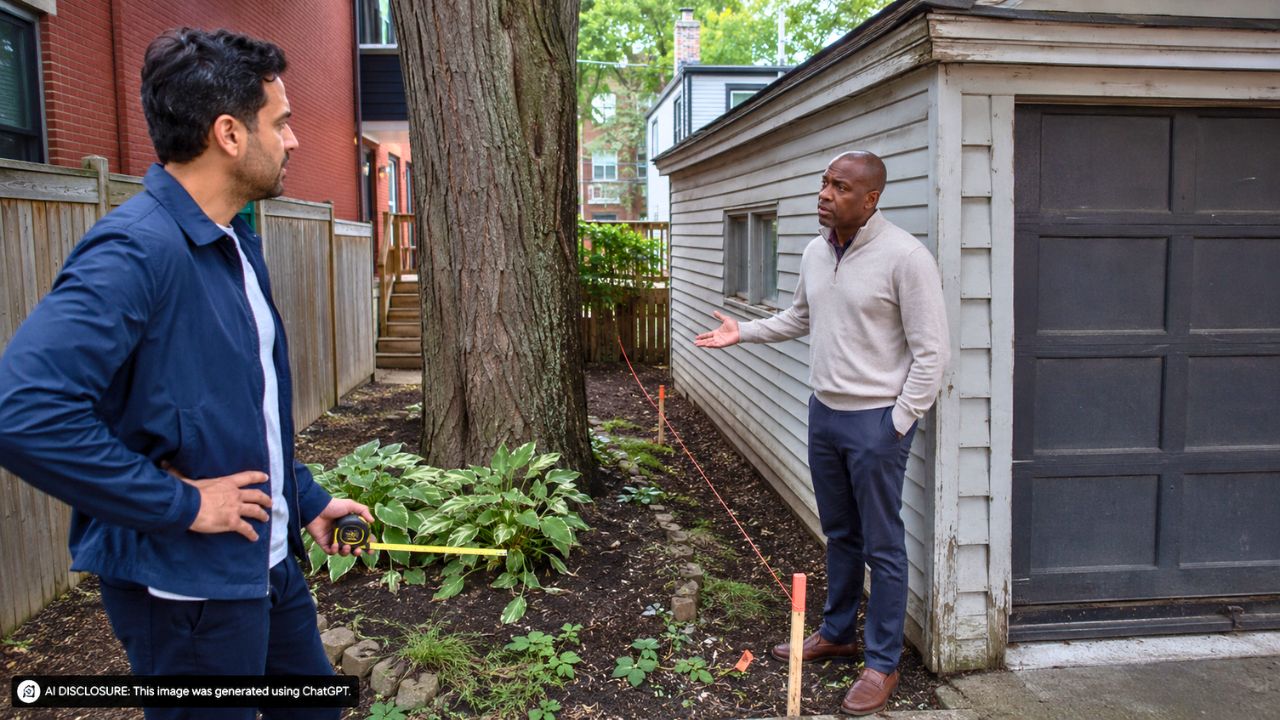
Buyer Finds a Garage on the House Under Contract Sits Six Feet Onto the Neighbor’s Land — Then the Neighbor Wants a Cash Payment to Let It Stay
Photo credit: AI-generated image created using ChatGPT. Illustrative only.
It started as a simple, almost exciting post-closing project: a new homeowner in an older East Coast city wanted to add a carport. Tight lot, tight driveway, the usual urban puzzle. But when they began eyeballing the space, they noticed something that made their stomach drop—what they believed was the neighbor’s garage sitting over the property line, partially hidden behind a large tree.
In the source post, the homeowner described a 15-foot-wide lot and said the garage appeared to extend about 1.5 feet into their property. It wasn’t an obvious, in-your-face encroachment. It was the kind of thing you could miss for months—until you try to build something, pull a permit, or even just measure for a structure you were counting on fitting.
The first sign was a carport plan that suddenly didn’t pencil out
Most people don’t walk their property line with a tape measure the day they get keys. They’re busy with boxes, paint samples, and figuring out which light switch does what. This homeowner only noticed the issue because they were planning to install a carport—one of those upgrades that forces you to think in inches.
On a narrow lot, inches aren’t “close enough.” They’re the difference between a clean install and a project that fails inspection, violates setbacks, or triggers a neighbor dispute you didn’t ask for. Once the homeowner saw the garage line up strangely against their measurements, they realized the “extra” space they thought they had might not be theirs at all.
And the detail that made it feel worse: the garage’s overlap was “visually obscured” by a large tree. Not necessarily intentional—trees grow, sightlines change—but it adds to that uneasy feeling that you may have bought into someone else’s long-running boundary problem.
Urban lots turn small encroachments into big problems
If you live on a sprawling rural parcel, a foot and a half can be annoying without being life-changing. In a dense city where the whole lot is 15 feet wide, it’s enormous. Losing 1.5 feet isn’t just losing a strip of grass; it can alter what you’re allowed to build and where.
That’s why this kind of discovery can quickly turn from “awkward conversation” into “serious paperwork.” If the homeowner really does own that sliver, then a neighbor’s structure occupying it can affect future improvements, fences, driveway layout, and resale. It can also complicate permitting, because setbacks and property lines are usually the first things a city cares about when you want to add anything new.
The homeowner’s question wasn’t aggressive. They weren’t looking to start a war on day one. They just wanted advice on how to handle it “without causing drama” in a new neighborhood—an understandable goal, and also a tough one.
The real fear: once you ignore it, it stops being “temporary”
There’s a special kind of homeowner anxiety that comes with boundary issues: the longer it sits, the more permanent it feels. It’s not like a noisy party you can complain about once and forget. A building is a building. It stays put every day.
One commenter bluntly summed up what many homeowners think but hate to say out loud: there may be no way to address it without tension. Even if you approach gently, you’re still telling someone their garage is on your land. That’s not a casual chat about trash cans or where the snow gets shoveled.
The same commenter also raised the possibility that the neighbor may not even realize it’s over the line—especially in older neighborhoods where structures have been sitting for decades and property corners aren’t clearly marked. But they also pointed to the darker possibility: that someone could be trying to let time do the work for them, leaning on adverse possession concepts to make an encroachment harder to challenge later.
Commenters honed in on proof before politeness
The advice in the thread didn’t start with “go knock on their door.” It started with “get facts.” Specifically: check with the town on permits, and get a survey.
That’s the part that can feel un-neighborly at first, but it’s often the only path that keeps the conversation from turning into a he-said-she-said. A survey draws the line in a way that doesn’t depend on anyone’s memory, assumptions, or the angle of a tree trunk. And checking permit history can help answer a basic question: was this garage built with the city’s blessing, or was it slapped together and quietly left to become everyone else’s problem later?
Another commenter pointed toward a potential middle ground: a property line adjustment, typically handled as a swap—square footage for square footage—so the neighbor isn’t “getting” land without giving something back. It’s the kind of option people like in theory because it sounds cooperative. It also underscores something important: the simplest emotional solution is not always the simplest administrative one.
There was also a practical money-and-paperwork angle. One commenter asked whether the homeowner had a mortgage, title insurance, and an attorney involved, noting that a lawyer generally advises on a survey or title search. That’s not internet blame; it’s homeowners recognizing a painful reality. Sometimes the most expensive part of a boundary issue isn’t the fix—it’s realizing the issue existed at closing and nobody flagged it.
Why “just let it stay” can turn into a cash demand later
When a structure crosses a line, it creates leverage on both sides. The homeowner has the leverage of ownership: the garage is allegedly on their land. The neighbor has the leverage of inconvenience: moving a garage is costly, and most people would rather negotiate than rebuild.
That’s where money enters the picture. In disputes like this, it’s common for a conversation about “permission” to morph into a conversation about “payment,” especially if the neighbor frames it as: you’re the one making an issue out of something that’s been “fine” for years. Even without direct quotes in the thread about a cash demand, the underlying dynamic is right there in the advice: act sooner, document everything, and don’t assume friendliness means protection.
Because once you give informal permission—once you say “it’s fine”—it can become harder to unwind later when you need that space for your own projects, or when you sell and the next buyer isn’t willing to inherit the headache.
The hardest part is that the homeowner just wanted a quiet start
This is the kind of discovery that changes how a new home feels. Instead of settling in, you’re measuring, researching, worrying about setbacks, and wondering whether your first real conversation with a neighbor is going to be about tearing down a garage wall or trading land.
The thread’s strongest theme was simple: don’t try to solve a boundary problem with vibes. Get a survey. Check the town. Understand what you actually own. Then decide whether the path forward is asking for the structure to be moved, negotiating a legal adjustment, or involving the professionals who were supposed to help catch problems like this at closing.
For the homeowner, the garage wasn’t just an eyesore or a minor annoyance—it was a physical reminder that in tight neighborhoods, property lines aren’t abstract. They’re the difference between a planned upgrade and a long, expensive argument you didn’t budget for.
Like Fix It Homestead’s content? Be sure to follow us.
- Man Says He Found Out the Fence He Paid For Wasn’t Actually on His Property
- Woman Says Her Neighbor Started Taking Mulch From Her Delivery Pile Before She Could Even Spread It
- I made Joanna Gaines’s Friendsgiving casserole and here is what I would keep
- What Caliber Works Best for Groundhogs, Armadillos, and Other Digging Pests?